
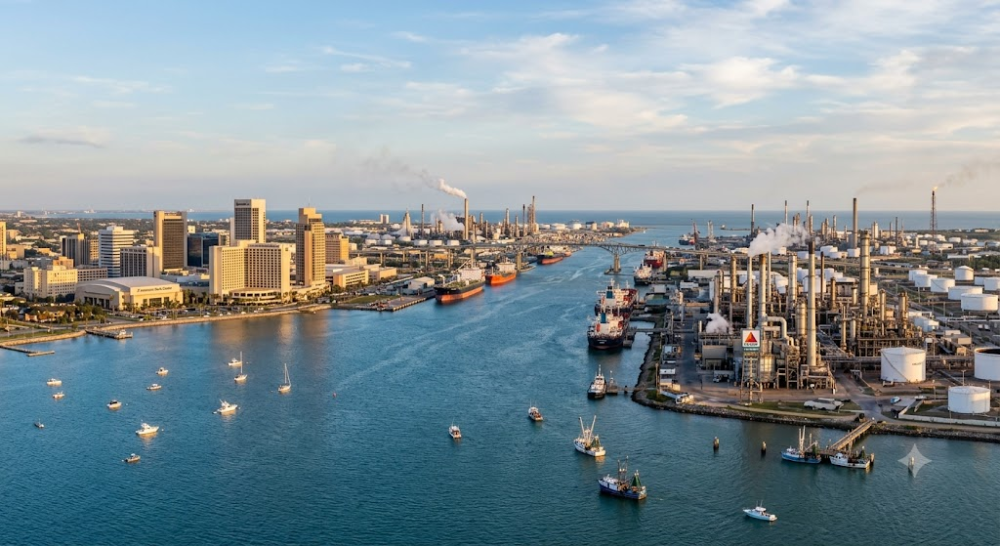
July 13, 2026 – Corpus Christi, Texas — A high-stakes trial beginning this week before the State Office of Administrative Hearings (SOAH) has put a national spotlight on Corpus Christi, Texas. The coastal energy hub is locked in a bitter legal battle with a powerful coalition of refining and chemical giants—including Valero, Citgo, and LyondellBasell—over a steep industrial water rate hike.
The industry group, organized under the banner Affordable Water for Corpus Christi, is demanding an estimated $80 million refund. The battle arrives at a critical juncture: Corpus Christi is facing an unprecedented water supply crisis, with reservoirs nearing historic lows and the city bracing for severe emergency water restrictions.
The Hidden Subsidy: Why Rates Doubled
The legal feud traces back to late 2023, when internal cost-of-service models revealed a staggering imbalance in how the city’s water system was funded. For at least a decade, “Outside City Limits” (OCL) large-volume industrial customers enjoyed a massive discount, paying roughly $2 per 1,000 gallons of water. Meanwhile, residential taxpayers and small businesses inside city limits paid up to three times that rate.
The data models showed that local residents and small businesses were effectively providing a $15 million annual subsidy—surpassing $100 million over a decade—to lower the overhead of some of the world’s wealthiest energy corporations.
To correct the deficit, the Corpus Christi City Council voted 8-to-1 to double water rates for these industrial behemoths, spiking Valero’s annual water bill alone from $9 million to $18 million. Six months later, the corporate coalition filed its formal protest with state regulators.
The Industry’s Stance: Industrial attorneys argue that the steep, sudden rate hike lacks a fair methodology, claiming large-volume plants should not have to pay for municipal distribution infrastructure they do not directly own or benefit from.
The City’s Stance: City officials counter that a failure anywhere in the interconnected water grid threatens the water pressure and safety of the entire system, including the heavy lines servicing the refineries.
The Public Utility Commission of Texas staff previously evaluated the case and recommended a minor $6 million adjustment. While the industry group recently offered a $4 million settlement, Corpus Christi leadership rejected the deal, choosing instead to defend their rate structure in court. If the city loses, it could be forced to payout tens of millions in refunds precisely when it is scrambling for capital to fund emergency desalination and water infrastructure projects.
The New Frontier: Industrial Refining vs. Data Centers
The battle over Corpus Christi’s water highlights a broader, statewide reckoning over industrial consumption. While traditional petrochemical plants have historically dominated Texas water demand, a massive new player is reshaping the landscape: hyperscale data centers driven by the artificial intelligence boom.
A May 2026 report from the University of Texas at Austin estimated that data centers could account for 3% to 9% of Texas’ total water use by 2040, up from less than 1% today. This shift is driving intense conversation about how different heavy industries consume water.
AttributeTraditional Heavy Industry (Refineries/Chemical)Modern Data Centers (AI/Hyperscale)Primary Consumption MechanismDirect & Chemical: Water is used directly in refining processes, steam generation, boiling, and product cooling.Indirect & Evaporative: Water is consumed directly via evaporative cooling systems and indirectly at the power plants generating their electricity.Water Quality FlexibilityRigid: Often requires highly treated potable water or complex onsite desalination to avoid corroding sensitive industrial machinery.Adaptive: Increasingly utilizing closed-loop air cooling (close to zero direct water) or reclaimed/recycled wastewater.Economic LeverHigh regional employment provider; historically secured heavy rate discounts to incentivize manufacturing footprint.High capital investment and tax base, but significantly fewer permanent local jobs post-construction.Water Recovery RateSignificant volume is lost to evaporation or contaminated as industrial wastewater requiring deep treatment.Heavy indirect regional impact; direct consumption can be mitigated entirely via closed-loop mechanical chillers.
As Corpus Christi leaders navigate this trial, the outcome will likely establish a critical regulatory precedent for how Texas municipalities price water for heavy consumers—whether they are refining the fuel of the past or cooling the data infrastructure of the future.