
Some morning wakeups these past few weeks, Monica Paul says, have resembled 1993’s Groundhog Day, but Tuesday’s dawning promises to be distinct. Historic.
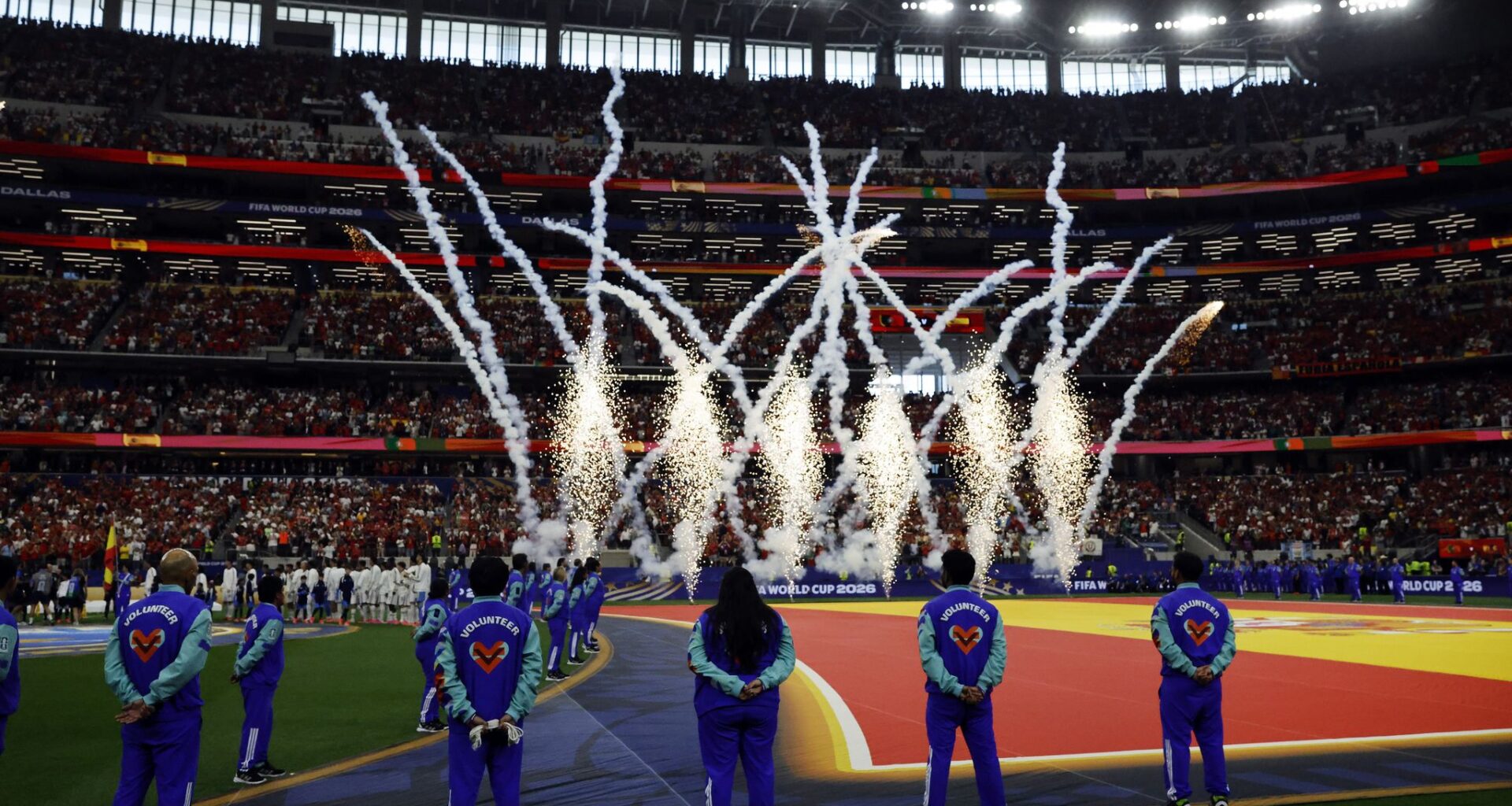
Eight World Cup games played in Arlington over the past 29 days have crescendoed to this momentous occasion: Tuesday’s 2 p.m. semifinal match between world No. 1-ranked France and No. 3 Spain in Dallas Stadium.
Although the 48-team tournament’s curtain closer will be Sunday’s title game in New York Stadium, the North Texas FIFA organizing committee, area municipalities and the Cowboys organization, among others, have earned a prolonged bow, regardless of Tuesday’s match outcome.
No region will have hosted as many games, marquee teams or fútbol superstars as North Texas. Seemingly by criteria, on and off the pitch, the region has risen to the moment of hosting its first World Cup in 32 years.
“It’s what we wanted, to be able to host a World Cup and to shine like this,” said Paul, president of the local FIFA organizing committee and executive director of the Dallas Sports Commission. “But I think it has exceeded even my expectations of what it could be for this region.”
Speaking to The Dallas Morning News by phone, Paul became emotional while describing the collaboration of city officials across the region. She said the spirit of unity began the moment North Texas learned on June 16, 2022, that it would be a host site and has gelled this past month, as they had hoped.
On Monday afternoon, Paul was part of a host committee news conference in the Kay Bailey Hutchison Convention Center, adjacent to the 485,000-square-foot International Broadcast Center that has been hosting 2,000 media workers from around the world.
Joining Paul at the news conference were North Texas FIFA organizing committee co-chairs Dan Hunt and Nina Vaca; Cowboys executive vice president of business operations Chad Estis; Arlington mayor Jim Ross; and Dallas city manager Kimberly Bizor Tolbert.
That day began with awe-inspiring scenes of an estimated 20,000 Dutch fans chanting, singing and marching alongside their double-decker Oranje Bus toward Dallas Stadium. It concluded with equally passionate, blue-clad Japanese fans following custom by cleaning the stadium after the 2-2 draw.
For North Texas, those were the first vivid splashes of a cultural mosaic that has brightened the region’s vast landscape, from large gathering spots such as Klyde Warren Park, the FIFA Fan Festival at Fair Park and Texas Live.
Before now, the highest-profile World Cup match in North Texas was played July 9, 1994, in the Cotton Bowl, where Brazil defeated Netherlands 3-2 in a quarterfinal match.
That year a combined 375,283 fans came to the Cotton Bowl for its six matches, an average of 62,547 fans. Assuming France-Spain is a sellout, 632,316 fans will have come to Dallas Stadium for nine games.
That would be an average attendance of 70,257, which is 99.4% of capacity in the FIFA-mandated configuration of Dallas Stadium.
In anticipation of hosting the World Cup, the Cowboys increased an already-planned “refresh” of the 2009-built stadium to $350 million, including the costs of temporarily removing ground-level corner suites and raising the floor by 4.5 feet to accommodate a grass pitch and irrigation system.
Cowboys owner Jerry Jones even had to cede his personal suite for FIFA to sell, as did other stadium suite-holders, with FIFA re-leasing many for $1 million each for the duration of World Cup.
Paul told The News it will take weeks for FIFA to analyze the ticket data of the 16 World Cup venues across the United States, Mexico and Canada, but she said metrics from the five group-stage games in Dallas Stadium revealed no surprises.
Tickets purchased by international fans ranged from 45% to 56% of the total. Another roughly 40% were purchased by out-of-state Americans. The remainder were purchased in-state and locally.
Paul said it will be weeks, if not months, before the World Cup’s full impact on North Texas is known. Pre-tournament projections were for an economic impact of $1.5 billion to $2.1 billion and as many as 4 million visitors to the region.
“We know this semifinal will be big,” she said. “But we just have to wait, collect data in certain areas and get with the economists to get a true glimpse.”
Soccer non-purists in North Texas might not have grasped all of the beautiful sport’s nuances these past few weeks, but a veritable parade of marquee teams and superstars has palpably heightened the region’s excitement level.
As of Tuesday’s kickoff, all of this World Cup’s semifinal teams will have played here at least once; and in the cases of Spain and Argentina, twice apiece.
Six of the top nine teams in the world rankings will have played here; as well as five of the eight World Cup quarterfinalists.
Like so many international visitors, Haaland personally reveled in North Texas culture with a trip-gone-viral to downtown Dallas’ Wild Bill’s Western Store, where he bought multiple cowboy hats and boots and sported a now-iconic T-shirt: “Y’all Can Kiss My Dallas.”
“I can’t say enough about our match schedule,” Paul said. “And every superstar, I think, will have been here. That’s pretty, pretty special.”