
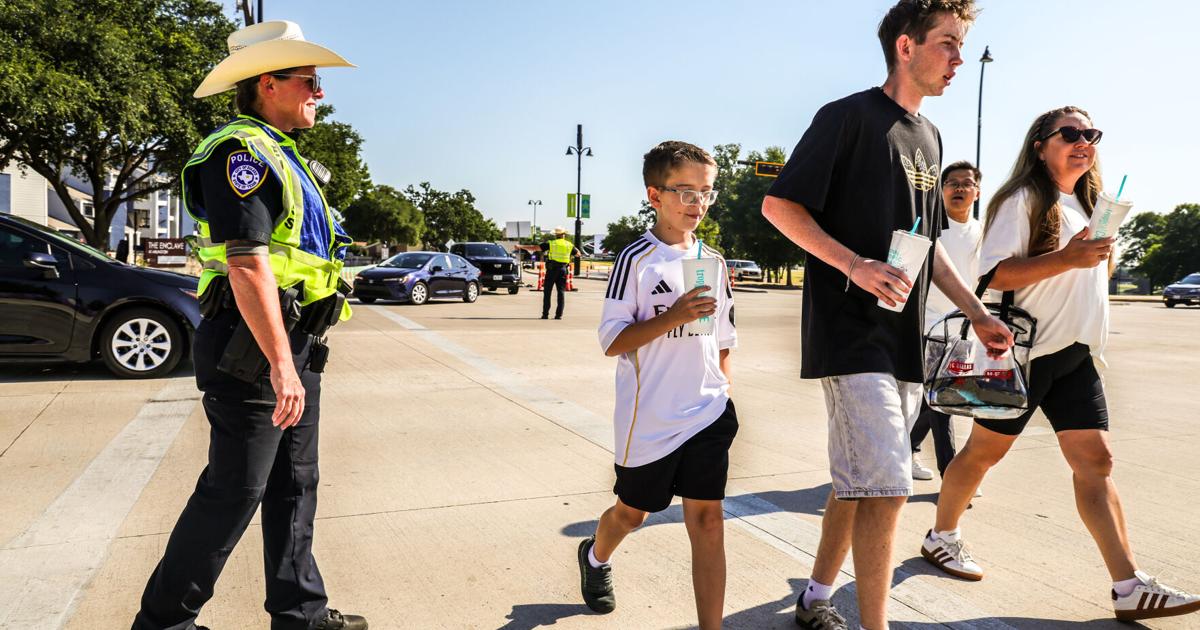


Lynette Gilliam, Euless Police Department community services officer, 46, patrols traffic July 6 in Arlington. Lynette said she is excited to work the event because she and her family are soccer fans.
Over the last month, a world of its own has emerged around AT&T Stadium.
Every few days, it would rebuild itself.
One World Cup brought waves of Dutch fans dressed head to toe in orange. Another welcomed Egyptians in headdresses and flags draped over their shoulders. Buses and cars emptied into the Arlington Entertainment District. Streets filled. The district buzzed. Then, after the final whistle, crowds disappeared.
But while the faces in the crowd changed, the people behind the scenes remained the same.
From traffic engineers adjusting signal timing to police officers directing thousands of pedestrians, each of the nine matches required the city to recreate a village that stretched beyond the stadium gate.
Tyler Hurd, solid waste and recycling manager for the City of Arlington’s asset management, began July 6’s World Cup match parking at Esports Stadium Arlington and dragging out clear plastic bins.
On average, he walks 16 miles a match, collecting litter into orange Home Depot buckets.
Over the course of the matches, Hurd has developed a system. Walking from Lot H to AT&T Stadium, Hurd said the Esports Stadium is where heavy foot traffic occurs, so he focuses a lot of attention there, too.
“It’s not a terrible day, but you’re on your feet all day, walking,” he said. “But it’s just to make sure that it looks good and that our city looks clean.”
While Hurd spends his days patrolling the streets on foot, an entire team is monitoring the city’s traffic flow from behind a screen.
Chris Funches, Public Works city traffic engineer for the city of Arlington, spends his match days deploying digital messages on the city’s overhead messaging board and monitoring traffic cameras to implement timing plans.

Photo courtesy of Amberley Shelby
Computer programming is used to manage the timing plans, which determine whether traffic lights turn red, green or yellow. Funches said all the computers are connected, and once the program is sent out, the time allotment for vehicle travel is able to be modified.
The traffic commander, typically at the stadium, works closely with the Arlington Police Department and other agencies to ensure everyone’s priorities are met.
“We want to make sure that while they’re making sure the parking lots are being empty that we’re doing the things to pretty much allow efficient flow on the roadways,” Funches said.
While Funches and his team control traffic through computer programming, officers and firefighters can be spotted around the stadium directing pedestrian foot traffic and leading fan marches.
Sgt. Kreyton Paschall is a part of the event management team for the Arlington Police Department. He said he manages all the stages for major events in the city and at the stadium.
As an escort for the fan marches, Paschall said he has two goals: safety, which includes prohibiting cars from making their way into the route, and ensuring there’s no negative cross-team interaction.
On July 6, for the Spain vs. Portugal match, officers on bikes pedaled ahead of a sea of Portugal fans draped in soccer attire and flags from their country. The fan march spanned from the Texan Golden Boot sculpture to the west side of AT&T Stadium.
Paschall said the spirit of the World Cup fans differs entirely from that of American football fans, noting the chants and jovial attitude each group brings in is unlike anything he’s experienced.
Lt. Juan Mata for the Arlington Fire Department agreed.
Mata, who was present for the Argentina vs. Jordan match, said the energy and passion from the fans was evident. Jordan, who made their first World Cup appearance, scored a goal against the defending champions, and Mata said he could feel the happiness of the fans just being able to be in the stadium.
“To them that’s still a victory,” he said. “All the people are like that, even though their team lost, they were having a great time — they were here for the experience.”
Mata recognized the enormity of hosting nine matches of this scale.
“Every World Cup is the biggest sporting event in history,” he said. “There’s no other tournament, mass gathering like this, ever.”
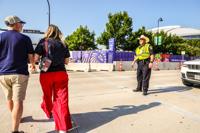
Westworth Police Department Lt. Glenn Lipperdt, 54, of Keller patrols traffic before the match July 6 in Arlington. Lippeidt said he has worked traffic enforcement for 11 years and helped direct vehicles safely as fans arrived for the event.
Mata and his team work with FIFA volunteers to ensure visitors and fans can attend each match safely. Mata said during the first two matches, there was an average of 30 heat-related emergencies.
To help combat the heat, four support units staffed by FIFA volunteers are located around the area and are set up for individuals to get a drink and cool off.
As each match passed, some city workers had to change their routine.
Cynthia Lemus, communications coordinator for the City of Arlington, said during the first World Cup match, her team would post one or two World Cup-related items on Instagram and Facebook. After seeing the positive support from residents, they upped the content.
“The city was very, very supportive; they were very happy to host this tournament,” Lemus said.
With the last match closing in, the chant of the Viking row that echoed from Texas Live and the ever-changing wave of fans that flooded the district will only be a memory.
“This is it, we’re done. One more, that’s it. We want to do it all over again,” Mata said.
@tay._.sansom