
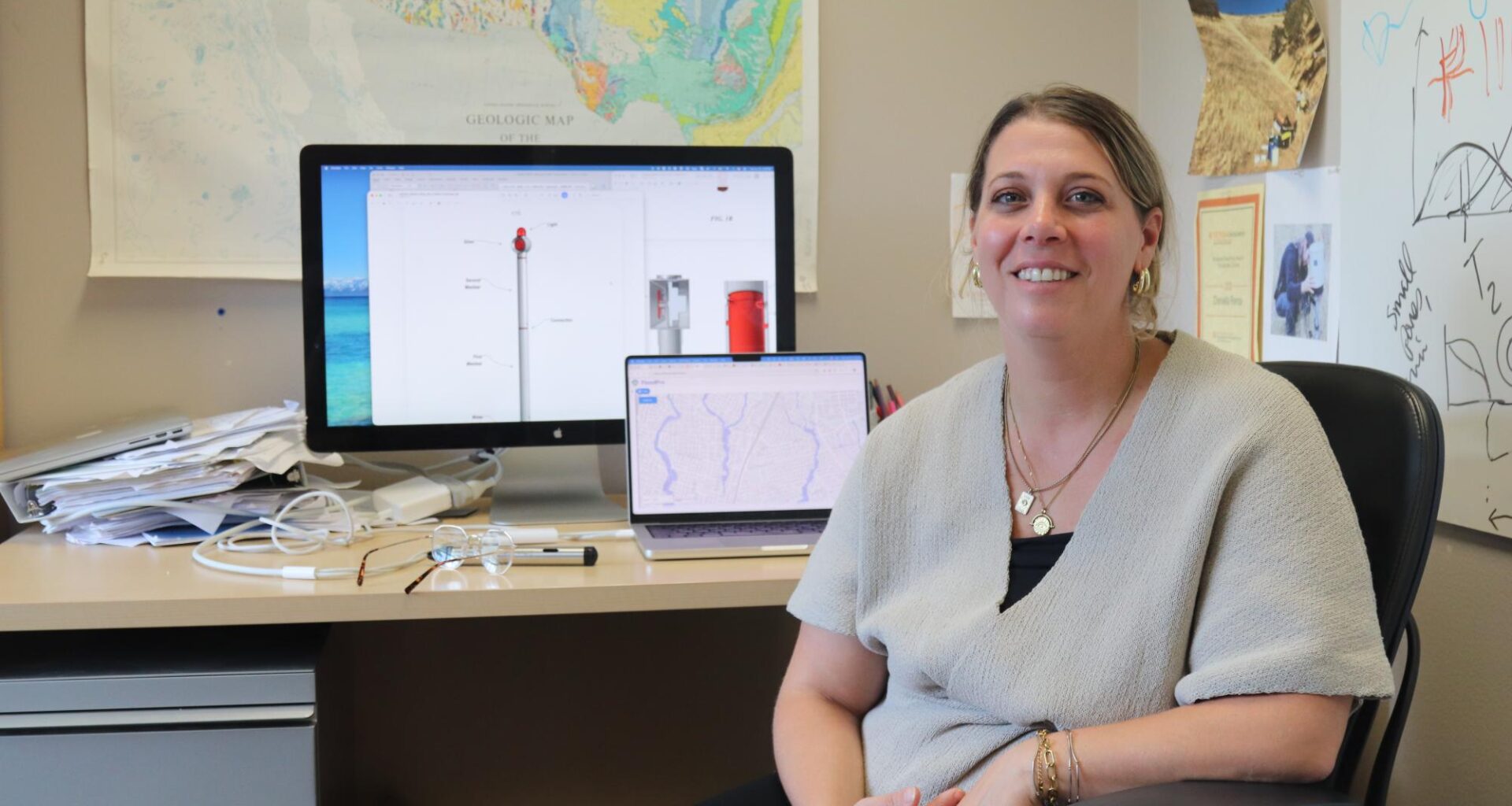
Following the devastating floods in the Hill Country in July 2025, a University hydrology professor was motivated to create a device that alerted homeowners of outdoor flooding. Now, nearly a year later, the flood alarm device has completed the design process and is one step closer to becoming available to the public.
Daniella Rempe, a hydrologist and professor in the Jackson School of Geosciences, developed the alarm. Rempe said she spent her childhood attending summer camps in the Hill Country and wanted to find a way to contribute to more solutions for flood safety.
Rempe collaborated with academics and friends Jesse Hahm, an assistant professor at Simon Fraser University, and David Dralle, a research hydrologist for the U.S. Forest Service. The group worked to develop an outdoor flood alarm, and a patent for the device was filed on June 22. Rempe said the device is currently in a prototype testing phase.
After speaking with people who had been around the floods, Rempe said the team needed to create something that could be easily heard and did not depend on Wi-Fi. She said they wanted a tool that woke and alerted residents of a flooding emergency before car alarms, sirens or the knocks of neighbors.
“How do I give the average person a tool to monitor their river by their house, like right now?” Rempe said. “How do I do it cheaply and in a way that you could buy it at the store? That’s what we designed.”
The “low maintenance” device works by securing to a tree or post that is on a downslope from a building. When floodwater rises outside, a water-level sensor triggers an alarm and light that goes off to warn people inside. The device utilizes batteries, doesn’t need to connect to the internet, is pest-resistant and designed to last over 10 years.
“Flash flooding is a global hazard,” Rempe said. “It’s not going anywhere, and the goal is to put safety into the hands of the people that are at risk.”
To achieve this, Rempe worked with her collaborators Hahm and Dralle to test similar products on the market to see what had already been done, but nothing fit the criteria the team was looking for.
“We (were) basically in our own garages (playing) around with off-the-shelf float sensors and alarms and batteries and PVC pipes,” Hahm said. “Basically to come up with a proof of concept to convince ourselves that something like this could work.”
Hahm said Rempe attended many meetings with local and municipal governments as well as conferences to try to understand concerns and needs of the communities.
Combining off-the-shelf materials was just the start. Dralle said they saw an opening to create something that was easy, affordable and valuable to public safety.
“I was just horrified by … disasters, flooding, certain events that are clearly very preventable,” Dralle said. “It’s sad to me when we as (a) species don’t spend the bare amount of money we need to keep people safe in certain environments.”
Dralle said he works on this project in his personal time as the trio stays in constant collaboration and does almost everything together, despite being located all over North America. They are facing new avenues together through testing prototypes, contracting with an engineering and prototyping firm to build a design and working to find investors for the product.
“Innovation is not easy,” Rempe said. “The three of us that are working on this have no shortage of experience in being told ‘No,’ having our ideas rejected. That comes in real handy in the business world.”
Rempe says she hopes the flood alarm can be a tool for people to protect themselves and others around them.
“We definitely have chosen these careers because of the potential to have (an) impact,” Rempe said. “This is another way that we’re excited to (make this) impact.”