
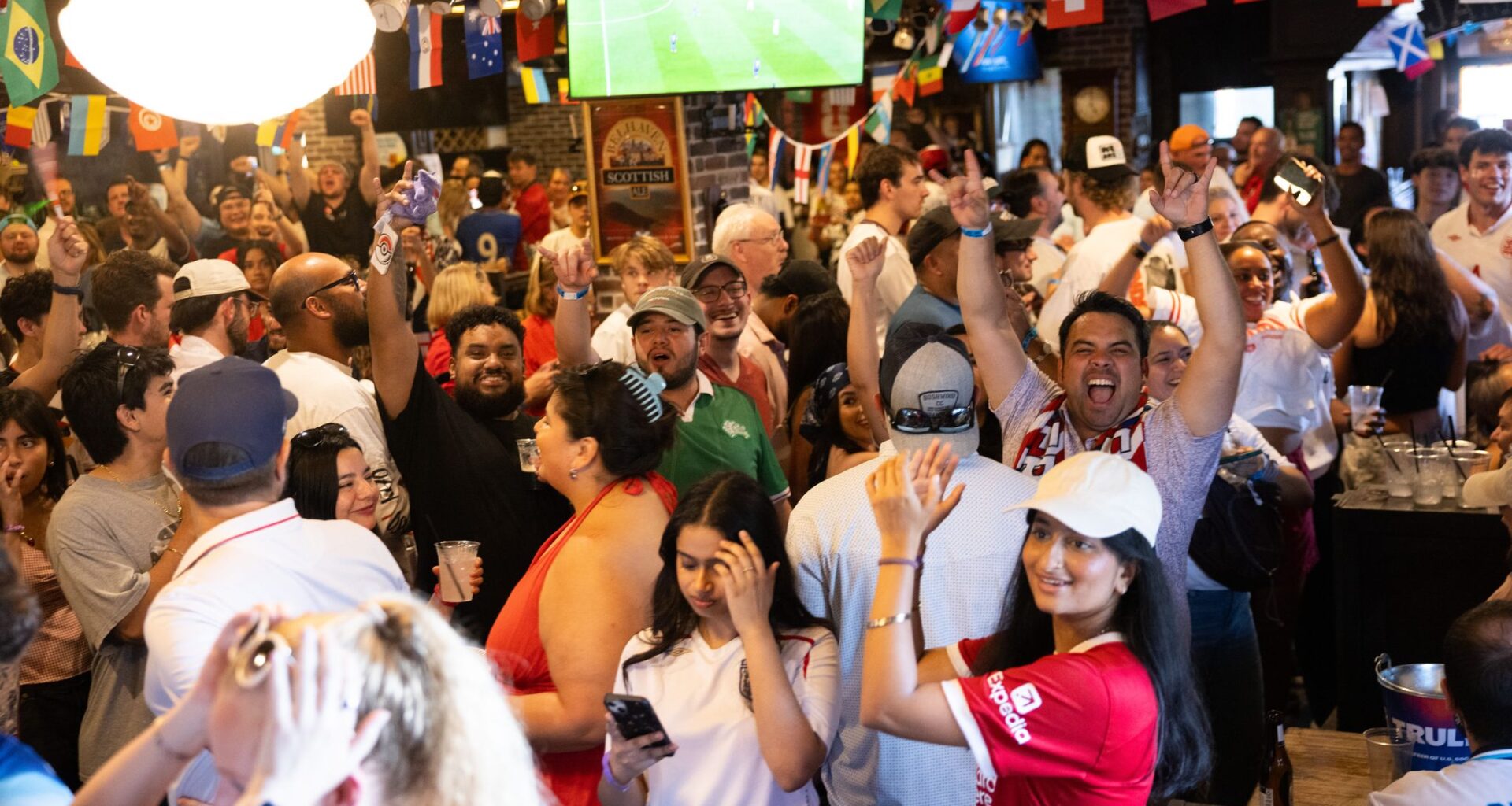
England fans celebrate during a watch party for World Cup match between England and Croatia at The Londoner Pub in Dallas on Wednesday, June 17, 2026. England defeated Croatia 4-2.
Juan Figueroa/The Dallas Morning News
It’s not over yet, but by many accounts the first World Cup on North American soil in two decades has already been a massive success. The history-making goals and captivating Cinderella storylines. The packed bars and restaurants. The infatuation with American cultural touchstones like ranch dressing and Buc-ee’s.

And, for many North Texans, an Andrés Cantor-level romantic boost: As of last month, when the tournament was still in its earlier stages, around three-quarters of unattached Dallas-area residents said the tournament made Dallas more fun to be single, and half said they had already gone on a date or hooked up with a World Cup visitor, according to survey results released earlier this month by DatingAdvice.com.
“The numbers are very high,” said Wendy Walsh, a psychology professor at California State University Channel Islands and dating expert at DatingAdvice.com. “They’re actually quite surprising to me — that 50% of single people in your city went on a date or hooked up with a fan? That’s like, pretty amazing.”
Article continues below this ad
To come up with its figures, DatingAdvice.com surveyed 1,000 single adults, representing a broad demographic range, across the 11 American cities hosting World Cup games. In greater Dallas the company surveyed 93 people, according to data shared with The News, who mostly had positive World Cup-driven dating updates to report. While roughly half of the Dallas respondents said they’d already gone on a date or hooked up with a visitor, an even greater share — 65% — said their dating activity had increased either “a little” or “a lot” since the beginning of the tournament.
Twenty-eight percent said their activity had decreased, and 6% said it had stayed the same.
The respondents were also overwhelmingly positive on Dallas’ World Cup-heavy vibes, with 33% calling the city “much more fun” to be single in during the tournament and 43% labeling it “somewhat more fun.” Just one respondent said the tournament made the city worse because of extra crowds.
DatingAdvice.com also asked respondents about which nationalities they might be most interested in dating. Dallas residents — who had a firsthand view of the passion of tens of thousands of flag-waving, drum-beating Argentinians — chose that country most, with 16% of respondents reporting it as their first choice. Australians, winning 10% of Dallas respondents’ vote, came in second, narrowly followed by Spaniards and Brazilians.
Article continues below this ad
The World Cup dating bump for Dallas was largely on par with that experienced by other U.S. host cities: Among respondents across the 11 cities, 68% of respondents said their dating activity had increased during the tournament, 76% said it had made their city more fun to be single in and 44% said they had gone on at least one date or hooked up with a visitor. More than a third of all respondents also said they were most attracted to the possibility of “learning about another culture,” while 25% said they were drawn to a “shared love of soccer” and 21% cited a foreign accent.
Not all cities were feeling the love equally: Seattle, Philadelphia and Boston residents were most likely to say the World Cup had made their city more fun to be single in, while Kansas City and Houston residents were most likely to say their dating activity had increased.
The broad romantic increase can partly be explained by dating psychology, Walsh said, especially for the countless Americans who may have already been romantically disillusioned.
“We are now introducing a dating pool to a new dating pool, because there is a perception, for those who have been single for a long time and have been having trouble making connections or finding commitment-oriented relationships — there is a perception that the problem is the mating marketplace,” she said.
“And so it stands to reason that when, you know, fresh meat comes to town, people are going to jump on those apps, thinking that the answer to their love life problems is about finding this magical person.”
Article continues below this ad
That dating scarcity theory is largely a myth, Walsh added — she noted that in psychological terms dating apps in fact have created “a paradox of choice,” where users often become frozen by too many, rather than too few, potential options — but the apps appear to have nonetheless experienced their own World Cup surge. Between June 11 and June 16, Tinder saw an average user spike of 47% in host cities, according to data cited by Fast Company.
Match Group, the Dallas-based parent company of Tinder and numerous other dating apps, did not respond Monday to an inquiry from The News about its apps’ usage. Its Austin-based rival Bumble also did not respond.
The Texas-heavy online dating industry is hoping the soccer action helps sustain a broader turnaround. After seeing massive spikes during the pandemic, Match Group, the industry’s dominant player, and Bumble suffered prolonged downturns as users grew disenchanted with the apps because of everything from fake accounts to ghosting to sexual misconduct.
Both companies have lately rolled out new AI-enhanced features as part of their turnaround strategies. Since briefly trading below $30 per share in March, Match Group’s stock has been rising, opening around $39 on Monday. The price was over $150 for much of 2021.
Article continues below this ad
Bumble’s stock opened this week at $3.06, up from last month but down roughly 14% on the year. In early 2021, hours after its public debut, the stock traded at over $75.