
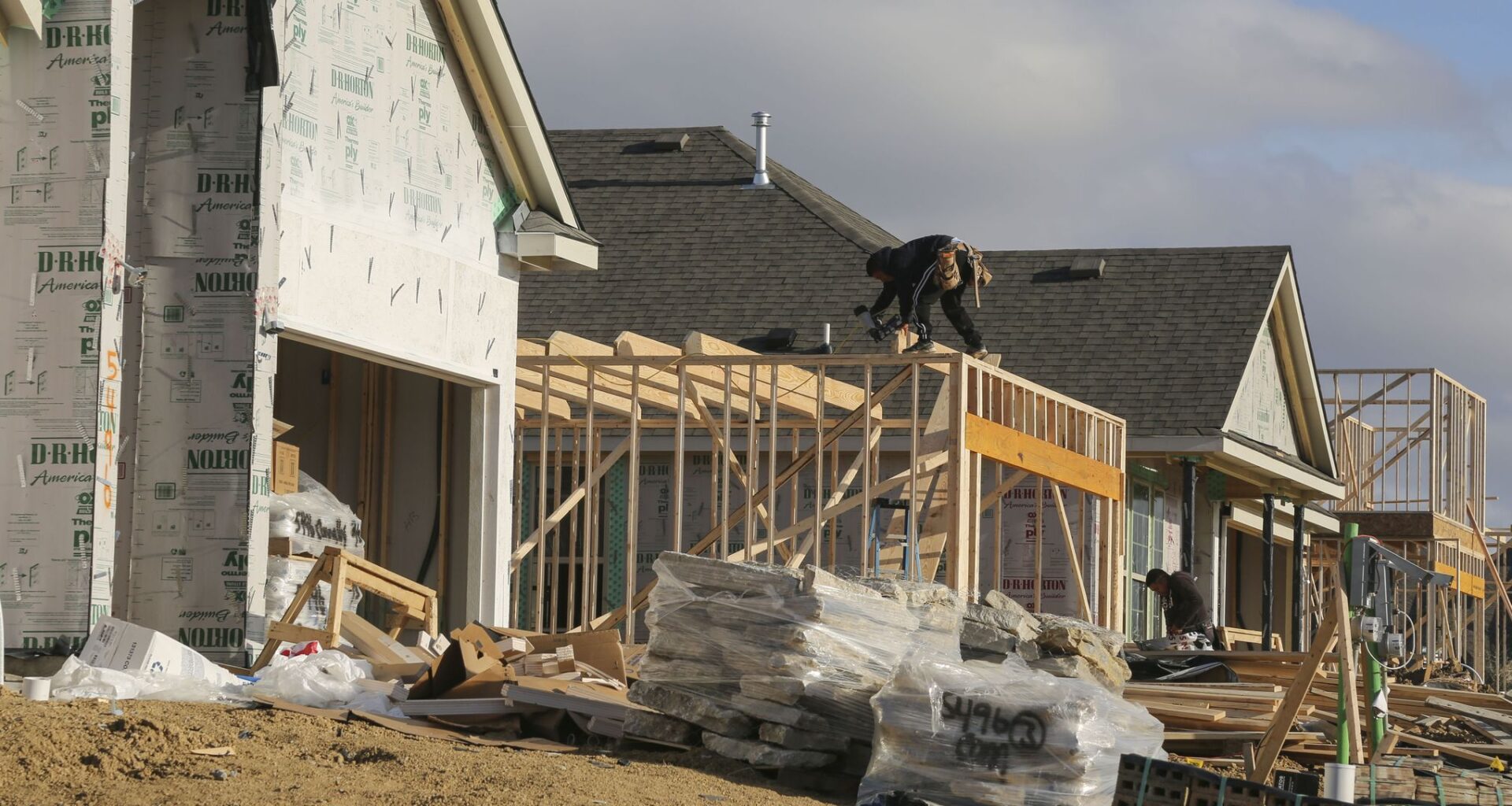
North Texas homebuilders started construction on 11,290 units, down 6.5% from a year ago, according to new data from Residential Strategies Inc.
File Photo/Staff
Homebuilding activity in North Texas decreased slightly from the previous year as economic pressures like elevated mortgage rates impacted the market, according to second quarter data collected by the Dallas-based market research firm Residential Strategies Inc.

The second quarter of the year — which includes April, May and June — tends to be one of the strongest times for home starts, said Ted Wilson, principal of RSI. It’s important to put this quarter’s numbers in perspective, he said.
“If you had told me a year ago, or last fall, that we were going to go into the spring market and that mortgage rates were going to climb to over 6.5% and we were going to be in a war with Iran, I would have been pretty nervous about how the spring market went,” Ted Wilson said. “And I think, all in all, I’ll take it. It’s been an OK market here for the past six months.”
Article continues below this ad
The homebuilding market faced economic pressures like mortgage rates and the war in Iran, which lowered expectations for the year. Builders reported that they met sales targets, but profit margins remain under pressure, according to the firm’s second quarter report.
North Texas homebuilders started construction on 11,290 units — slightly ahead of the previous quarter’s 11,149 starts — but down 6.5% from a year ago, according to the report. Total starts for the last four quarters slipped to 39,962, down 11.7% year-over-year, according to the report.
Meanwhile, builders closed 11,386 homes during the quarter, a 7.6% decrease from the previous year, according to the report. The annual closing rate was about 42,887 units.
Existing home sales remained largely flat for the quarter, with 91,864 home sales over a 12-month period ending in May, according to the Texas A&M University Texas Real Estate Research Center.
Article continues below this ad
Mortgages and jobs
The most important market drivers for the housing industry are mortgage rates and job growth, Ted Wilson said.
Mortgage rates stayed elevated for the quarter, ranging from 6.23% to 6.53%. The 30-year fixed rate mortgage was set at 6.49% as of July 9, according to Freddie Mac.
Mortgage rates moved higher in March as the Iran war continued. Mortgage rates tend to follow the 10-year treasury bond yield. Uncertainty and the prospect of higher inflation due to rising oil prices caused the treasury bond yield to rise.
Article continues below this ad
However, prospective home buyers have seen that rates aren’t going down anytime soon and have gone ahead and made purchase decisions, Ted Wilson said.
Job growth in Texas could be on the rise. The report pointed to recent headquarter moves to D-FW like Samsung’s relocation to Plano along with signs that Morgan Stanley will move to the area.
Texas’ 12-month job growth pace was at about 24,700 jobs added as of May 2026, according to the Texas Workforce Commission. According to the RSI report that rate likely means growth figures for 2026 will surpass those of 2025, but remain behind the higher growth figures of some previous years.
Vacant inventory
The amount of finished vacant housing inventory fell to the lowest level in two years, meaning that more speculative homes are being sold in what the report said was a bright spot for the quarter.
Article continues below this ad
By the end of the second quarter there were 9,745 units available, down 1,413 units from the previous quarter.
“Builders embarked on the painful task of purging excessive levels of unsold homes during the first half of 2026,” said Cassie Gibson, executive vice president with the firm, in the report. “The surplus levels of housing required discounts to sell, and many of these houses were sold with minimal profit.”
Aerial view of new home construction in the Williamsburg subdivision on Thursday, Feb. 9, 2023, in Fate, Texas.
Smiley N. Pool/Staff Photographer
Although the number of unsold homes decreased, there are still plenty of vacant developed lots in D-FW. At the end of the second quarter, there was a record of 111,511 lots for homes, representing a 33.5 month supply. According to the research firm, a 24-month supply is considered equilibrium.
Builders became bullish about housing market conditions in 2023 and 2024 when job growth was stronger and mortgage rates were expected to drop, said Ned Wilson, senior vice president at RSI, said in the report.
Article continues below this ad
“Unfortunately, the resulting push to put lots on the ground has now occurred at a time that demand for new homes is retreating in D-FW as a result of slower job growth and persistently high mortgage rates,” he said.
Build-to-rent
Starts for homes built as rentals fell to just 688 units in the second quarter of 2026.
The build-to-rent sector includes large institutional investors which would have been heavily regulated in an earlier version of the 21st Century ROAD to Housing Act. The act became law on Saturday, but with fewer restrictions for large institutional investors than some initial versions of the bill.
Article continues below this ad
In addition to uncertainty over the act, Ted Wilson said the sector isn’t as profitable as it used to be and has been trending downward.
Over the last four quarters the builders in the sector produced 3,720 home starts, representing 7.6% of all construction activity.