
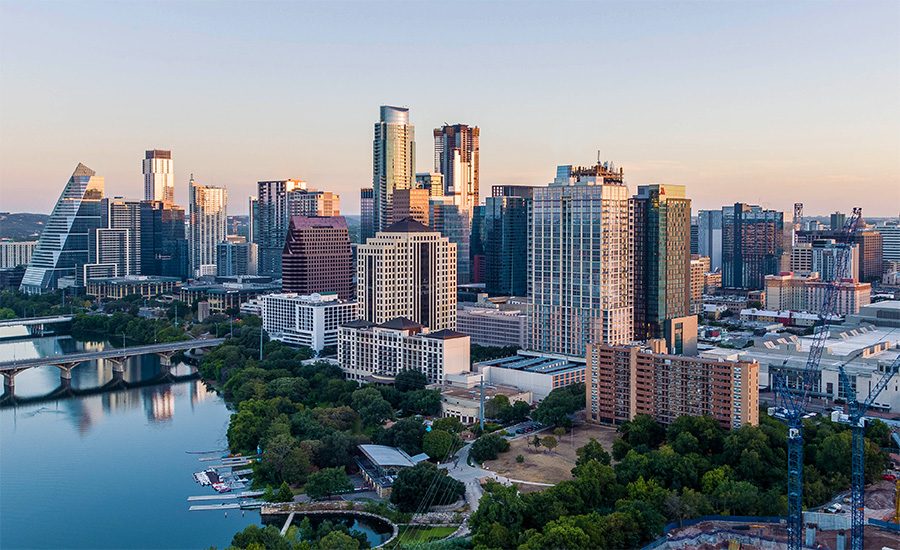
Skyline rules are shifting in the Texas capital. Last month, the Austin City Council adopted an ordinance setting a 350-ft by-right height limit for projects in the Central Business District, replacing the city’s long-standing floor-area ratio (FAR) system after state lawmakers limited local zoning powers.
The cap takes effect for development applications filed from Nov. 3 through “early June 2026,” according to city government officials, when staff expects to bring forward a broader downtown code rewrite.
Projects seeking to exceed 350 ft must now enter the Downtown Density Bonus Program (DDBP) and obtain council approval. The Planning Commission unanimously endorsed the change on Oct. 14, following a September affordability-impact analysis.
How Senate Bill 840 Forced Austin’s Hand
The new rule stems from Senate Bill 840, a state law that took effect Sept. 1, which bars Texas cities from regulating FAR for mixed-use or multifamily development in commercial zones.
With that restriction, Austin planners warned that the CBD’s prior 8:1 FAR baseline—roughly equivalent to a 200-ft to 230-ft tower—would have left downtown with no effective height limit.
]]>
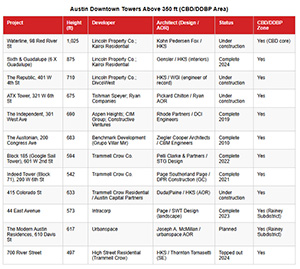
This ENR chart shows central downtown Austin towers taller than 350 ft and indicates whether each is within the new CBD/DDBP zone. Click the image to view the table.
To prevent uncontrolled growth while maintaining incentives for community benefits, the city established a fixed base height of 350 ft and retained the DDBP as a mechanism for taller buildings.
Under the bonus program, developers exchange additional height or density for on-site affordable-housing units, payments into the city’s housing trust fund, or participation in its Great Streets initiative, which includes wider sidewalks, shade trees, and active ground-floor uses along downtown corridors.
Staff reports note that the median height of recent DDBP projects was about 220 ft, while many new proposals topped 500 ft, prompting the city to choose a threshold aligned with recent market patterns but below upper ranges.
Planning officials describe the measure as an “interim fix” that preserves predictability for developers while new land-development code language is prepared. The height cap runs through mid-2026, after which the council will consider a comprehensive downtown zoning update.
Councilmember Chito Vela said the intent is to “hold onto both the density-bonus dollars and our downtown Great Streets treatment.”
RELATED
Austin’s Waterline Skyscraper Rises to New Heights
However, the Downtown Commission opposed the 350-ft cap, calling it arbitrary and warning that fewer projects might participate in the bonus program, thereby reducing affordable-housing revenues.
]]>
The Downtown Austin Neighborhood Association, a nonprofit comprising businesses and residents, expressed opposition to the height cap in a letter to the city council, arguing that height limits and other “exclusionary” zoning mechanisms hinder housing production and contradict the city’s stated affordability goals.
“Density-bonus programs rely on exclusionary zoning to ‘work’ and produce less housing relative to granting the same entitlements by right,” the organization wrote.
The ordinance directs staff to report back by February 2027 on DDBP outcomes and potential permanent code amendments.
In the meantime, developers and engineers preparing new downtown towers will need to design within a narrower by-right envelope or budget time for council review to reach higher. Structural teams say the new baseline could alter tower-to-podium ratios, crane sequencing, and facade selection as Austin’s central-city skyline adjusts to the post-SB 840 era.