
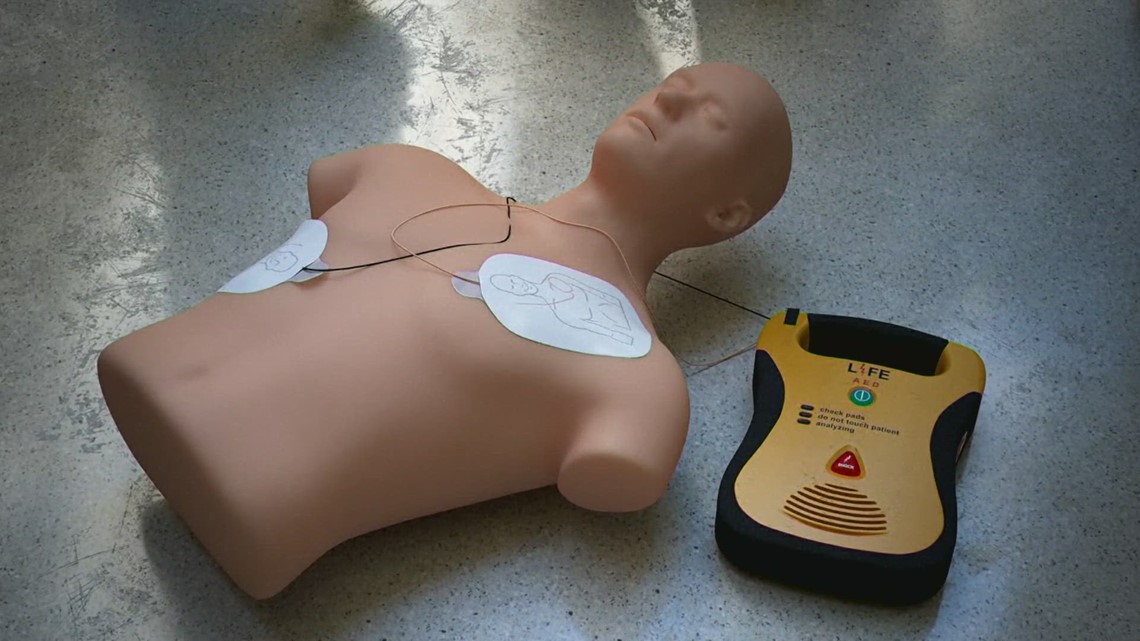
What started as one rescue in Plano is now a nationwide mission— Cardiac Crusade, a nonprofit mapping AEDs to close the gap between life and death.
PLANO, Texas — In October of 2018, Julie Coon was volunteering outside Plano Senior High School, handing out pink ribbons for the drill team’s “Pink Out Day,” when her world went dark.
“I went from talking to my friend to just dropping to the ground,” she said. “It was like a light switch off.”
Total strangers saw her collapse.
Within seconds, a pair of twins on the volleyball team, named Christy and Riley Winkler, called for help—alerting their bus driver, a first responder, who sprinted over and sent the girls to find the school’s athletic trainer. They began CPR, while the twins ran for the school’s automated external defibrillator—the small device that can shock a heart back into rhythm.
“They had all the equipment and two trained responders to tag team and do CPR and shocked me with the AED,” Julie Coon said. “I came back on the second shock. It was like clockwork.”
That quick action—and the people who knew what to do—saved her life.
Turning survival into a mission
Coon doesn’t remember the moments that saved her, only the stories retold to her later from her hospital bed. But those seconds inspired what would become her family’s life’s work.
Together with her husband, Greg Coon, she founded Cardiac Crusade, a nonprofit built to make AEDs easier to find when every second matters.
“The idea started with a simple question,” Greg said. “Why can I ask Google where the closest Starbucks is—but not an AED? That thought started this whole campaign.”
Cardiac Crusade partners with PulsePoint AED, a verified database and app that helps 911 dispatchers and users locate nearby defibrillators in real time. Volunteers nationwide, many trained by the Coons, go business to business, photographing and verifying AED locations so emergency responders and bystanders know where they are and can access them instantly.
“If that takes 90 seconds instead of seven minutes while waiting for an ambulance, that’s the difference between life and death.”
The nonprofit’s work has already mapped more than 10,000 AEDs nationwide, from Buffalo to Boston to San Diego—boosting survival rates in cities that adopt the program. Cardiac Crusade campaigns helped Buffalo grow its AED registry from 115 to 1,200 devices in just four months, and the Coons hope to continue that growth in North Texas.
To raise awareness and fund new volunteers, they hosted a pickleball fundraiser at Chicken N Pickle in Allen—complete with families, friends, and a surprise reunion.
One of the twin sisters who helped save Julie’s life showed up to play on Greg’s team.
“We both got choked up,” Julie said. “It was so great to hug her because she and her twin noticed something and took action. It’s why I’m here.”
Keeping the heartbeat going
Cardiac Crusade continues to expand city by city, to eventually integrate AED data into Google and Apple Maps, so anyone with a phone can find the nearest lifesaving device in seconds.
Because Julie Coon knows what difference those seconds can make.
All because someone knew what to do—and now, she’s making sure the rest of us do too.