
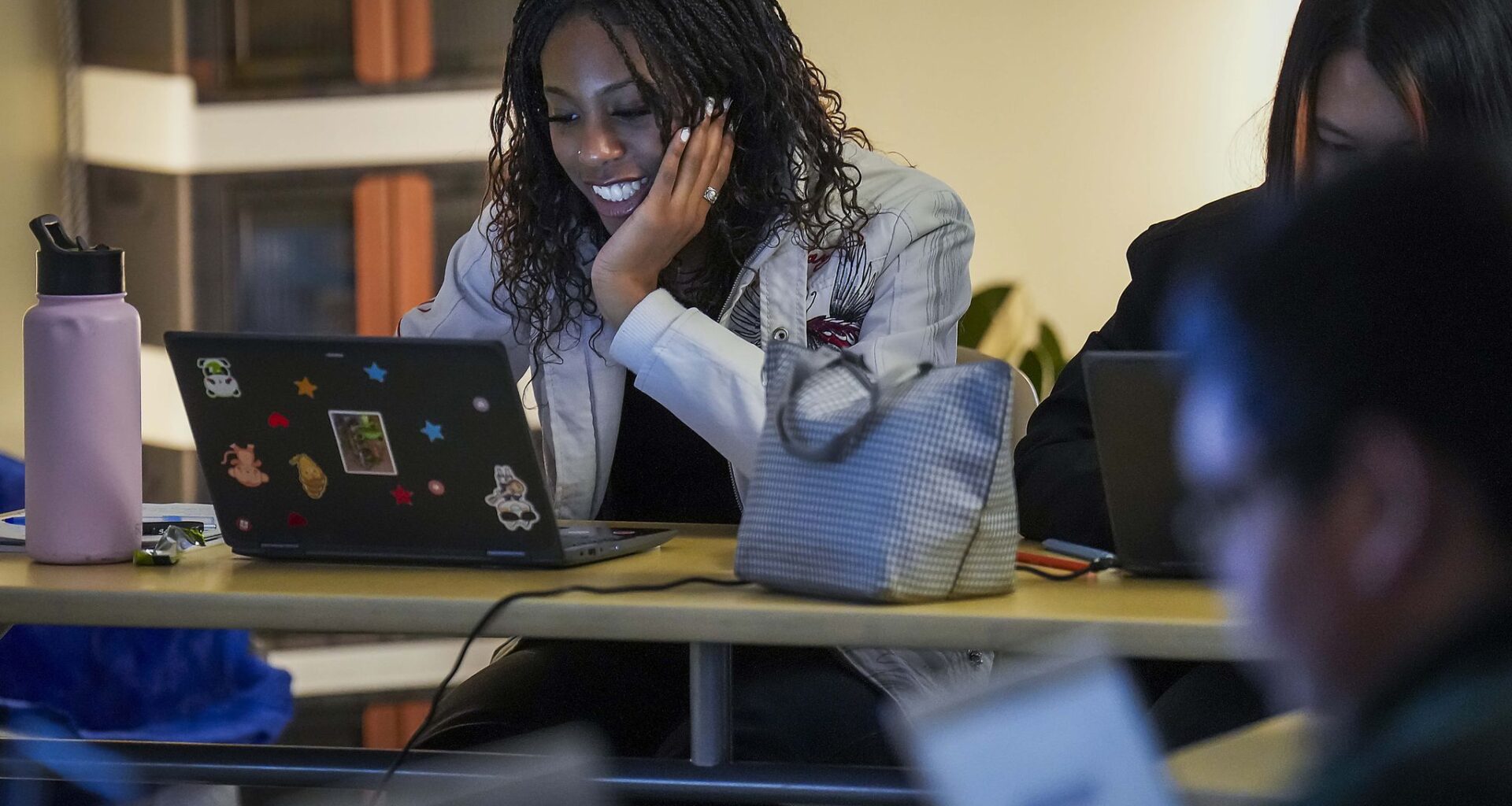
Ariah Barnes works on a laptop during an AP African American Studies class at Kathlyn Joy Gilliam Collegiate Academy on Dec. 15, 2023, in Dallas.
Smiley N. Pool/Staff Photographer
At the beginning of the pandemic, school districts scrambled to get laptops and tablets into the hands of every student as they shifted to online learning.

Six years later, those devices are a near-ubiquitous presence in many Texas classrooms. A growing number of parents are concerned about how much screen time their children get at school, and North Texas districts are trying to find a balance between the benefits of learning the tech and the potential negative impacts.
Related: Here’s when North Texas students head back to school
Article continues below this ad
Richardson ISD leaders are rolling out a policy they hope will cut back on screen time while still allowing teachers to use online content in their lessons. The move comes as other districts across Texas and nationwide consider limits on how devices like tablets and laptops can be used at school.
Some parents and policymakers worry the increased presence of screens in classrooms could disrupt students’ sleep patterns, affect social-emotional growth and create a source of distraction.
Scott Ricamore, father of two elementary-aged students in the district, said he’s happy to see the district pulling back on how much technology teachers use in class. He’d like to see the district go further and scale back the use of devices for any lesson that isn’t about how to use those devices themselves, he said. Still, he wants students in the district to have access to top-of-the-line equipment and instruction about how to use that technology.
“We want them to understand how to use it,” he said. “But what we don’t want is for kids to be using a device all day for all their learning.”
As school leaders across the state grapple with what role technology should play in classrooms, one expert says it’s less important to focus on how much time students spend on screens than what they’re doing during that time.
Article continues below this ad
“The amount of time on a screen doesn’t seem to matter that much when it comes to academic outcomes,” said Liz Kolb, a professor at the University of Michigan’s Marsal Family School of Education. “It’s much more about the type of screen use and what you’re doing on the screen that makes a difference.”
Some Texas districts consider curtailing screen time
State lawmakers passed a bill last year banning students from using cellphones and other devices such as smartwatches and headphones during the school day, including at lunch and between classes. The ban went into effect at the beginning of the 2025-26 school year.
Related: This Dallas ISD middle school banned cellphones years before the rest of Texas. Here’s what happened
Since the bill’s passage, some school districts across the state have gone further, putting restrictions on how much time students spend using laptops and tablets. In Lockhart ISD, about 30 miles south of Austin, board members voted last spring to approve a policy reducing screen time and creating more time for outdoor play. In Garland ISD, officials rolled out a policy at the beginning of the 2025-26 school year limiting screen time to one hour per day for students ages 2 to 5 and two hours per day for students age 6 and older. And now in Richardson ISD, district leaders are cutting down on “passive screen time” during the upcoming school year.
Article continues below this ad
Related: Search Dallas-area elementary, middle school 2026 STAAR results
Under the new guidelines, teachers will no longer give students extra screen time as an incentive or reward, said Richardson ISD Superintendent Tabitha Branum. Students also won’t be able to spend the last few minutes of a class period on their devices if they finish their work or get done with a test early, she said.
That doesn’t mean screens will be completely absent from the classroom, Branum said. Teachers will still be able to use online photos and videos as teaching tools, she said — for example, a science teacher will still be able to pull up a short video of an animal the class is learning about. But district leaders are asking teachers to be judicious about how much they’re exposing students to screens in class, she said.
Richardson ISD Superintendent Tabitha Branum speaks during the Dallas Regional Chamber’s 2022 State of Public Education on Sept. 27, 2022 in Dallas.
Elias Valverde II/Dallas Morning News
Related: Abbott launches teacher-led commission to shape Texas education
Article continues below this ad
Branum said the change isn’t intended to be a complete overhaul of the way the district handles technology in the classroom, so much as a reset. During the pandemic, the use of screens skyrocketed because teachers had no other way to work with their students. Now that schools have largely returned to normal, district leaders need to offer guidance to teachers about what appropriate use of technology looks like, and assurances to parents that the district will only use technology in ways that support learning.
Parents weigh in on Richardson ISD policy
Zoë Lewis, a mother of two boys in Richardson, said the widespread use of tablets in Richardson ISD was a major problem for her oldest son. He has ADHD, which creates what she describes as an unhealthy obsession with screens. For that reason, Lewis and her husband don’t let him use a tablet at home.
But at school, her son was on an iPad every day, Lewis said. Some of that time was the kind of passive screen time the district is looking to eliminate, she said, but even the educational apps the district used for instruction included games that could be a major source of distraction for students with ADHD.
Last year, Lewis withdrew her son from Canyon Creek Elementary School in Richardson ISD and moved him to Shelton School, a private school in Far North Dallas for students with learning disabilities. Since the move, her son has thrived, Lewis said. She and her husband suspect the fact Shelton School doesn’t use screens is a big part of the reason. Lewis acknowledges Richardson ISD can’t craft a policy that eliminates screens from schools completely. But nothing short of that would work for her son, she said.
Article continues below this ad
“I don’t think there’s any way that daily tablet time could have been OK for him,” she said.
Cassie Scott has three kids, two of whom have graduated from Richardson ISD. Her youngest daughter will start fourth grade next month. She’s noticed a big difference in how technology affects her youngest daughter, compared with her older two kids. Scott’s daughter was in pre-K in a different district at the beginning of the pandemic, so she was exposed to more extensive use of screens for school at a much younger age than her older siblings.
Scott, a former special education coordinator in the district, said she’s noticed her daughter seems less resilient than her older siblings. If a task seems too hard, she’s quick to give up on it, Scott said. There’s no emotional outburst, she said, she simply walks away from it.
Scott said her daughter also has what she worries is an unhealthy fixation on technology. She always thinks she needs a screen in her hand, Scott said. She sees the same impulse in her two older kids, too, but she said her daughter is of an age where she should spend her time playing outside and not buried in her tablet.
Erin Price, a parent, school counselor and former teacher in Richardson ISD, said she doesn’t see the policy as a major departure from the expectations that were already in place in the district. But she said it can be valuable to clarify those guidelines and communicate with the community about what expectations are.
Article continues below this ad
Students hand their laptops to the side before walking through detections at Mansfield High School in Mansfield on Oct. 27, 2023.
Juan Figueroa/Dallas Morning News
The way teachers use technology in the classroom shifted after the pandemic, Price said. Teachers got access to new tools that, in many cases, help them do their jobs better, she said. But that shift also affected the balance between the use of screens in the classroom and pencil-and-paper work. Sometimes, she said, using classroom technology effectively means not using devices at all.
The cellphone ban that lawmakers passed last year doesn’t apply to district-issued devices like laptops and tablets, and there’s been little movement in the Texas Legislature toward broader restrictions on classroom technology. In a statement, state Rep. Caroline Fairly, R-Amarillo, the author of the Texas House version of the cellphone bill, said she’d like to see more school districts adopt those restrictions on their own.
“This is exactly the kind of local responsiveness we should want to see in Texas,” Fairly said. “Districts don’t need to wait on Austin to act when parents raise legitimate concerns about screen time and school-issued devices. I would love to see more districts across the state following in Richardson ISD’s footsteps. When schools take a hard look at how devices are actually being used and make changes based on what parents and teachers are telling them, that’s good governance at the local level.”
School screen time gets attention elsewhere
Garland ISD introduced its guidelines around screen time in the classroom at the beginning of last school year. Besides limiting screen time, the guidelines also recommend taking frequent breaks and balancing schoolwork with physical activity and social interaction. The guidelines came out of recommendations from the district’s School Health Advisory Committee, which were based in large part on recommendations from the American Academy of Pediatrics.
For years, the academy released recommendations that included limits for school-related screen time. But the organization moved away from that practice last year. Rather than specifying limits, the academy made recommendations for how schools incorporate screens into their classrooms, including minimizing passive tasks like filling out digital worksheets and ensuring screen time doesn’t crowd out physical activity and social interaction.
At a meeting last month, members of Coppell ISD’s School Health Advisory Council presented board members with a report that included recommendations similar to those in Garland ISD’s guidelines. The board is expected to discuss the issue in the coming months.
Third grader Natalie Davis watches on a tablet as two Coppell High School juniors read an Indian folktale titled “Sukhu and Dukhu” using Zoom, to dual language elementary students at W.H. Wilson Elementary in Coppell, on April 19, 2021.
Ben Torres/Dallas Morning News
Although only a few Texas districts have cut back on how much screen time students are exposed to at school, education leaders and policymakers elsewhere are taking steps to limit technology in the classroom. In May, Iowa Gov. Kim Reynolds signed a bill limiting screen time to 60 minutes per day for students up to fifth grade. Following the signing, Reynolds and Health and Human Services Secretary Robert F. Kennedy Jr. visited an elementary school in Gilbert, about 40 miles north of Des Moines, where Kennedy announced a new surgeon general’s warning on the dangers of screen use.
Last month, board members in the Los Angeles Unified School District, the nation’s second-largest district, approved a revised policy that bans screen time in early education, kindergarten and first grade, and caps it for students in higher grades. The cap allows up to 100 minutes of screen time weekly for students in grades two and three. The time allowed steps up as students advance to higher grades.
Kolb, the University of Michigan professor, said placing hard limits on the amount of time students are allowed to spend using laptops and tablets may not be the best approach. Instead, she said, district leaders and policymakers should focus more on what teachers do with that time — “is it passive, are students actively engaged in it, are they hands-on with it?”
There are indications that far too much or far too little screen time can lead to bad academic outcomes, Kolb said. But within moderation, access to technology almost always leads to growth, as long as it’s used appropriately, she said. Good teachers know when to use screens and when to take them out of the classroom, Kolb said.
In any given week, the amount of screen time a good teacher incorporates into a class can vary widely, depending on what the class is doing, she said. One week, the class might not use tablets and laptops at all, she said. The following week, students could be doing research that requires access to resources like the National Archives, which involves spending a certain amount of time online. That variability makes it difficult for school boards or state lawmakers to set hard limits on screen time that don’t interfere with the work students are doing in class, she said.
“To limit teachers’ ability to do what they do best — and they are the experts in the field, and they understand how students learn — can actually potentially inhibit student learning in a variety of ways,” she said.
The DMN Education Lab deepens the coverage and conversation about urgent education issues critical to the future of North Texas.
The DMN Education Lab is a community-funded journalism initiative, with support from Bobby and Lottye Lyle, Communities Foundation of Texas, The Dallas Foundation, Dallas Regional Chamber, Deedie Rose, Garrett and Cecilia Boone, Judy and Jim Gibbs, The Meadows Foundation, The Murrell Foundation, Ron and Phyllis Steinhart, Solutions Journalism Network, Southern Methodist University, Sydney Smith Hicks, and the University of Texas at Dallas. The Dallas Morning News retains full editorial control of the Education Lab’s journalism.