
Austin leaders are reviewing the city’s proposed $6.63 billion budget for the upcoming fiscal year 2026-27, a nearly 5% larger spending plan that would raise the typical household’s costs about $350.
Additionally, officials proposed millions of dollars in cuts to social services to offset some of those cost drivers.
City Manager T.C. Broadnax framed the budget as maintaining long-term fiscal stability while withstanding local revenue challenges.
“Like the community members we serve, we must live within our means,” he wrote in his budget message. “We achieved a balanced budget in part by identifying reductions and reallocations in the City’s General Fund through this thoughtful, strategic and focused process.”
The overview
The draft FY 2026-27 budget is about $301 million larger than the current $6.32 billion spending plan. It includes a $1.54 billion general fund largely backed by tax collections that supports community services, from parks and libraries to public safety and social programs.
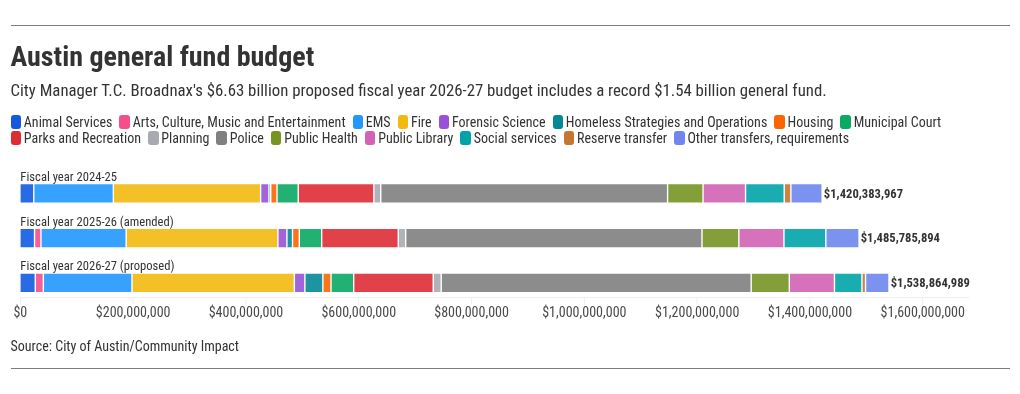 General fund costs would rise a combined $53 million or nearly 3.6%, led by spending on public safety. Austin Police’s budget would jump by $24.22 million, followed by an $18.86 million increase for Austin Fire and a more than $6 million increase for Austin/Travis County Emergency Medical Services. Much of those cost increases are due to employee raises included in current labor agreements, and to address staffing and overtime needs.
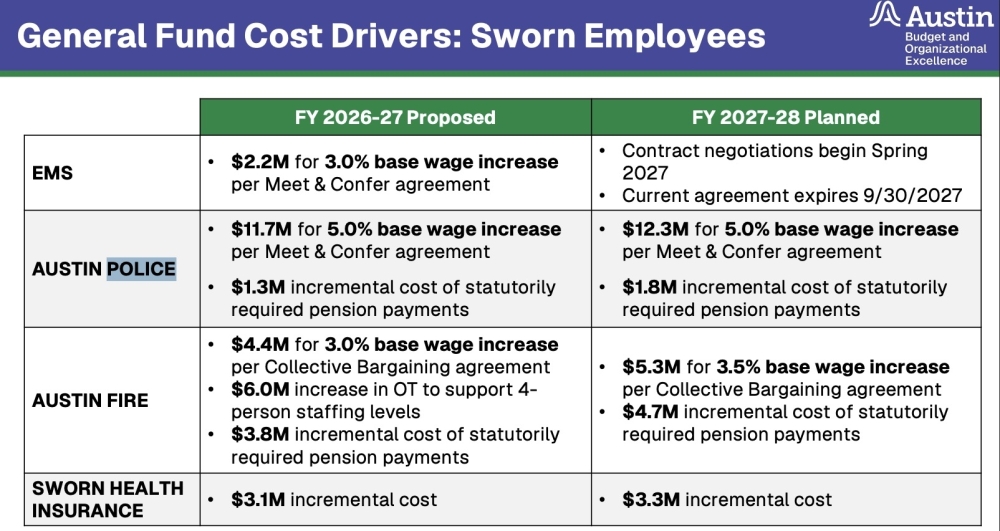 Personnel wages under current public safety labor agreements will cost more than $18 million in fiscal year 2026-27 and at least $17.6 million the following year. (Courtesy city of Austin)The Austin Homeless Strategies and Operations budget would increase by roughly $22 million, largely through a reallocation of current social service spending rather than new departmental expenses. A total of $19.4 million related to homelessness response would be transferred into AHSO and Austin Public Health from the general social services budget. More than $5 million would be cut from all other city social service spending.
The budget was based around strategic prioritization, Broadnax said, including some cuts alongside program increases. Budget staff will share more information about proposed social service changes July 22.
“While there are reductions in this budget–that’s not the entire story. We also increased investments in key areas, especially those that matter most to our community,” Broadnax said in a statement.
Aside from those changes, Austin Parks and Recreation would see the next-highest annual increase in the general fund, at $5.23 million. That includes an extra $1.2 million for maintenance and operations of parks facilities.
The impact
Austin residents can expect higher expenses from property taxes to utilities under the FY 2026-27 spending plan.
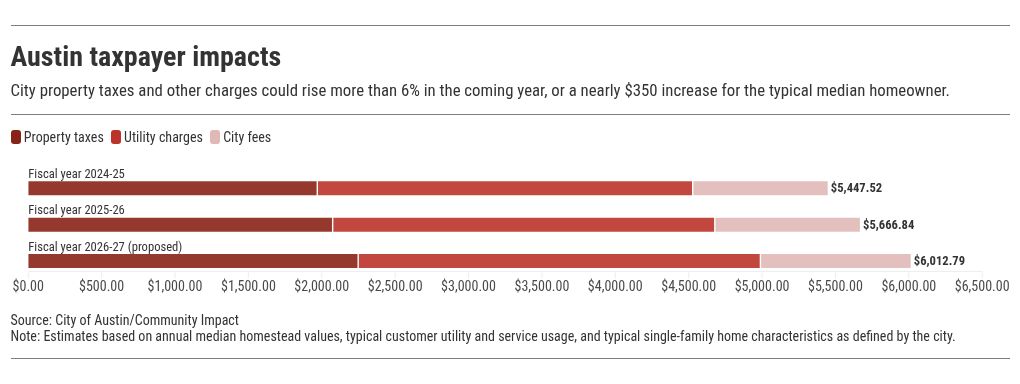 Broadnax proposed the maximum tax rate allowed under state law, $0.57953 per $100 in appraised property value, representing a more than 10% increase over the current $0.524017 rate. That change would add $174 to the typical annual property tax bill, based on Austin’s projected median homestead value of $484,907 next year—down $10,000 from this year’s median of $494,803.
Annual Austin Energy and Austin Water charges would rise a combined $137, or more than 5%, and other city charges would cost about $35 more, or 3.5%, based on typical usage and service to single-family homes.
Those changes come as Austin anticipates slower growth in taxable value across the city, while a development slowdown is bringing less new property value online each year. City budget staff also expect weaker economic and jobs growth, impacting sales tax revenue.
Under proposed cuts and based on current spending and revenue projections, Austin will see balanced budgets and potential surpluses in the coming years—a reversal from recently forecast deficits.
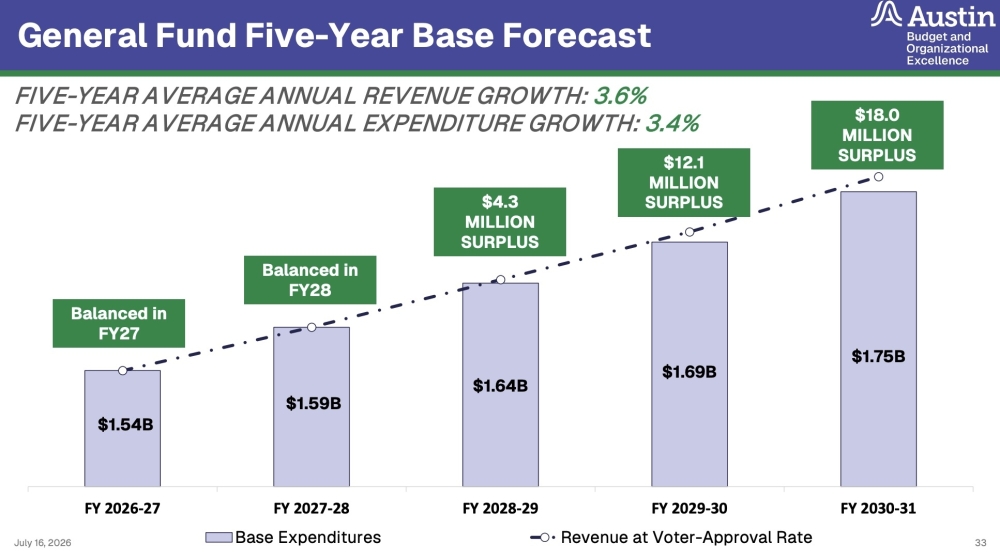 Austin budget staff project budget surpluses in the coming years based on the city’s draft fiscal year 2026-27 spending plan. (Courtesy city of Austin)Council member Marc Duchen said he’d hoped to see more fiscal discipline in the spending plan presented this summer, which he called a “take now and hope later budget” that doesn’t fully account for future spending increases. He also questioned departments’ budget increases based on factors like inflation, with funding he said may be outpacing actual financial conditions.
Council member Ryan Alter disagreed, saying that projected city costs are only keeping pace with larger economic impacts and community needs.
“This is not a rampant spending budget, and if something is too much—and there are things that I’m going to try to pinpoint as areas where we can save—I would encourage anybody to put those things on the table so we can have a discussion,” he said.
A closer look
Broadnax’s budget proposal highlights several spending changes for the year ahead. Pay increases are a large driver of increased city costs, with a planned 3% civilian base wage increase totaling more than $35 million in addition to the millions of dollars added for sworn police, fire and EMS staff. A 10-cent increase to Austin’s minimum wage is expected to cost about $140,000.
Ongoing financial efficiency efforts are also expected to impact FY 2026-27 spending. A City Council-approved audit program is budgeted at $1.5 million, while an ongoing consolidation of technology services staff could result in nearly $6 million savings.
Notable changes within Austin’s general fund services include:
Spending another $8 million to operate the Marshalling Yard homeless shelter and reserving $6 million for permanent supportive housing projectsSpending more than $10 million on the city’s housing voucher and emergency rental assistance programsAdding about $1.5 million for staff and facility improvements at the Austin History CenterEliminating the $652,000 Summer Youth Employment Program, a collaboration with Travis County city officials recently asked to strengthenEliminating Austin’s $500,000 Creative Space Assistance Program, and using nearly $400,000 on new staff positions and facility upgrades at city museums and cultural centersAdding $275,000 to improve security at the Austin Animal CenterCouncil will hold a series of public meetings to dive into budget details and receive more public feedback this summer, starting with the review of social services funding July 22. The FY 2026-27 budget could be adopted Aug. 12.