
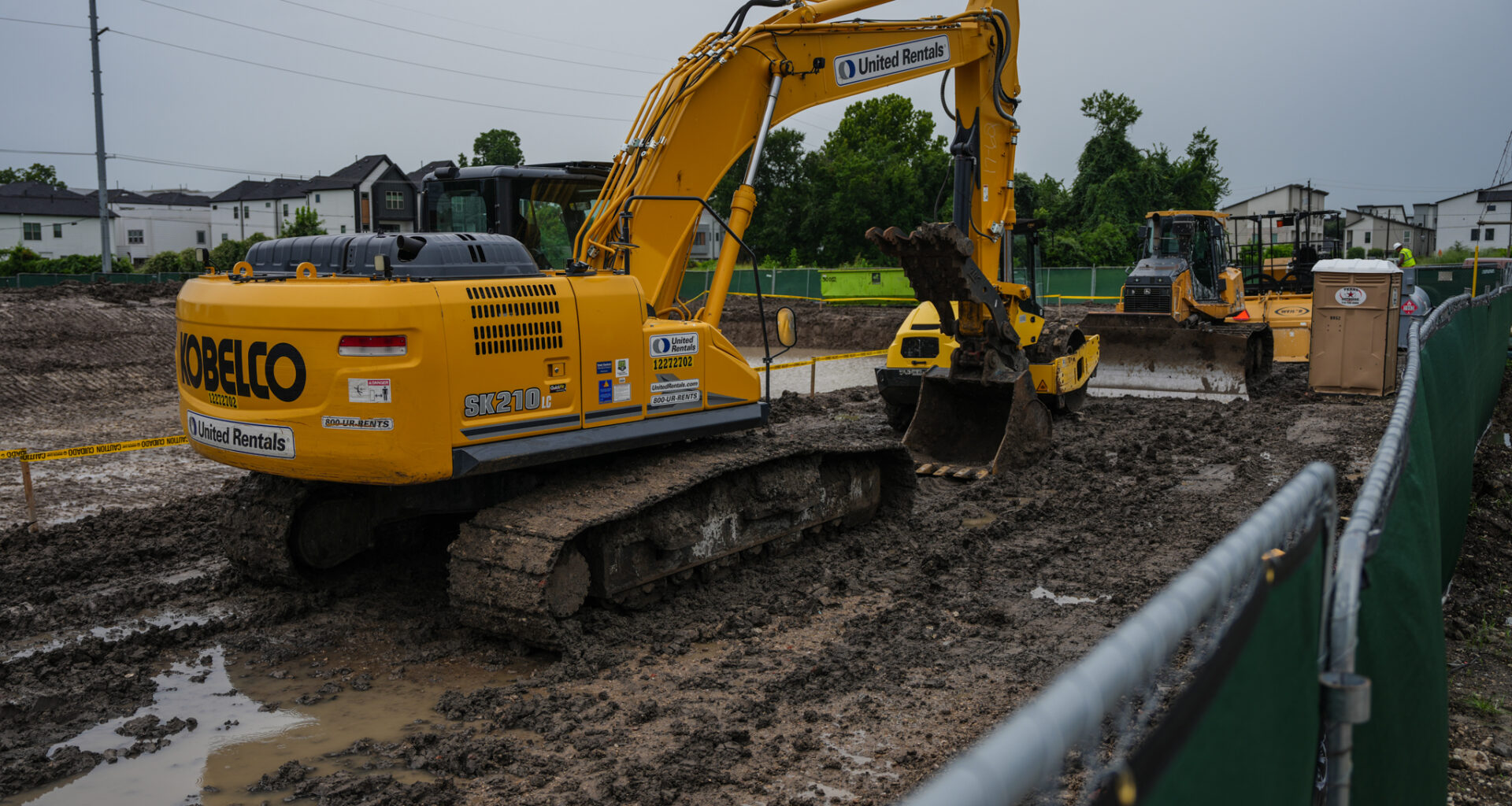
Trinity East Village Senior living is breaking ground in downtown Houston, Wednesday, July 15, 2026.
Jacob Lujan/Houston Chronicle
A street sign reads the intersection of McGowen and St Charles street which will house the Trinity East Village Senior living is breaking ground in downtown Houston, Wednesday, July 15, 2026.
Jacob Lujan/Houston Chronicle
Trinity East Village Senior living is breaking ground in downtown Houston, Wednesday, July 15, 2026.
Jacob Lujan/Houston Chronicle
As they walked out of the Sunday morning service at Trinity East United Methodist Church, Erma Davis pointed to the grassy field across the street, which the church used for overflow parking and for picnics.
“I don’t think God gave us this land just for us to grow weeds,” Herbert Green remembers her telling him. “I think he gave us the land to do something with it.”
Why not build housing for Third Ward seniors who had spent their lives in the historically Black neighborhood but faced the prospect of being priced out as land values climbed? The community, home to two universities, borders downtown and the Museum District.
Article continues below this ad
That conversation took place about 34 years ago, Green said.
EMPTY LOTS, EMPTY PROMISES: How Houston missed a $150M chance to fight displacement in Third Ward
After decades of work, the resulting 90-unit affordable development, Trinity East Village Senior, broke ground at the corner of McGowan and St. Charles streets. Over the decades, Davis and Green helped found the church’s community development corporation; they and other members of the congregation spent years meeting with government officials, real estate developers, banks, nonprofits and other faith groups to bring the project to life. The $32 million development is expected to be completed in the third quarter of 2027.
“This is truly the Lord’s doing,” said Rev. Marilyn White, pastor at Trinity East. “It is the result of years of faith, perseverance, partnership and unwavering belief that our seniors deserve a place that they can afford to live.”
Next, she announced, the church and its community development corporation would begin assembling financing to build a roughly 100-unit development next door for families with children.
Article continues below this ad
The church’s hands-on approach to tackling gentrification in its community is part of what some call the YIGBY movement. YIGBY is a play on the phrase NIMBY, or Not In My Backyard, often seen as a hindrance to development; YIGBY stands for Yes In God’s Backyard. In addition to Trinity East United Methodist Church, St. John’s Downtown has developed housing for those who were once homeless through its community development corporation, Temenos, and in Third Ward, Rev. Leslie Smith II helped build affordable housing for seniors through the Change Happens community development corporation.
Such churches see affordable housing as part of their mission to serve the community. Often, they either already own land in areas with rapidly rising land prices or have established reputations that can help acquire land.
THIRD WARD TRANSFORMATION: $500M Houston plan would tear down and rebuild Cuney Homes, create two new Third Ward developments
“God blessed Trinity East with valuable land,” White said. “But we believe that blessing was never meant just for the church. It was meant for us to use as a resource for the community.”
Neighboring property owners also donated land adjacent to the church’s vacant field and sold other parcels for a nominal price, said Green.
Article continues below this ad
The church’s community development corporation partnered with the affordable housing nonprofit NHP Foundation to co-develop Trinity East Village Senior. SCA served as the architect, NRP Construction will serve as the general contractor, and Studio Avid is the landscape architect. The complex will have a community dining area with a food pantry (to mitigate food insecurity, the complex will provide regular meals to residents), a backup generator to power the elevators and community spaces during outages, a fitness center, and in-unit washers and dryers.
The development will serve adults 55 years of age or older with low or extremely low incomes. Sixty units will be set aside for residents of nearby Cuney Homes, Houston’s oldest public housing development, which is being redeveloped in phases. The units are part of a promise to build “replacement housing” so residents can remain in the neighborhood while their homes are being redeveloped. The units will not be ready for the first phase of Cuney Homes residents moving out this year, but officials say they will be available for later phases.
The City of Houston and Rice University’s Real Estate Group both contributed to the project, and Houston’s housing authority, Housing Alliance HTX, exempted it from property taxes and contributed a federal subsidy known as project-based vouchers.
Trinity East Village Senior also received a 9% Low Income Housing Tax Credit, allocated by the state.
White, members of the congregation, a NHP Foundation project manager, the Housing Alliance HTX president and three Cuney Homes residents traveled to Austin in 2025 to meet with the board that allocates the low-income housing tax credits.
Article continues below this ad
When the group began speaking on behalf of the project, White said, she had a sinking feeling.
Texas Department of Housing and Community Affairs staff had recommended rejecting their application for the tax credit because the violent crime rate in the Third Ward far exceeded the level allowed for the investment. Board member after board member said they would not support the project unless they could be convinced it would be safe by the time the project opened.
The crux of the issue, said Lauren Avioli, who managed the project for NHP Foundation, was what type of neighborhoods needed affordable housing. Should affordable housing be prioritized in already safe neighborhoods with access to jobs and good schools? Or should money be invested to “transform” neighborhoods where longtime residents had built a community that they didn’t want to leave?
Jamie Bryant, the president of Housing Alliance HTX, argued that Trinity East Village Senior was vital for the planned transformation of the neighborhood, which involves not only rebuilding Cuney Homes but also building additional mixed-income housing throughout the neighborhood.
“The Trinity East Senior project is a key to the ultimate transformation of the Cuney Homes public housing because that transformation cannot commence until the families currently housed at Cuney Homes are provided appropriate replacement housing,” he said.
Article continues below this ad
White spoke of all the work Third Ward organizations were doing to better the neighborhood.
“We are not just sleeping in Third Ward,” she said. “Now, we are starting to see positive results from our efforts.”
Ultimately, the board gave the project additional time to develop a specific security plan to convince them that the neighborhood would be safe by the time Trinity East Village Senior opens, and the Houston Police Department and its partners pulled together to make that happen.
At the groundbreaking, longtime members of the Trinity East congregation admitted to having doubts over the decades over whether the project would happen, and expressed their joy at seeing it move forward.
“It’s wonderful, wonderful, just wonderful,” Godfrey McCoy said, as he waved to Brenda Davis, whose mother was the first president of the Trinity East Village CDC.
“I am so grateful,” Brenda Davis said, of her mother’s vision to provide housing and fight homelessness coming to fruition. “I would like to see more churches get involved.”
“I just thank God,” said Green. “Because we were birthed in Trinity East United Methodist Church to help the people of this community. And I mean not just our church members, but all of the members of this community.”