
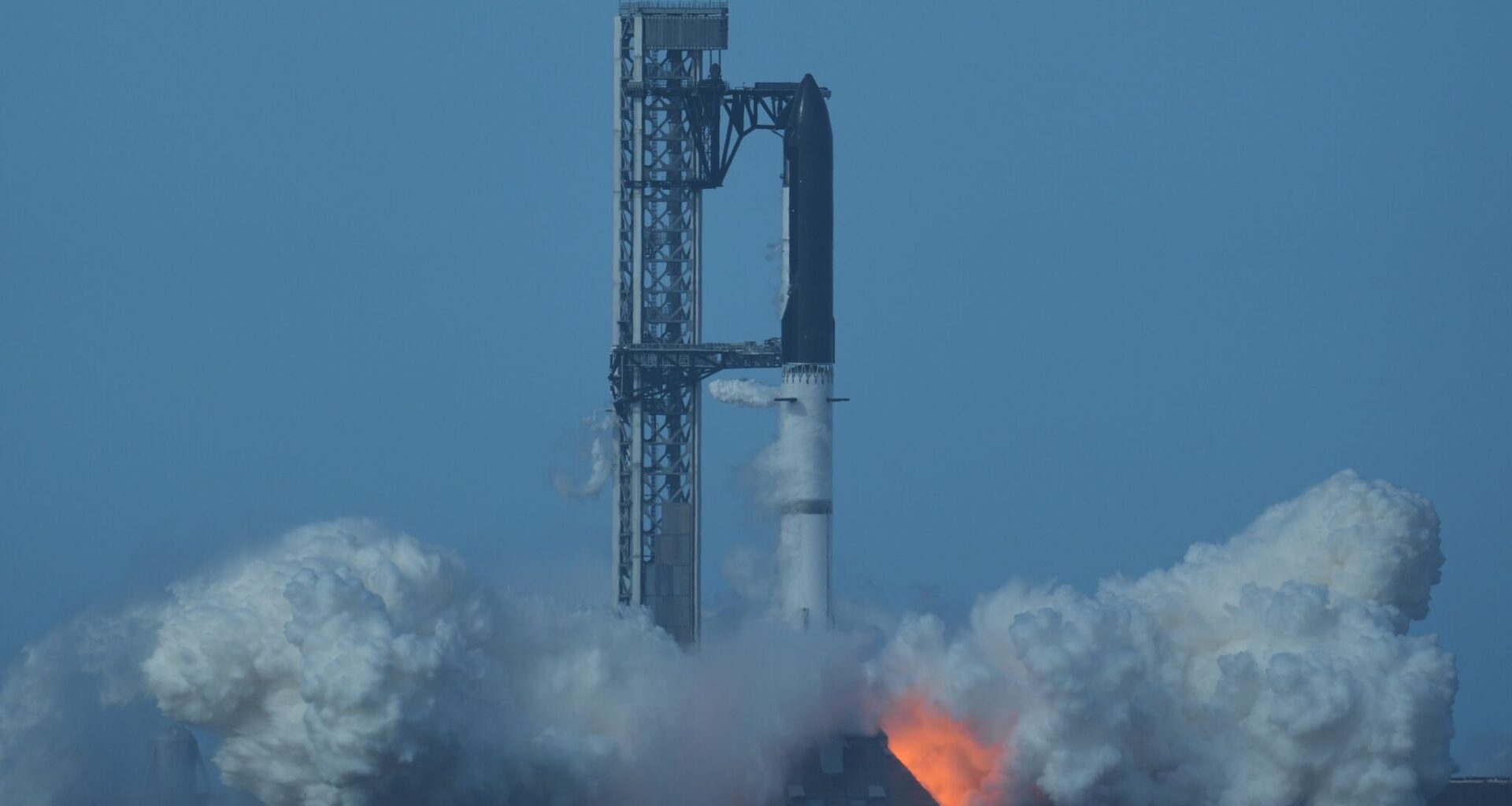
A SpaceX Starship fires its engines briefly before Thursday’s test flight was aborted. It was unclear what caused the shutdown or when the 13th test flight might be rescheduled.
Eric Gay/Associated Press

6:15 p.m update: SpaceX CEO Elon Musk confirmed Thursday’s planned launch was aborted due to engine problems.
Article continues below this ad
A SpaceX Starship is prepared for a test flight this evening from Starbase in South Texas.
Eric Gay/Associated Press
SpaceX’s Starship stands at the launch pad at Starbase in South Texas ahead of its 13th test flight.
SpaceX
“Some of the engines didn’t start, triggering an automatic launch abort,” he said on X. “Next launch attempt hopefully in a few days.”
A real-time image showing the flight status during the SpaceX livestream indicated that only some of the Super Heavy Booster’s 33 Raptor engines ignited before the abort.
6:10 p.m. update: Planned test flights followed by a launch on another day are nothing new for SpaceX at Starbase. Seven of the 12 Starship launches so far have slipped at least one day due to problems with the rocket or weather. Five have lifted off on the first target date.
Article continues below this ad
6 p.m. update: SpaceX was unable to restart its countdown for another launch attempt — as has happened during previous launch holds — because there wasn’t enough water.
San Antonio Express News Logo
Make us a Preferred Source on Google to see more of us when you search.
Add Preferred Source
When the Super Heavy booster’s 33 Raptor engines briefly fired, it triggered the water deluge system under the rocket, which diffuses heat and vibration. Though the engines were immediately shut down, the system released thousands of gallons of water from tanks that will need to be refilled before the next launch attempt.
Article continues below this ad
5:46 p.m. update: SpaceX aborted today’s planned test flight of its Starship mega-rocket after engines on the lower-stage booster began to fire, then shut down.
It was too early to say exactly what happened and when the next attempt could be scheduled.
“Not the end result you’re looking for, but we’ve still got a vehicle on the pad,” SpaceX spokesman Dan Huot said. “Hopefully, we’ll be back real soon for Flight 13 and another attempt to get Starship off the pad.”
Article continues below this ad
5:40 p.m. update: The countdown continues toward launch with about 5 minutes to go before today’s launch window opens.
SpaceX began fueling the mega-rocket with tons of liquid oxygen and methane at 5:10 p.m. It was set for completion about 5:43 p.m.
“Good news is very little news,” SpaceX spokesman Dan Huot said. “We are continuing to look on track for a liftoff today, not tracking any issues on the vehicle or the pad side.”
Article continues below this ad
The weather looks “gorgeous,” he said, with blue skies and low winds. “We’re looking good. We’re counting down.”
5:35 p.m. update: The 20 next-generation Starlink satellites set to be deployed on today’s test flight will only have about 20 minutes to attempt a series of activation and connection tests before they reenter Earth’s atmosphere, SpaceX said.
“Starlink V3 is our next generation satellite design that includes meaningful increases in capacity, data density, and power generation,” the company said. “These enhancements, along with Starship’s payload capacity to orbit, will enable us to scale the constellation and serve millions of more customers around the world with increasingly better service.”
Article continues below this ad
5:25 p.m. update: Today’s flight path will be the second along a new trajectory that sends Starship southeast from Starbase over the Gulf of Mexico. It’s expected to fly south of Cuba and continue over the Caribbean and Atlantic toward southern Africa before splashing down in the Indian Ocean northwest of Australia.
A Starship Super Heavy booster returns to the launch pad during a January 2025 test flight from Starbase.
Eric Gay/Associated Press file photo
The flight path was among three the FAA approved for SpaceX earlier this year, as it plans to eventually bring an upper-stage Starship back to land at its Starbase tower. While SpaceX has successfully landed the craft’s booster back at Starbase, it has yet to attempt the feat with a Starship upper stage.
Article continues below this ad
Musk has said that SpaceX won’t attempt a tower catch for Starship until it has had “two perfect soft landings in the ocean” because “the risk of the ship breaking up over land needs to be very low.”
The last flight’s landing in the Indian Ocean appeared to go as planned, and a successful splashdown today could clear the way for a catch attempt in an upcoming launch.
SpaceX is still clearing regulatory hurdles for flying the craft over land. The FAA is seeking public input on SpaceX’s contingency plans that would expand landing areas off the coast of Hawaii and South America as well as add new zone that in the Pacific that stretches from the Aleutian Islands to the U.S. mainland.
The agency is also seeking feedback on an additional return trajectory that could impact airspace over six states — Oregon, California, Nevada, Arizona, New Mexico and Texas.
Article continues below this ad
The FAA has said the path could impact 90 air traffic routes and up to 600 flights per hour.
5:15 p.m. update: A live webcast of today’s test flight has begun, signaling that the countdown remains on track for a 5:45 p.m. launch.
It can be accessed via the SpaceX website here and on X @SpaceX.
Article continues below this ad
Though the 90-minute launch window opens at 5:45 p.m., SpaceX says: “As is the case with all developmental testing, the schedule is dynamic and likely to change.” So keep checking this liveblog for updates.
5:05 p.m. update: SpaceX has its Starship mega-rocket ready for launch from South Texas and remains on track for a 5:45 p.m. launch.
Though parts of Texas has been contending with flash flooding and heavy rain, the weather around Boca Chica Beach is still favorable for today’s test flight, the first since SpaceX went public and the first to carry a payload of actual Starlink satellites.
Article continues below this ad
The test will resemble past flights, with the craft’s booster expected to land in the Gulf of Mexico while the upper-stage Starship will travel around the world at the edge of space for a landing in the Indian Ocean.
The 20 Starlink satellites it will release won’t join the company’s constellation of about 10,800 orbiters providing internet connectivity to millions of people around the world. Instead, they will extend solar arrays and antennas and test “high-capacity lasers” to connect to the constellation before burning up in the atmosphere about 20 minutes after deployment.