
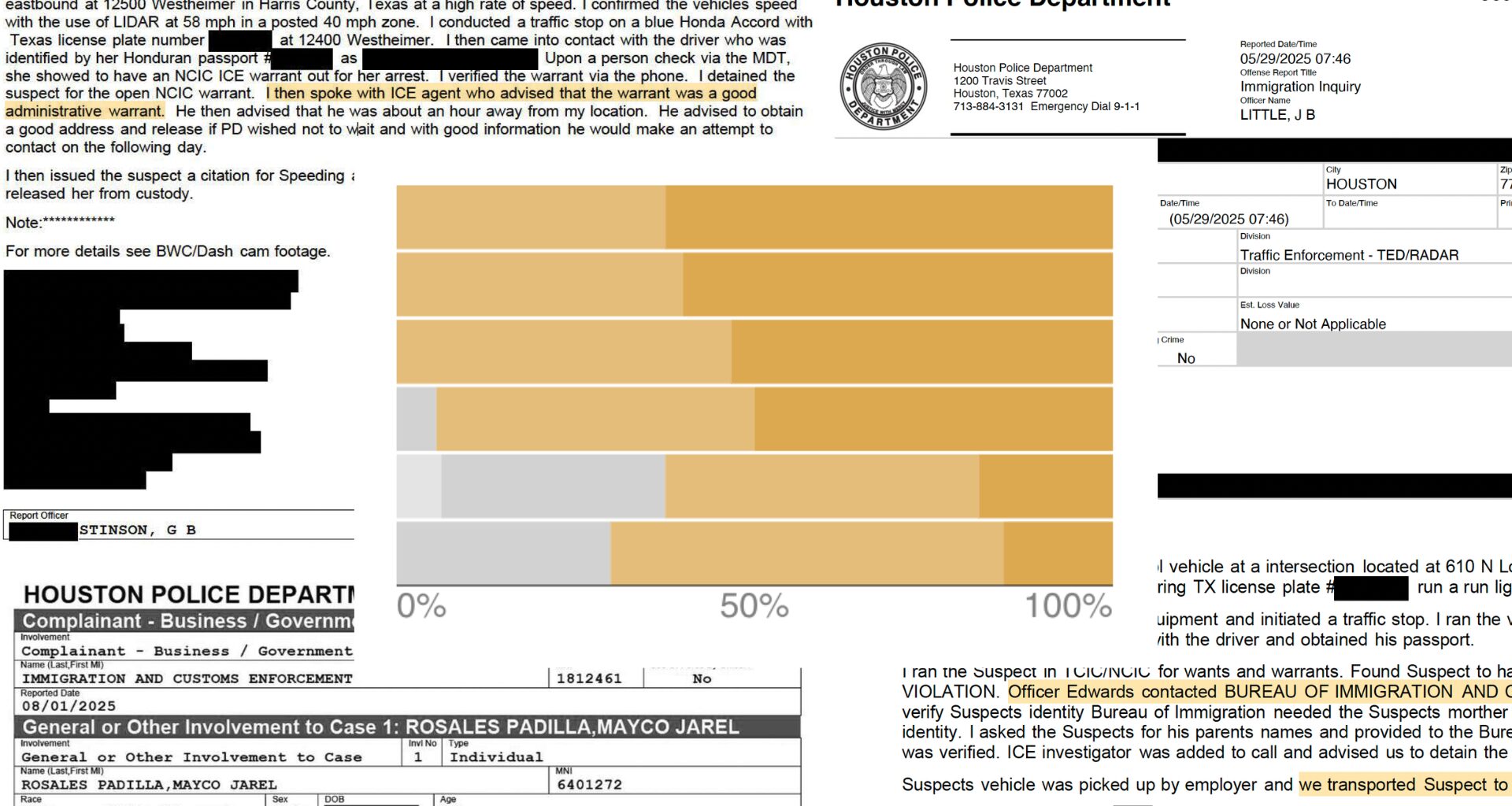
One traffic stop in May 2025, for instance, lasted five hours and seven minutes. The officer explained the delay in a summary of the incident report as “ICE hit on traffic stop.”
Officers continued spending far longer on traffic stops after calling ICE than on almost any other type of call, the city data show, even as Mayor John Whitmire and city council briefly limited how long officers should wait for ICE agents to pick up motorists with civil immigration warrants.
The findings offer one of the clearest pictures yet of how Houston police have worked with federal immigration authorities during the Trump administration, despite repeated efforts by city leaders to define, and at times limit, that relationship. That dynamic has come under renewed scrutiny following last week’s fatal ICE shooting of Lorenzo Salgado Araujo, fueling calls for the agency to leave the city and resurfacing questions about the role local police play in immigration enforcement.
Excerpt from a May 29, 2025, police report for a traffic stop in which officers contacted ICE that lasted over five hours. Houston Police Department
More than two-thirds of all traffic stops and other cases in which officers called ICE from the start of 2025 through late April tied Houston officers up for at least an hour, according to a Chronicle analysis, leading experts to question whether it was a good use of limited police resources in America’s fourth-largest city.
“I find it outrageous that when you could be patrolling or proactively responding to areas you know in the city that are high-crime areas, you’re instead waiting more than an hour for a civil violation,” said Jorge Colina, a retired Miami police chief who now runs a consulting business for law enforcement agencies. “If I were the chief, I would not allow that. I just wouldn’t.”
Last August, Mayco Rosales Padilla, 38, had just finished a night shift at a tire shop when Houston police officers pulled him over in northeast Houston for running a red light in his work truck, according to an interview with Padilla and a police report of the incident.
Officers saw that Padilla, an immigrant from Honduras, was living in the country illegally and called ICE. Then, in violation of HPD policy, the officers placed Padilla in their car and drove him to a police station five miles away.
Excerpts from the Aug. 1, 2025, police report for Mayco Rosales Padilla. Houston Police Department
Padilla waited in the backseat for about 45 minutes until an ICE agent arrived to arrest him. By the time he was taken into custody, nearly three hours had passed since officers first stopped his truck, call records show.
“I think it’s a bit unjust, but also it’s the law so I can’t reproach them too much,” Padilla said, upon learning that his transport to ICE violated HPD policy. “But still, I never committed a crime that should cause them to treat someone like that.”
Neither Whitmire’s office nor the Houston Police Department responded to a request for comment.
Padilla’s stop lasted nine times longer than average
Officers spent nearly three hours waiting for an ICE agent to pick up Padilla.
By comparison, the average traffic stop takes just 18 minutes.
Chart: Caroline Ghisolfi • Source: Houston Police Department
Stops involving ICE drag, despite policy changes
The time officers spend on calls is important because police resources are limited and many residents judge an agency’s effectiveness on how quickly officers show up when they call for help, Colina said.
“Let’s say you’re slammed with calls about break-ins and things like that,” he said. “I would not be thrilled if I discovered cops were spending a lot of time on marijuana arrests where they could’ve written a citation and gone to answer more important things.”
Houston police officers called ICE at least 290 times from the start of 2025 through the end of April, mostly after traffic stops. A fifth of the calls came after crashes, disturbances and assaults. Another fifth were spread across various less common case types.
Officers consistently spend more time on calls after involving ICE
Since 2025, most calls in which officers contacted ICE have lasted at least an hour. Comparable non-immigration calls rarely took that long.
Call types shown describe at least one call in which officers contacted ICE. Top call types describe at least 10 calls involving immigration agents.
Chart: Caroline Ghisolfi • Source: Houston Police Department
After initially claiming that Houston police officers were not working with immigration enforcement, Whitmire in March directed officers to wait no more than 30 minutes for ICE agents to reach the scene. Records show, however, that these stops lasted an average of more than two hours even after Whitmire’s announcement.
Then, Whitmire and city council in April approved an ordinance instructing officers not to hold drivers with civil immigration warrants longer than the initial purpose of the stop. The length of those stops dropped to an average of about an hour – still roughly three times longer than the typical stop.
The policy reversal has left Houston police operating as they did since shortly after Trump took office last year. Officers are instructed to call ICE anytime they come across someone with a civil immigration warrant and wait “a reasonable amount of time” for an agent to come to the scene.
Most of the time, that has happened when an officer has pulled someone over for a traffic violation, city records show. Even when ICE has declined to pick up the motorist, data show, the encounters stretch far longer than the average traffic stop.
One typical report, from January, describes an officer stopping a Honduran woman for driving 58 miles per hour in a 40 mph zone. The officer ran her name through a national crime database, found a civil ICE warrant in her name, and called an ICE agent.
Excerpt from a Jan. 5, 2025, police report for a traffic stop involving ICE of a Honduran woman. Houston Police Department
“(The agent) advised that he was about an hour away from my location. He advised to obtain a good address and release if PD wished not to wait and with good information he would make an attempt to contact on the following day,” the report reads.
Records show the stop lasted for just over 90 minutes – five times longer than the typical HPD traffic stop, the data show – and the woman was released with citations for speeding and driving without a license. It’s unclear if ICE ever followed up.
Violations prompt policy change, to little effect
Local police cannot arrest someone solely on the basis of an administrative ICE warrant, as they are civil documents. But in at least 17 cases Houston police arrested and transported people to ICE agents, leading Whitmire to acknowledge the officers violated policy in those cases and institute the 30-minute wait time.
Padilla, the Honduran man who was deported after being pulled over by HPD in August, was one of the 17 people officers transported to ICE agents.
He told the Chronicle that officers ran his information through their database and informed him that he had an outstanding deportation order from 2001, when his mother had first brought him to the United States as a teenager. He was told that he was going to be transferred to ICE.
“The worst was when I realized they were calling ICE. That was the moment when I really felt … there’s no turning back,” Padilla said. “The whole world comes crashing down. You feel like you lose out on all your opportunities”
He said he was deported a week later to Honduras, where he remains now.
Excerpt from the Aug. 1, 2025, police report for Mayco Rosales Padilla. Houston Police Department
Padilla’s wife — who is an American citizen — remains in Houston with his two children, one of whom he has not met because his wife was still pregnant when he was deported, he said.
Reports from that time indicate that officers were aware of the new limitation, but still ended up holding people for hours at a time.
On March 27, one officer stopped a driver for making an unsafe lane change and found that the man had an ICE administrative warrant in his name, records show. The officer contacted ICE and advised the agent he would only be able to hold the driver for 30 minutes, records show.
The ICE agent told the officer that no further action would be needed and the driver was released with a warning, according to the police report. Yet the stop lasted more than two hours, call logs show.
The police report does not indicate what kept the officer on the scene for so long.
Excerpt from a Mar. 27, 2026, police report for a traffic stop involving ICE. Houston Police DepartmentPolice resources poorly allocated, some say
The time it takes officers to respond to calls for service has long been a crucial metric inside the Houston Police Department, and experts say many residents base their impression of an agency’s effectiveness on how long it takes officers to arrive.
That focus has historically led police leaders to pressure officers to handle calls quickly, said Domingo Garcia, executive director of the Organization for Spanish-Speaking Officers and a retired HPD officer.
But traffic stops in which HPD calls ICE have continued to last far longer than other stops.
Amid criticism over the department’s handling of ICE calls, the city council this summer approved a new $1.2 billion HPD budget for the current fiscal year.
Given how long police are spending on civil immigration warrants, immigration rights attorney Jennefer Canales-Pelaez questioned whether residents are getting a good return on their investment.
“My main concern is the use and waste of resources,” she said. “Especially in the police department… which is one of the most well-funded departments in the city.”
The deadly Salgado shooting last week is further evidence that ICE cannot be trusted, said District C Council Member Joe Panzarella, and that Houston police should limit their cooperation with the agency accordingly.
“I firmly believe that ICE is a dangerous, unqualified and untrained organization,” Panzarella said. “HPD’s priority should be local public safety, and not wasting critical resources on an unqualified agency that frankly has shown zero regard for the lives of Houstonians and Americans.”
About the data in this story
The Chronicle analyzed clearance times for all traffic stops and other cases in which Houston police officers called ICE from Jan. 1, 2025 to April 28, 2026. Clearance time measures the minutes between an officer’s arrival at a call, or the start of a traffic stop or other self-initiated call, and the time the call was cleared.
The Chronicle compared data on clearance times with corresponding police reports of the incidents in which Houston police officers called ICE, obtained on a continuous basis over the course of more than a year.
Seven calls listed negative clearance times and were excluded from the analysis.
 A morning newsletter that keeps you connected to Houston in 5 minutes or less.
CreditsReporting by Matt deGrood, Caroline Ghisolfi and Sam González Kelly. Data analysis by Caroline Ghisolfi. Design and development by Caroline Ghisolfi. Editing by Mike Morris. Audience by Brady Stone and Rebecca Hennes.
Originally published on July 12, 2026