
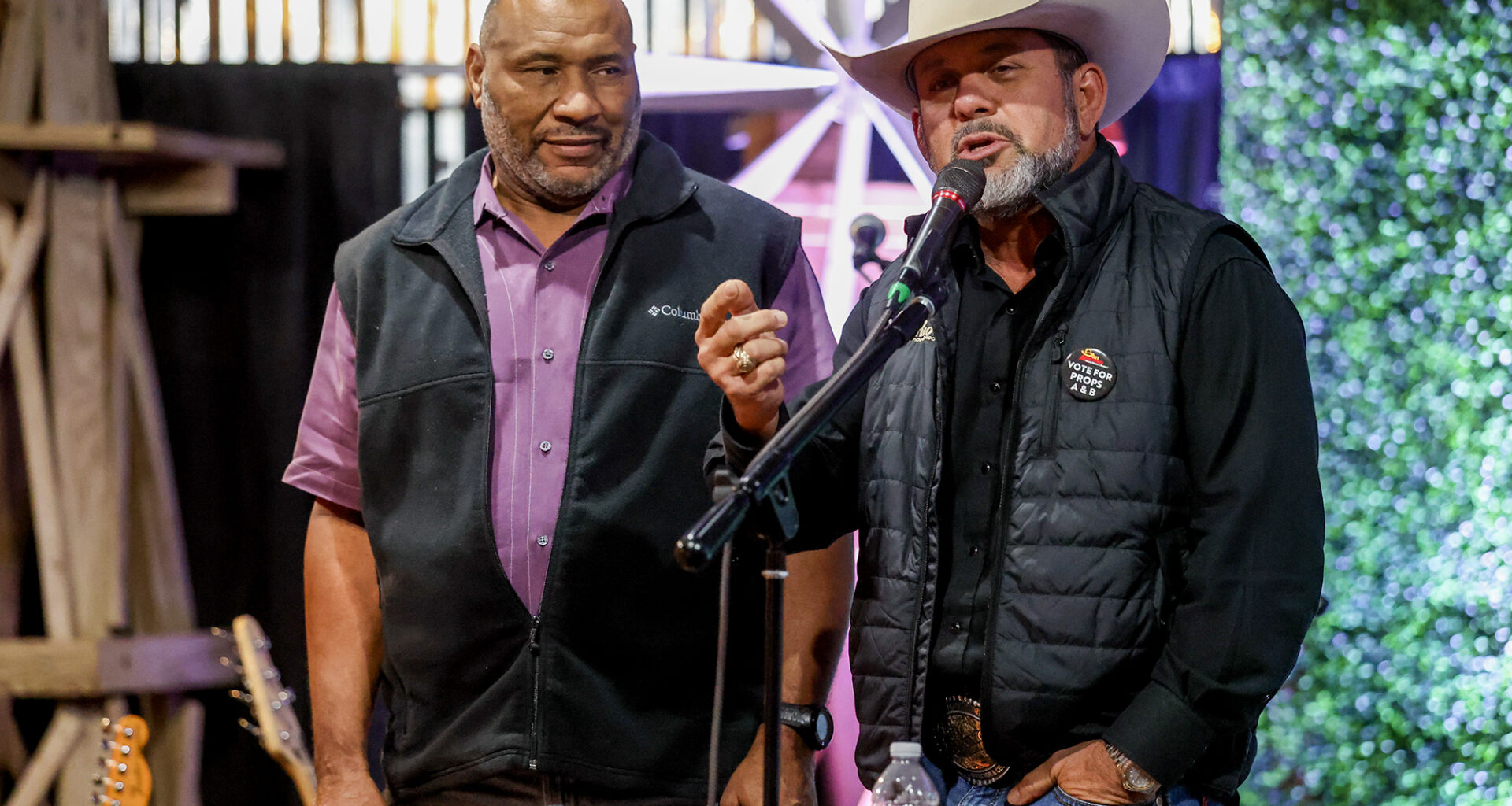
Cody Davenport, right, CEO of the San Antonio Stock Show & Rodeo, speaks on Nov. 4, 2025, to people gathered to watch election results for Proposition A, as Derrick Howard, Bexar County’s executive director of community arenas, stands next to him. Soon after, Davenport was shown a development proposal that had been in the works and that jeopardizes the success of the Stock Show & Rodeo expansion plan that Proposition A was created to finance.
Marvin Pfeiffer/San Antonio Express-News
A conceptual site plan contained in a development proposal from a group led by El Paso-based Hunt Development Group and Dallas-based Lincoln Property Co. shows a diminution of San Antonio Livestock Exposition Inc.’s mission and presence on the Bexar County-owned property around the Frost Bank Center and Freeman Coliseum.
Courtesy of Hunt Development Group
A conceptual site plan for the grounds surrounding the Frost Bank Center and Freeman Coliseum preserves surface parking space vital to the logistical operations that are integral to San Antonio Livestock Exposition Inc.’s mission.
The Coliseum Advisory Board and the San Antonio Livestock Exposition Inc.
Bexar County officials need to exit the side street they turned onto — the one alongside a mixed-use development proposal for county property around the Frost Bank Center — and get back on the main road that leads to expanding the livestock and rodeo facilities there — i.e., the plan sold to voters last year.

Proposition A, which county voters approved in November, authorized the use of hotel occupancy and vehicle rental taxes to improve the San Antonio Stock Show & Rodeo grounds, along with renovations to the Frost Bank Center and Freeman Coliseum.
Article continues below this ad
The idea conceived by San Antonio Livestock Exposition Inc., which produces the annual Stock Show & Rodeo, was that with the Spurs planning to leave the arena after 2032, the livestock-focused nonprofit could expand its programming from several weeks to year-round.
While the annual rodeo is a beloved tradition, Stock Show & Rodeo CEO Cody Davenport knows that much more livestock-related programming could be produced outside that short annual window, and he worked with his counterpart at the Coliseum Advisory Board on a plan to make it happen.
In doing so, his organization sought to flip the Spurs’ pending departure from a devastating loss to a serendipitous opportunity that could bring the kind of sustained economic activity to the East Side that hasn’t occurred with the NBA team.
Since learning about the plan nearly 14 months ago, we’ve been enthusiastic about its potential to succeed where others have failed, and we supported it and Proposition A in multiple editorials.
Article continues below this ad
That’s why it’s been alarming to learn that even as voters were being told about the potential linked to year-round livestock and Western-themed programming, county officials were working behind the scenes on a conflicting plan that jeopardizes the advertised one.
Unknown to Davenport and his team, the Coliseum Advisory Board issued a request for qualifications seeking a mixed-use developer for what it called the Bexar County Community Arenas Expansion Project.
The way the RFQ ignores the San Antonio Livestock Exposition’s mission and reduces its presence to a sidenote is breathtaking — with only a passing mention of the livestock show and rodeo in its eight priorities and nothing in its 16 project goals.
Given that, it’s unsurprising that the lone submission, from a group led by El Paso-based Hunt Development Group and Dallas-based Lincoln Property Co., demonstrates little understanding of what the San Antonio Livestock Exposition does and adulterates the plan that county commissioners bought into a year ago.
Article continues below this ad
The conceptual drawing for the overall site in the Hunt-Lincoln proposal includes a hotel and commercial buildings, such as retail and office space, where the San Antonio Livestock Exposition plan shows a new flex building and promenade.
Worse, the developer’s plan envisions eliminating the surface parking lots that lie along the site’s perimeter and which the livestock show and rodeo expansion plan preserves for a reason.
The Hunt-Lincoln site drawing shows commercial and residential structures replacing most of the surface parking, and in an uninformed effort to compensate for lost spaces, it includes a tiny “rodeo laydown” structure on the grounds’ northwest corner and three garages.
But merely matching the number of existing parking spaces ignores the logistical requirements. Such garages make the space inaccessible to the kind of trailers used to transport livestock and other essentials to the facilities where they’re needed.
Article continues below this ad
“In essence,” Davenport said, “we’re off those grounds inside of that plan.”
Per the proposal, rodeo and livestock operations would “be consolidated on the site’s west side” to make way for “year-round hotel, retail, entertainment, dining venues, parks, plazas, outdoor flexible event spaces and a connected network of well-lit, walkable streets, and hike-and-bike trails.”
Such development, the proposal states, would “amplify the two-week rodeo celebration, creating a thriving destination for residents and visitors alike.” Nowhere does it mention stock show events or other activities beyond the rodeo.
Article continues below this ad
In short, the Hunt-Lincoln plan is like any mixed-use development — commercial, residential, hospitality — with a minor rodeo component and no thought about the stock show.
It’s no wonder it was only after the November election that county officials sprung the Hunt-Lincoln proposal on Davenport. And they likely expected — or should have expected — that he would object to it.
As such, it’s befuddling that a member of the Coliseum Advisory Board suggested San Antonio Livestock Exposition’s consternation is merely a result of “miscommunication” and only items approved by voters would be built on the arena grounds.
Similarly, Derrick Howard, the county’s executive director of community arenas, said the county “would never do anything that would be a negative impact to the rodeo.”
Article continues below this ad
Kind of late to say that. Not only has the Hunt-Lincoln plan been allowed to hang around for months, but it also hasn’t officially been taken off the table. And it’s unclear why, although a cue could be taken from those who haven’t publicly rejected it: Bexar County Judge Peter Sakai and Precinct 4 County Commissioner Tommy Calvert.
It’s understandable that Calvert, whose East Side constituents have been promised much and received little in terms of positive economic development, might want to explore ways to build on the Stock Show & Rodeo expansion. But building on doesn’t mean bulldozing over.
Killing the goose leaves no gold for anyone.
Moreover, Davenport and his organization would welcome development that springboards from the approved plan, provided it’s on property adjacent to or near the county-owned site, which is subject to covenants that appear to bar such incompatible uses.
Article continues below this ad
We’re encouraged that at least three county commissioners — Rebeca Clay-Flores, Grant Moody and Justin Rodriguez — have indicated that when it comes to development on the county’s property, they would give deference to the proposal voters approved.
We’re hopeful that means the plan can move forward soon. But if so, it will hardly be a no harm, no foul matter. More than eight months have passed since voters approved Proposition A, during which Davenport has been blocked from executing the plan.
Meanwhile, in late June, the Houston Livestock Show and Rodeo announced a roughly $300 million plan to build a new arena and agricultural complex a few miles from Reliant Park. The goal is to support … wait for it … year-round programming.
“Exactly what we’ve been trying to preach and talk about,” Davenport said. “We’re sitting here postelection November, and I still have no grant and development contract even signed. Once we get that signed, we still have to do the licensing agreement. So there’s still a long ways to go.”
Article continues below this ad
And although Davenport is confident that if the San Antonio and Houston livestock organizations realize their respective visions, they can work together on mutually beneficial programming, it’s nonetheless frustrating.
“Why do we have to be behind Houston?” he said.