
Expletive, said the man in short pants and a golf shirt yanking on the locked downtown door a little past 1 Wednesday afternoon. He muttered something else as he began reading the note affixed to the glass, behind which the gate was locked. It began, “We are truly grateful for the welcome Ari’s Pantry received from the downtown Dallas community.” Which was a warm wind-up to the bad news that followed: “We have made the difficult decision to close our Downtown Dallas location effective today.”
Holy expletive, the man said, loudly, at which point Ari himself — Ari Lowenstein, the grocery store’s friendly Rhode Island-raised proprietor — opened the gate and stepped outside. He apologized; said, yeah, sorry, that’s just business, then extended his hand and asked the man his name. Maybe the guy didn’t hear him because of the AirPods. Or maybe he no longer cared. He turned and walked off.
At which point a man and a woman walked up, hoping to grab a drink and a sandwich. Lowenstein turned them away, too. “Aw, no,” said the man. “Sorry,” said Ari, who’d become used to such interactions in the few hours since he had taken to social media to announce he was abruptly closing the downtown location that has served as sandwich shop, coffee bar and gelato dispensary since May 2025.
This is what greeted Ari’s Pantry customers on July 15, when it closed without warning — well, to everyone but owner Ari Lowenstein.
Robert Wilonsky/Staff writer
Ari’s Pantry was also the central business district’s lone purveyor of fresh fruits and vegetables, pastas and pasties, prepared meals, beer and wine, recipe cards and kitchen tools and shelves filled with specialty items and staples. I was a regular, as I’d been when Royal Blue Grocery first opened in the space eight years ago; so, too, many of my colleagues. We’d been in just the day before to grab lunch, a drink and a few snacks, and there’d been no hint that it was last call.
Article continues below this ad
“This decision was made more recently than you might think,” Lowenstein said as family and staff began preparing to move product to his Oak Cliff and Cypress Waters locations. “We were looking at many ways to stay open. I was a passionate believer in downtown, and I still am. If I was a larger brand, I could look at this and say, ‘How much can we afford to lose over the next three years?’ But the dynamics here have changed.”
Here meaning downtown, where World Cup crowds in recent weeks brought a vibe and vibrancy missing from Main Street most days. Here meaning the interaction of Main and Ervay streets, surrounded by — and towered over — buildings empty or close to.
Across Ervay sits Neiman Marcus, which Saks Global will shutter at September’s end. Its future remains uncertain. Downtown real-estaters like to speculate about what’s next; high-end apartments seem to be the consensus. Developer John Sughrue, founder of Dallas Art Fair, would like to see it become an exhibition space and fashion museum. Saks declined to comment for this column.
Lowenstein, who once lived in Manhattan and Brooklyn, loved looking out his window and seeing Neiman’s, whose workers and visitors were among Ari’s customers. His first day in the grocery, he said, he looked out the window and thought, “You’re fighting above your weight class,” Lowenstein said.
Article continues below this ad
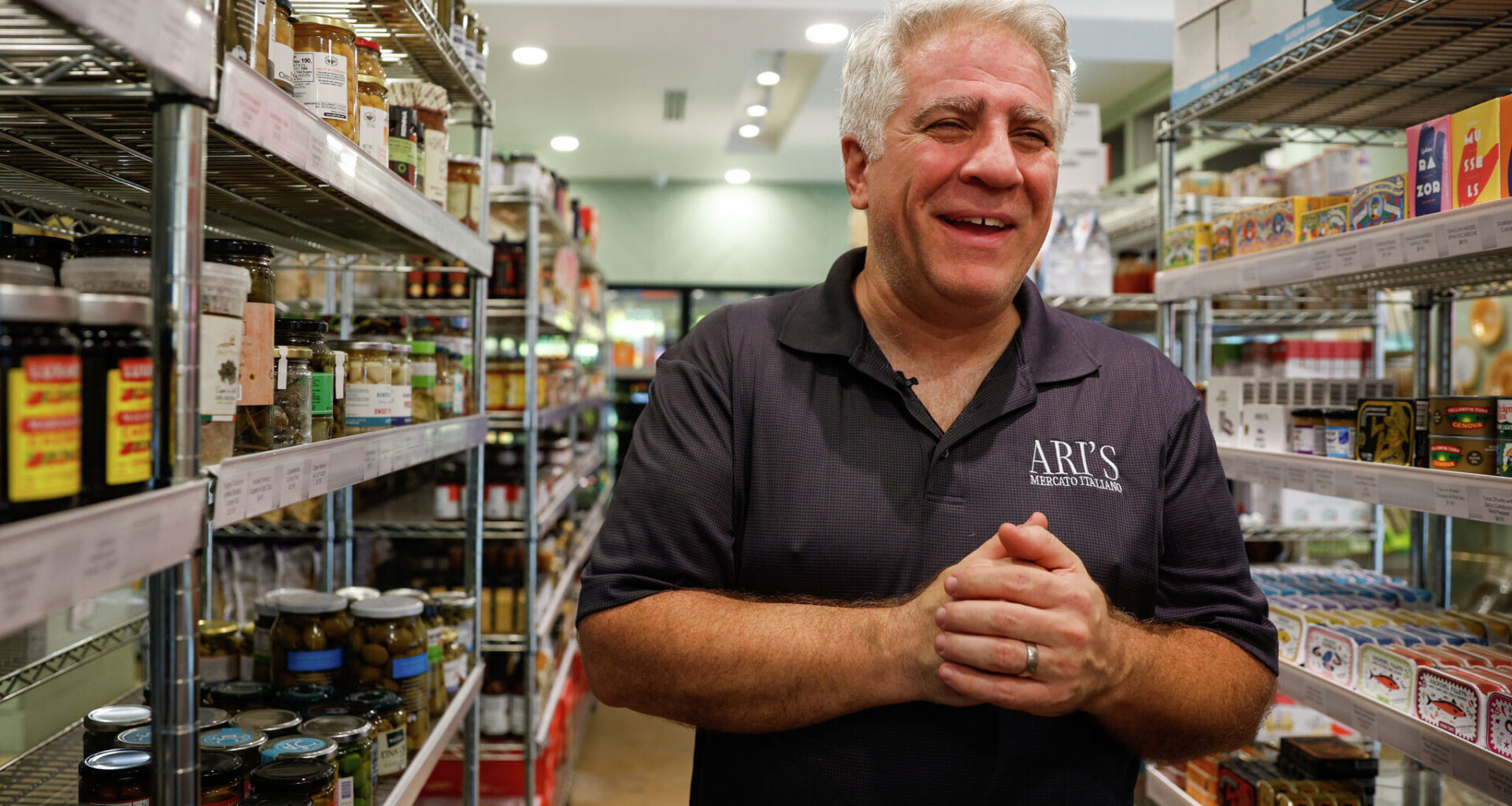
Ari’s Pantry owner Ari Lowenstein took a break from packing up his downtown Dallas grocery store to discuss the factors that led to its sudden closure.
Robert Wilonsky/Staff writer
On the other side of Ervay sits Comerica Bank Tower — until the name came off downtown’s second-tallest skyscraper in recent days, anyway. Its dwindling occupants, too, were regulars.
But above Ari’s sits the anchor that likely sunk it for good: the landmark Mercantile Bank Building, one of downtown’s first office building conversions, now gutted after an October pipe break flooded most of its 31 stories down to the parking garage and sent its tenants scattering. The Merc, too, has an uncertain future, no timeline for a rehab of the building its owners deemed “uninhabitable.”
Brookfield Partners didn’t respond to calls about the Merc’s status, but its 213 units, once filled with customers who ran downstairs for coffee in the morning and lunch in the afternoon and dinner ingredients at night, sit empty. And the weight of all that nothing crushed Ari’s for good.
“Those were great customers, professionals who would come in and get some ingredients or people coming over in a rush to grab some stuff,” Lowenstein said. “It might seem like, well, that’s one customer, but that’s one customer that was spending every single day every single week. That’s a building block, and it was part of why we came here.”
Article continues below this ad
Main and Ervay, where the Wilson Building also sits, used to be one of the busiest, most glamorous downtown destinations. Now, but blocks from the likewise departing AT&T, it’s in the middle of all the bad news battering downtown of late.
“There is no question Ari’s in the center of the storm,” said Downtown Dallas Inc.’s president and CEO, Jennifer Scripps, who often brought her kids to Ari’s for gelato. “There’s no storefront I am sadder to lose. We were blindsided by the news.” But, she would say later, “I am not going to say all is lost because we lost one store today.”
There have seemingly been for-lease signs in the Continental Building’s ground-floor windows since the Commerce Street building reopened as apartments in 2009.
Robert Wilonsky/Staff writer
I called her because of course I was going to call the woman tasked with looking on the bright side of the shadow hovering above the skyline. Where those of us who walk downtown every day see only the blank spaces, Scripps looks to the future and the promise and potential of the delayed convention center do-over and the $500-million makeover of the Dallas College El Centro campus, both years away from completion. I guess the visionary has to see beyond today’s demolition debris and gloomy headlines.
Scripps and I discussed what downtown needs — retailers would be a start, I said for the millionth and one time, somewhere visitors can go without ordering an Uber. I recounted a run-in I had last year with DDI’s economic development director, Doug Prude, who was showing a Whataburger rep around downtown. Prude asked what I thought downtown needed. “Everything,” I told him.
Article continues below this ad
“We have 16,000 residents and are working on a downtown plan, because there’s no question that number needs to grow by a quantum factor,” Scripps said. “And incentives from the city will drive what you’re talking about. … I don’t want you to think we’re putting all of our eggs into one basket, but the convention center is key, and the Dallas College campus could be bigger. But I think we need more bodies.”
In 2005, City Hall invested more than $600,000 in Urban Market on Jackson Street, which failed after seven years because there weren’t enough residents to sustain a grocery store. Last year, Assistant City Manager Robin Bentley, in charge of economic development, told me the city had “tried incentives with a few retailers, and, for one reason or another, they just haven’t stuck.”
Ari Lowenstein handed out recipe cards to customers so they could decide what to make — and learn how to make it.
Staff photo/Dallas Morning News
DDI’s latest annual report, released in April, says there are more than 200 bars and restaurants downtown. But the nonprofit’s website lists only 56 downtown retailers, which include gift shops in the Dallas Museum of Art, the Morton H. Meyerson Symphony Center and hotel lobbies. Twenty are in the Dallas Farmers Market, which is also included. On Main Street, there’s a cannabis dispensary and a CVS. DDI’s count also inclues seven 7-Elevens.
Article continues below this ad
It’s not hard to find a vacant downtown storefront. Just work downtown and walk outside. In any direction. Data from real estate firm CoStar confirms that. Researchers there said via email that in the central business district submarket, “retail vacancies are some of the highest in the Metroplex, pushing over 12%. Taking a look at how much of the CBD’s inventory is available for lease and it takes the top spot with an availability rate of 14.6%. Since the start of 2020, this rate has effectively doubled.”
And it will jump even higher once Neiman’s closes.
Scripps said it’s hard to pin down precisely how many vacant storefronts there are downtown — in part because some could be combined and many aren’t “tenant-ready,” like the ground level of the DalPark garage wrapped in vinyl. That Commerce Street, Neiman’s-facing space originally housed the American Savings Association; a few years back, DDI filled it with pop-ups at Christmas.
The Dallas Fish Market closed in the spring of 2020, though at the time, the downtown eatery said the closure would only be temporary. These colorful vinyls hide a lot of vacant spaces in downtown Dallas.
Robert Wilonsky/Staff writer
Scripps said DDI’s working with the city and landlords to get more spaces ready for tenants — and the city’s working “on a toolkit for new incentives.” Which comes too late for Lowenstein.
Article continues below this ad
“All of our tools are available for anyone who wants to talk about retail downtown,” Bentley told me last year. “But I think it’s more imperative that we focus on the building conversions and getting employers into those buildings, converting them into hotels and residential so that there are people to utilize that retail, and then it’ll fill itself.”
Lowenstein said he never heard from the city after the Merc’s flood forced Ari’s six-week closure (and $200,000 in estimated lost revenue); nor did he hear from the city after he reopened, when he had good enough reason to walk away no questions asked. But he said he spoke at a local real estate conference a few months back, where “I talked about what we were doing and what our concept was and so on, and when I got off the stage, there were six towns waiting with business cards.”
Any of them Dallas, I asked?
“No, but all the others are like, ‘We’re doing a thing, and we’re interested.’ … If you’re not going to put in a big grocery store, you put in a boutique grocery. And we have some great conversations going with them.”
Meanwhile, downtown’s left with another hole. And I’m left without one of my favorite go-to’s. And I am not alone.
Thursday morning, a new sign was taped to Ari’s front door. This one was green, with a note that looked like it had been written by a child. It read, “Don’t go! We’re going to miss you all very much. Thank you all for your kindness.” It was signed “Marcel, David and Adriana,” and punctuated with a heart.
“To take the time to write that …,” Lowenstein said. He signed. He paused. “I wish it were up to me.”