
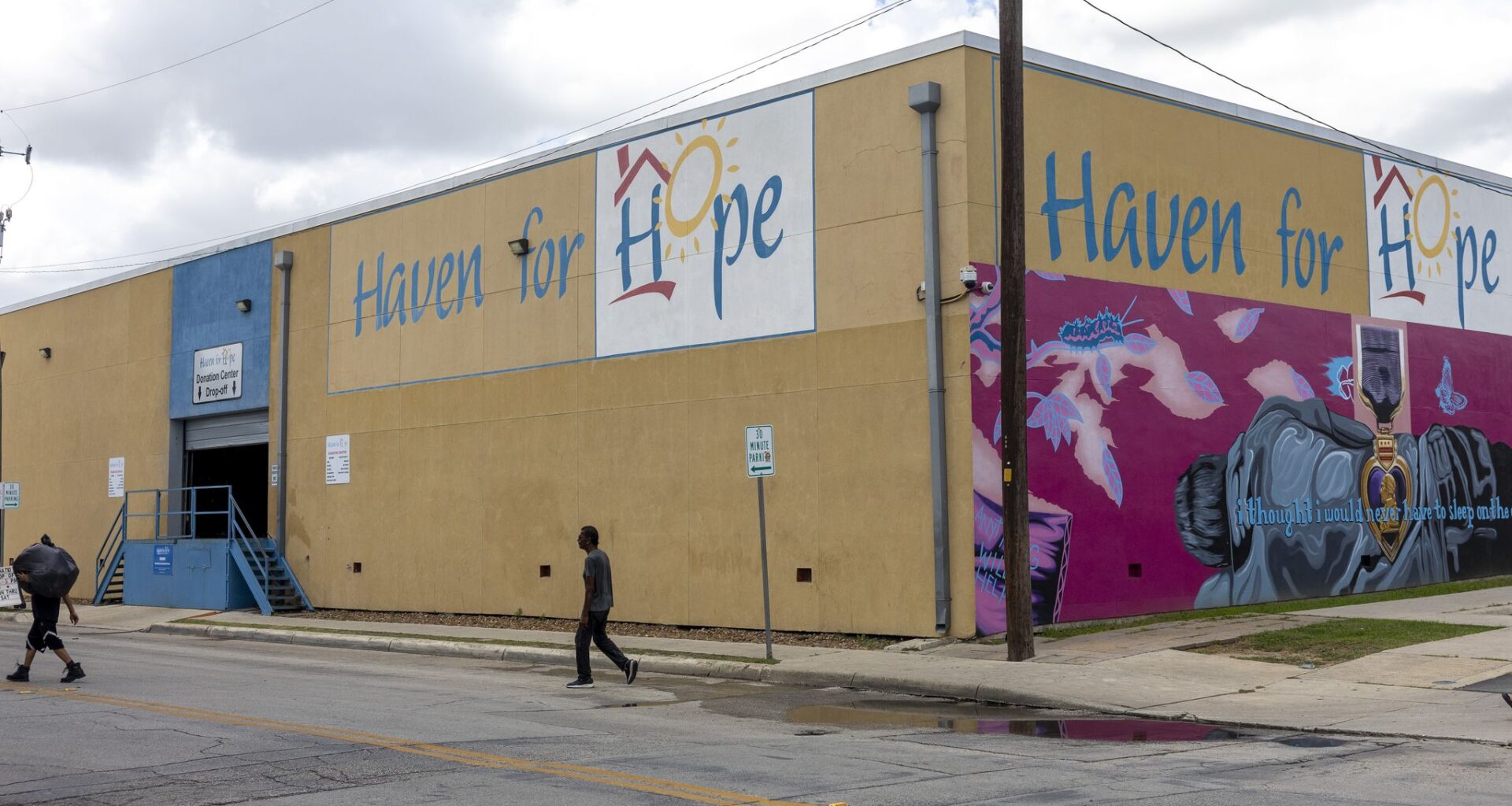
Julio Dunlap a resident at Haven for Hope walks his dog Ollie on Friday, June 12, 2026, in San Antonio. The 22-acre campus serves around 1,700 individuals and families experiencing homelessness as a centralized resource hub.
Andrew J. Whitaker/San Antonio Express-News
While John Whitmire campaigned to become Houston’s mayor, he often expressed admiration for San Antonio’s approach to homelessness.
“My model is the Haven for Hope in San Antonio,” he told a room filled with homelessness advocates in the lead-up to the 2023 election. He urged people to Google it. “I’ve been there twice.” He’d already looked for sites where Houston could build a similar shelter.
The resource center at Haven for Hope on Friday, June 12, 2026, in San Antonio. The 22-acre campus serves around 1,700 individuals and families experiencing homelessness as a centralized resource hub.
Andrew J. Whitaker/San Antonio Express-News
Maerilyn Riggs, a volunteer at the resource center at Haven for Hope, stocks shelves on Friday, June 12, 2026, in San Antonio. The 22-acre campus serves around 1,700 individuals and families experiencing homelessness as a centralized resource hub.
Andrew J. Whitaker/San Antonio Express-News
The resource center at Haven for Hope on Friday, June 12, 2026, in San Antonio. The 22-acre campus serves around 1,700 individuals and families experiencing homelessness as a centralized resource hub.
Andrew J. Whitaker/San Antonio Express-News
Haven for Hope on Friday, June 12, 2026, in San Antonio. The 22-acre campus serves around 1,700 individuals and families experiencing homelessness as a centralized resource hub.
Andrew J. Whitaker/San Antonio Express-News
A barbershop is seen at Haven for Hope on Friday, June 12, 2026, in San Antonio. The 22-acre campus serves around 1,700 individuals and families experiencing homelessness as a centralized resource hub.
Andrew J. Whitaker/San Antonio Express-News
A resident’s cat is seen at Haven for Hope on Friday, June 12, 2026, in San Antonio. The 22-acre campus offers space for 20 dogs and 10 cats.
Andrew J. Whitaker/San Antonio Express-News
Julio Dunlap a resident at Haven for Hope walks his dog Ollie on Friday, June 12, 2026, in San Antonio. The 22-acre campus serves around 1,700 individuals and families experiencing homelessness as a centralized resource hub.
Andrew J. Whitaker/San Antonio Express-News
Wendy Khalil a resident at Haven for Hope walks her dog Bear on Friday, June 12, 2026, in San Antonio. The 22-acre campus serves around 1,700 individuals and families experiencing homelessness as a centralized resource hub.
Andrew J. Whitaker/San Antonio Express-News
Wendy Khalil a resident at Haven for Hope walks her dog Bear on Friday, June 12, 2026, in San Antonio. The 22-acre campus serves around 1,700 individuals and families experiencing homelessness as a centralized resource hub.
Andrew J. Whitaker/San Antonio Express-News
Resident halls at Haven for Hope on Friday, June 12, 2026, in San Antonio. The 22-acre campus serves around 1,700 individuals and families experiencing homelessness as a centralized resource hub.
Andrew J. Whitaker/San Antonio Express-News
The Mary Rose Brown Chapel of Hope at Haven for Hope on Friday, June 12, 2026, in San Antonio. The 22-acre campus serves around 1,700 individuals and families experiencing homelessness as a centralized resource hub.
Andrew J. Whitaker/San Antonio Express-News
Haven for Hope’s South Campus on Friday, June 12, 2026, in San Antonio. The 22-acre campus serves around 1,700 individuals and families experiencing homelessness as a centralized resource hub.
Andrew J. Whitaker/San Antonio Express-News
Craig Sudduth, center, trains Shawn Perry in the kitchen at Haven for Hope on Friday, June 12, 2026, in San Antonio. The 22-acre campus serves around 1,700 individuals and families experiencing homelessness as a centralized resource hub.
Andrew J. Whitaker/San Antonio Express-News
“If we give you a meal that makes you forget, is our ultimate goal.” Chef Lorris Gibson said in the campus Faith Kitchen at Haven for Hope on Friday, June 12, 2026, in San Antonio. The 22-acre campus serves around 1,700 individuals and families experiencing homelessness as a centralized resource hub.
Andrew J. Whitaker/San Antonio Express-News
Alberto Rodriguez, VP of Operations, at Haven for Hope on Friday, June 12, 2026, in San Antonio. The 22-acre campus serves around 1,700 individuals and families experiencing homelessness as a centralized resource hub.
Andrew J. Whitaker/San Antonio Express-News
A playground at Haven for Hope on Friday, June 12, 2026, in San Antonio. The 22-acre campus serves around 1,700 individuals and families experiencing homelessness as a centralized resource hub.
Andrew J. Whitaker/San Antonio Express-News
Haven for Hope on Friday, June 12, 2026, in San Antonio. The 22-acre campus serves around 1,700 individuals and families experiencing homelessness as a centralized resource hub.
Andrew J. Whitaker/San Antonio Express-News
Lana Hernandez, Program Director at Street 2 Feet, talks with Terri Behling at the Transformational Center at Haven for Hope on Friday, June 12, 2026, in San Antonio. The 22-acre campus serves around 1,700 individuals and families experiencing homelessness as a centralized resource hub.
Andrew J. Whitaker/San Antonio Express-News
A full map at Haven for Hope on Friday, June 12, 2026, in San Antonio. The 22-acre campus serves around 1,700 individuals and families experiencing homelessness as a centralized resource hub.
Andrew J. Whitaker/San Antonio Express-News
Three years later, Houston opened its new shelter at 419 Emancipation. It’s inspired by San Antonio’s megashelter, though it’s far from a replica.
Article continues below this ad
Whitmire isn’t alone. Officials from around the country have traveled to San Antonio to study Haven for Hope, hoping to borrow pieces of a model that is gaining sway nationally.
HOUSTON SHELTER: Houston’s embattled new homeless shelter opens quietly, one drop off at a time
“We’re trying to figure out how to build a smaller version of San Antonio here in Wichita,” said a Kansas county commissioner after a visit; in 2024, they transformed the site of a former elementary school into a shelter with more than 100 beds.
Las Vegas took a shortcut and hired Haven for Hope’s chief executive to build a shelter there. That 26-acre facility is projected to open in 2028.
Article continues below this ad
“Haven for Hope in San Antonio works,” said Gov. Greg Abbott in a post on X, formerly known as Twitter. President Donald Trump tapped the shelter’s founding president to head the U.S. Interagency Council on Homelessness in 2019 and then to serve as his senior advisor on the issue.
Since the shelter’s opening in 2010, San Antonio hasn’t seen the drop in homelessness, as measured by a count of people living in shelters, tents and other places not meant for habitation, that Houston’s strategy of moving people into homes has created. But it has seen drops in unsheltered homelessness — the number of people visible on the streets and in parks.
And therein lies a significant part of its appeal. After becoming mayor, Whitmire announced his goal to end street homelessness specifically.
“Housing first works,” said Alberto Rodriguez, vice president of operations at Haven for Hope, when asked why people from around the country are flying to San Antonio to visit their shelter. “But most communities aren’t seeing enough housing stock available to be able to get everyone into housing if they say yes today, right? There is that wait. So what happens in that in-between?”
When most of the country, under the George W. Bush administration’s direction in the early 2000s, began focusing on housing as the solution to homelessness, San Antonio moved in the opposite direction, opening a $101-million shelter and pouring roughly $29 million annually into its operation. It served nearly 7,000 clients in the 2025 fiscal year.
Article continues below this ad
That alternate path, Rodriguez explained, was what people were coming to see.
Haven for Hope on Friday, June 12, 2026, in San Antonio. The 22-acre campus serves around 1,700 individuals and families experiencing homelessness as a centralized resource hub.
Andrew J. Whitaker/San Antonio Express-News
A 22-acre campus near the city’s center
As Terri Behling, director of communications and government relations for Haven for Hope, gives public officials campus tours, she’ll hear them start brainstorming.
What about that 10 acres outside the city limits? The vacant land they didn’t know what to do with? Could they build their own version of the San Antonio shelter?
Article continues below this ad
She’ll then gently ask questions that underscore just how special San Antonio’s setup is: How will people who have lost their homes travel to the shelter? And once there, how would they get to jobs and reintegrate into society?
Haven for Hope occupies a whopping 22 acres just outside of downtown — the same footprint as the prized Pearl District, which has been called “the crown jewel of downtown San Antonio revitalization,” or the new Texans training facility, which includes four NFL-sized fields (three outdoors and one indoors).
SEARCH OUR MAP: As downtown homelessness declines, these Houston suburbs are seeing the biggest gains
The shelter is so big that it needs multiple parking lots, like a college campus. About 1,350 people sleep there on any given night. If you park at the Volunteer Center lot, you’ll walk past the Sarah E. Davidson Clinic, which serves both the general public and shelter residents, and the mailroom on the way to the North Campus entrance.
To enter, first you must pass through security, which is like that at City Hall or a small airport — except at this security line, there’s a breathalyzer (the campus is sober), you have to tap a badge (criminal histories are pre-screened, and sex offenders and violent convictions are not allowed) and you are not allowed to bring in food (all meals on campus are provided, and staff concluded that bringing food into rooms could attract pests).
Article continues below this ad
Upon exiting the security building, you enter an open-air campus so large that it is dotted with posts bearing signs pointing toward various destinations. The kennel, where you might board your cat or dog, is to the north; transformational services, where you might talk to staff or one of 75 other service providers on campus about finding work or therapy or classes, to the west; the chapel just beyond it; the dining hall further south of that. There are lawns and trees and outdoor seating.
The Butterfly Garden at Haven for Hope on Friday, June 12, 2026, in San Antonio. The 22-acre campus serves around 1,700 individuals and families experiencing homelessness as a centralized resource hub.
Andrew J. Whitaker/San Antonio Express-News
Music plays in the public spaces (Disney’s “Let it go” played on a recent Saturday morning, but it rotates between genres); now and then, it is paused to play the sound of a doorbell, a tradition announcing that a client has just received housing. There are two playgrounds, an entire YMCA, a garden alive with the sound of a fountain and butterflies flittering between native plants. There’s a Child Learning Center, where kids — who are otherwise required to be with a parent at all times — can participate in a bevy of programs hosted by local groups: a basketball clinic by United We Hoop, theater classes from the Magic Theatre, interactive STEM activities by the Doseum. During the school year, almost 20 yellow buses pull into campus every year to shuttle students throughout the city so they can continue attending the schools they attended before losing housing. In the summer, they shuttle the kids to summer camps. Dorm-like rooms come furnished with twin-sized beds, lockers and desks.
A citywide task force to build the shelter was spearheaded in the ’00s by Bill Greehey, the founding chief executive and chairman of the petroleum refinery giant Valero. Greehey also led a fundraising effort, and $61 million in private money joined the $40 million in public funds to acquire land and construct the campus on a stretch west of Downtown, where an ice cream warehouse once stood next to a shuttered dog food mill and a Bexar County Jail. Greehey insisted that all client housing should be newly built from the ground up, but some of the warehouses were retrofitted for staff buildings. For example, the break room for intake used to be an ice cream freezer, Rodriguez said, and the transformation center was also once a warehouse. There, a skylight installed along a strip of ceiling sheds light on the main room filled with cubicles officing various nonprofits.
“We’re so grateful to be housed here,” said Lana Hernandez, chief executive of a three-person nonprofit, Street2Feet, focused on wellness (among other things, it helps people train for 5ks). Before setting up shop at Haven for Hope, the nonprofit had been operating out of a van.
Another warehouse facing the visitor’s center has been turned into a Goodwill-like “shop” where clients can browse racks of clothes, shoes and other donations for items they need. On a recent Friday, a woman walked up to the door with two girls and a baby in tow. They were about to pick out a new blanket, she told the little ones.
Maerilyn Riggs, a volunteer at the resource center at Haven for Hope, stocks shelves on Friday, June 12, 2026, in San Antonio. The 22-acre campus serves around 1,700 individuals and families experiencing homelessness as a centralized resource hub.
Andrew J. Whitaker/San Antonio Express-News
Inside, Maerilyn Riggs greeted clients, her blonde hair pulled back and her face serene. Much of Haven for Hope is run by clients, since one of their goals is often finding work, and doing jobs at the shelter for a stipend is often seen as an interim step. Riggs had just unpacked shoes that had been gifted new in the box. “The donors are amazing,” she marveled.
“Houston has Star of Hope,” she said upon encountering a reporter from the Houston Chronicle. While Houston did not direct much government funding to shelters before this year, Star of Hope is a sober, privately funded Christian shelter that serves about 950 people a night. “Texas is lucky to have these places.”
News spreads about worthwhile places to go, which is why San Antonio has instituted a residency requirement for its North Campus — people must have lived in Bexar County for at least 12 of the previous 24 months to become clients.
Riggs was near the end of her Haven for Hope journey, renting a room for “a couple hundred a month, which is dirt cheap,” she said. The low rent was allowing her to save for a car. Her room is part of the Pay It Forward program, which provides on-campus housing and support for up to a year for people graduating from the Integrated Treatment Program.
For those of you who have been wondering what options are available for those who don’t qualify for North Campus, the Integrated Treatment Program offers part of the answer.
Directional signs at Haven for Hope on Friday, June 12, 2026, in San Antonio. The 22-acre campus serves around 1,700 individuals and families experiencing homelessness as a centralized resource hub.
Andrew J. Whitaker/San Antonio Express-News
A residential recovery program and a low-barrier shelter
Outside North Campus, on the other side of Haven for Hope Way from the visitor’s lot, stands a nondescript beige building with the words “Restoration Center” written in letters smaller than the address. There, the Integrated Treatment Program is run by the county’s Center for Health Care Services, which specializes in working with people on their mental health and substance abuse.
People who can’t start on North Campus because of addiction or unstable mental health instead enter through the Integrated Treatment Program, a residential program referred to by clients as ITP.
HOMELESS COUNT: Houston’s homelessness strategy faces a test. So far, the numbers are holding.
Lorris Gibson, Jr. came to ITP after losing his job as a technician at Sony. He’d reached a point where he’d wake up and begin drinking until he passed out.
Haven for Hope gave him a place to recover without judgment, he said (he’s now been sober for 14 years). It also planted the seeds of giving back to the community.
Mykayla Montalvo talks with a resident at the Faith Kitchen at Haven for Hope on Friday, June 12, 2026, in San Antonio. The 22-acre campus serves around 1,700 individuals and families experiencing homelessness as a centralized resource hub.
Andrew J. Whitaker/San Antonio Express-News
Gibson now serves as executive chef for Faith Kitchen, which provides three meals a day for a portion of Haven for Hope residents. There, he says, his focus goes beyond making a great meal. He’s also working to help others become better versions of themselves.
“Ninety percent of my staff came through Haven for Hope.”
The people Gibson serves make up the third portion of Haven for Hope’s campus: those who, perhaps, don’t need a residential recovery program, but don’t qualify for North Campus (either because they aren’t invested in a sober, goals-based environment or because their criminal history precludes them). Perhaps a judge told them to go, or they had nowhere else to go upon leaving a group home or jail or having their encampment shut down.
This low-barrier environment, where those who can’t get a spot at shelters like Star of Hope can safely stay and get connected with on-site resources, is the niche Houston’s new 2-acre 419 Emancipation fills. Previously, there had been a dearth of such shelter in the city.
In the back hallway staff uses to travel from North Campus to South Campus, Behling paused.
“It’s going to feel a little different,” she said. “It’s going to look a little different.”
Haven for Hope’s South Campus on Friday, June 12, 2026, in San Antonio. The 22-acre campus serves around 1,700 individuals and families experiencing homelessness as a centralized resource hub.
Andrew J. Whitaker/San Antonio Express-News
A few things about South Campus:
“We don’t really call it the courtyard anymore,” said Rodriguez, though plenty of clients still do, and it’s easy to see why. The heart of the campus is a courtyard where, on a recent Friday, people hung out, catching the breeze from several fans in metal cages. When it gets hot enough, misters turn on. Clients are also always welcome to go into the dining hall for some AC.
“We have, since 2018, moved everyone indoors, so there’s no longer any overnight outdoor sleeping,” said Behling. Outside the dining hall, there’s a fenced-off space stacked high with blue plastic mats. At night, they’re dragged into Faith Kitchen and the food bank to sleep on. (There’s a separate space where women sleep on bunks.)
And, while “we could fit, if we needed to, 450 men” in the two indoor areas, and in the past they had, “that is literally folks sleeping elbow to elbow, feet to feet, head to head,” Rodriguez said. Now, they try to keep the number of male clients around 250 to 300 so that everyone has some breathing room, even if it means turning some people away. A spot will usually open up for them the next day, he said.
For men ready to pursue their goals, there are bunks on South Campus — the first step toward transitioning to North Campus.
A new beginning
“There’s levels,” Leander Sharpe said, in a deft summary of Haven for Hope’s system.
Inside the nonprofit’s board room on a Saturday in June, Sharpe and other recent clients donned blue satin graduation stoles and caps. They’d made it to Haven for Hope’s highest level: stability.
They were readying for Haven for Hope’s annual commencement ceremony, open to anyone who’d regained housing in the prior year.
Sharpe started at Haven for Hope’s lowest-barrier-to-entry level, the South Campus, after an arrest on a charge that was later dismissed. His marriage was falling apart. When the judge asked him where he was going to go, he recalled, “I was like, ‘I don’t know. I’m going to sit in the street.’” The judge ordered him to go to the shelter.
HOUSTON PERMANENT HOUSING: She helped change how Houston solves homelessness. Now she’s stepping aside.
He stayed in the courtyard for over three months until friends moved to North Campus and told him it was cool, and he should come.
He got sober and set goals of getting his driver’s license and social security card; family drama meant he couldn’t retrieve his from the house. His case manager helped him navigate divorce proceedings.
Then he set his sights on work. First, he volunteered in the kitchen, then started working in concessions with a nonprofit at the Alamodome.
Now he’s a forklift operator, which is what he had done before he lost his home. He makes enough to fly to Virginia to see his brother and drive to North Carolina to see his mother.
“It’s the life I’m used to,” he said. “But it feels so good to get it back.”
That day, he readied for commencement with a big smile.
Several people, picking up their graduation caps alongside their children, said their paths to Haven for Hope had been set in motion by an eviction.
Icsheccka Moses had lost her job as a truck driver when it appeared a rotator cuff surgery would leave her unable to drive. She was at home, sitting in a virtual training session for her new job, when she learned she, her three children and her granddaughter were being evicted.
She went to San Antonio’s housing authority looking for help, and they told her to go to Haven for Hope. When her family got their room and could close the door, she felt a wave of relief. They didn’t have to spend a night outside. And North Campus’s restrictions created a safe environment. Within three months, her family had graduated from the program and returned to their usual lives.
And then there were people with less straightforward paths through Haven for Hope. Steve, who asked not to use his last name because of the stigma of mental illness, first came to Haven for Hope from a group home. He started in South Campus. But he said he was overmedicated on antipsychotic drugs and couldn’t summon the energy needed to wake up for the meetings he needed to take to progress to North Campus. He decided to stop his medication, which gave him energy, but also allowed his schizophrenia to return. He left Haven for Hope.
It wasn’t until after a stint in jail, on the streets and in the hospital that he found the right door into Haven for Hope: ITP, then Pay It Forward.
Now he gets his medication as a shot, which has ended the “cycle of devastation” that would occur when he became tempted to stop his medication for the burst of energy that would result. He recently went to New Jersey to visit his brother and mother.
It’s a normal life, he said, one he could regain because “I went along the continuum of care.”
A return to normal life (94% of Haven for Hope graduates don’t touch San Antonio’s homeless system again in the following year) is one of Haven for Hope’s measures of success, staff said. They also track how many clients secure jobs (384 in the 2025 fiscal year) and take pride in measures that are harder to count, such as people like Steve, who are able to regain control of their mental health.
In celebration of the new beginnings the clients had achieved, they processed through the campus, to the cheers and calls of congratulations from current residents and staff.
They entered the dining hall, which had a stage at the far end, to the tune of Pomp and Circumstance. “Happy graduation!” read a banner. There were pillars of red, yellow and blue balloons.
They stood for the National Anthem, then sat down to be greeted by Haven for Hope’s chief executive, Rhonda Mundhenk.
“When the world is too much,” she said, “you need a door to close between it and you, so you can rest, recuperate, and recover before going out and facing it all again.”
“You are our voyagers, you are star-following navigators who found their way. Now I have a question: Was it easy?”
“No!” responded the graduates.
“Those who wait upon the Lord will renew their strength. They will mount up with wings like eagles,” she said, quoting a verse from the Bible. “So fly, graduates, fly. We are so proud.”