
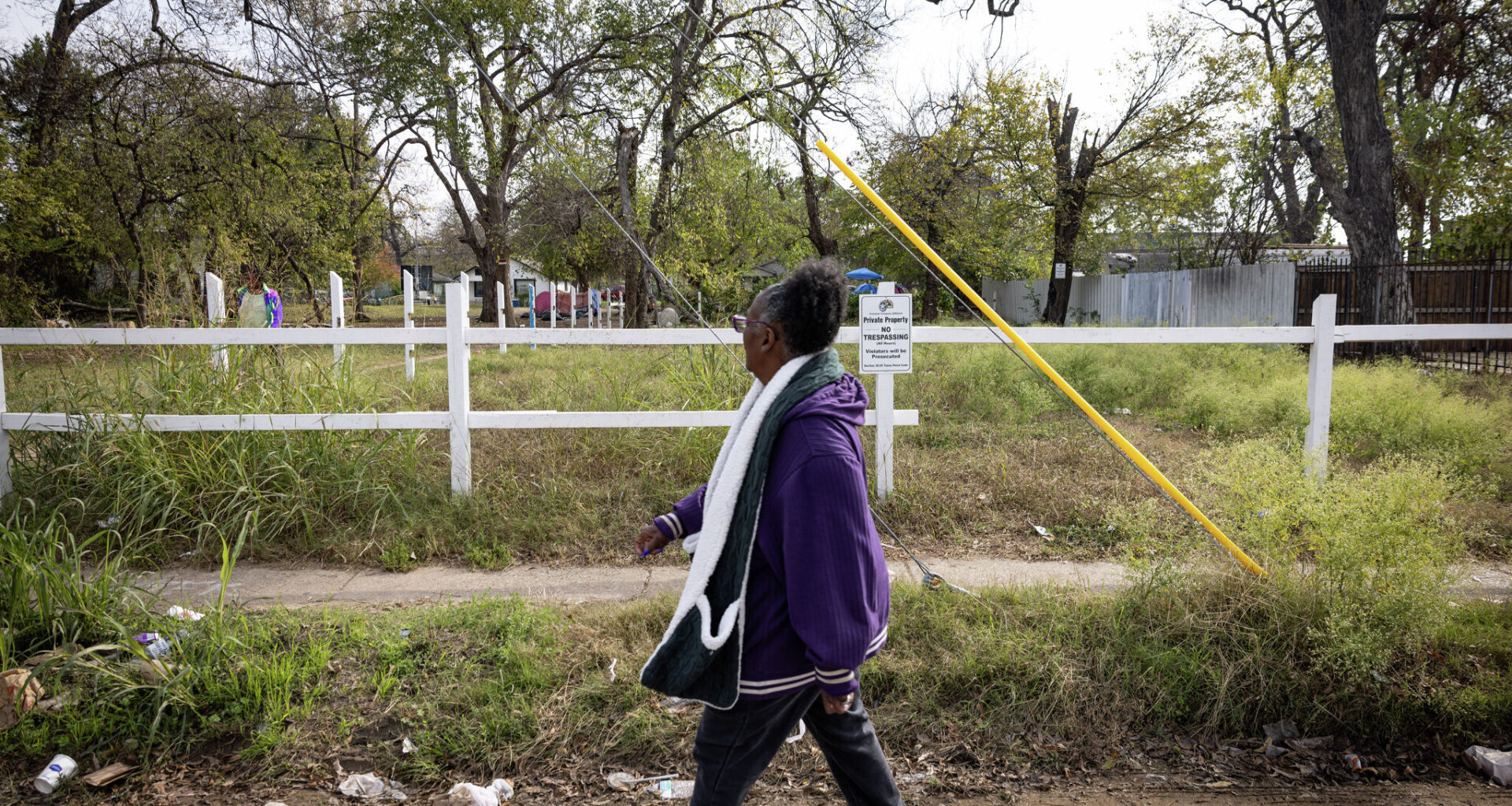
Making It Count, Inc. nonprofit owner Rhonda Willingham walks past an overgrown city owned vacant lot on Metropolitan Avenue in the Mill City neighborhood on Dec. 5, 2025, in Dallas.
Angela Piazza/Staff Photographer
In Dallas, the legacy of redlining lives on as Interstate 30 continues to divide the city’s more affluent north from the historically underserved south.

Residents of southern Dallas’ predominantly Black and Hispanic neighborhoods were once denied mortgages and the opportunity to create generational wealth through homeownership. They are now more likely to live with poor infrastructure, lower property values and unkempt vacant land.
Long overdue repairs to aging streets, water lines and sewer systems in the rehabilitation of these neighborhoods have led to higher costs, widening the gulf between the haves and have-nots of Dallas.
Article continues below this ad
A 2024 report by Verdunity, a consulting firm that assesses the fiscal health of communities, found real estate, businesses, neighborhoods and infrastructure — all do significantly better to the north, with sustained public and private investment.
South of I-30 however, neighborhoods — abound with vacant lots and infrastructure issues — struggle to spark an urban renewal. These areas have craved development seemingly forever, said Kevin Shepherd, founder and CEO of Verdunity. “Instead, you just have this stagnation. It’s just kind of been sitting there.”
“Banks won’t lend in many parts of southern Dallas,” said Monte Anderson, president of Options Real Estate, a firm in Dallas. “It’s deteriorated so bad you can’t get a return.”
“We actually set policy and plans in place that are causing our demise.”
A man uses a well-worn footpath to cut through a privately owned vacant lot on Metropolitan Avenue in the Mill City neighborhood on Nov. 15, 2025, in Dallas.
Angela Piazza/Staff Photographer
This pattern is not unique to Dallas. Though redlining was outlawed more than half a century ago, its consequences reverberate across U.S. cities today. In a 2022 study of vacant lots, Maria Pappas, the treasurer of Cook County, Illinois, found it to be the throughline driving the current trend of urban decay across Chicago, Detroit and Philadelphia.
Article continues below this ad
Decades ago, Dallas developers anticipated infrastructure costs and took more risks, Shepherd said. Today however, as repairs and upgrades entail so much more work and money, they demand fully-served plots and city incentives to boot. “And then, with the values in southern Dallas,” he added, “they aren’t getting the same return on investment.”
So they choose to work on undeveloped land in formerly rural areas instead. These provide a large blank canvas for development with infrastructure costs folded into the final home sale price, Shepherd said. “This way everybody is financing the work all at once over the course of their mortgage.”
Vacant lots in southern Dallas on the other hand, are a particular predicament. Small in size and scattered around existing neighborhoods, they challenge conventional urban design plans and opportunities to recoup costs from individual home sales.
“This has led to infrastructure deserts in southern Dallas,” Shepherd said.
And the people living there are stuck. “They’re paying taxes on their property,” he said. “But they’re not getting the same level of service and infrastructure that other parts of Dallas receive, and it’s not necessarily their fault.”
Article continues below this ad
This reporting is part of the Future of North Texas, a community-funded journalism initiative supported by the Commit Partnership, Communities Foundation of Texas, The Dallas Foundation, the Dallas Mavericks, the Dallas Regional Chamber, Deedie Rose, Lisa and Charles Siegel, the McCune-Losinger Family Fund, The Meadows Foundation, the Perot Foundation, the United Way of Metropolitan Dallas and the University of Texas at Dallas. The News retains full editorial control of this coverage.