
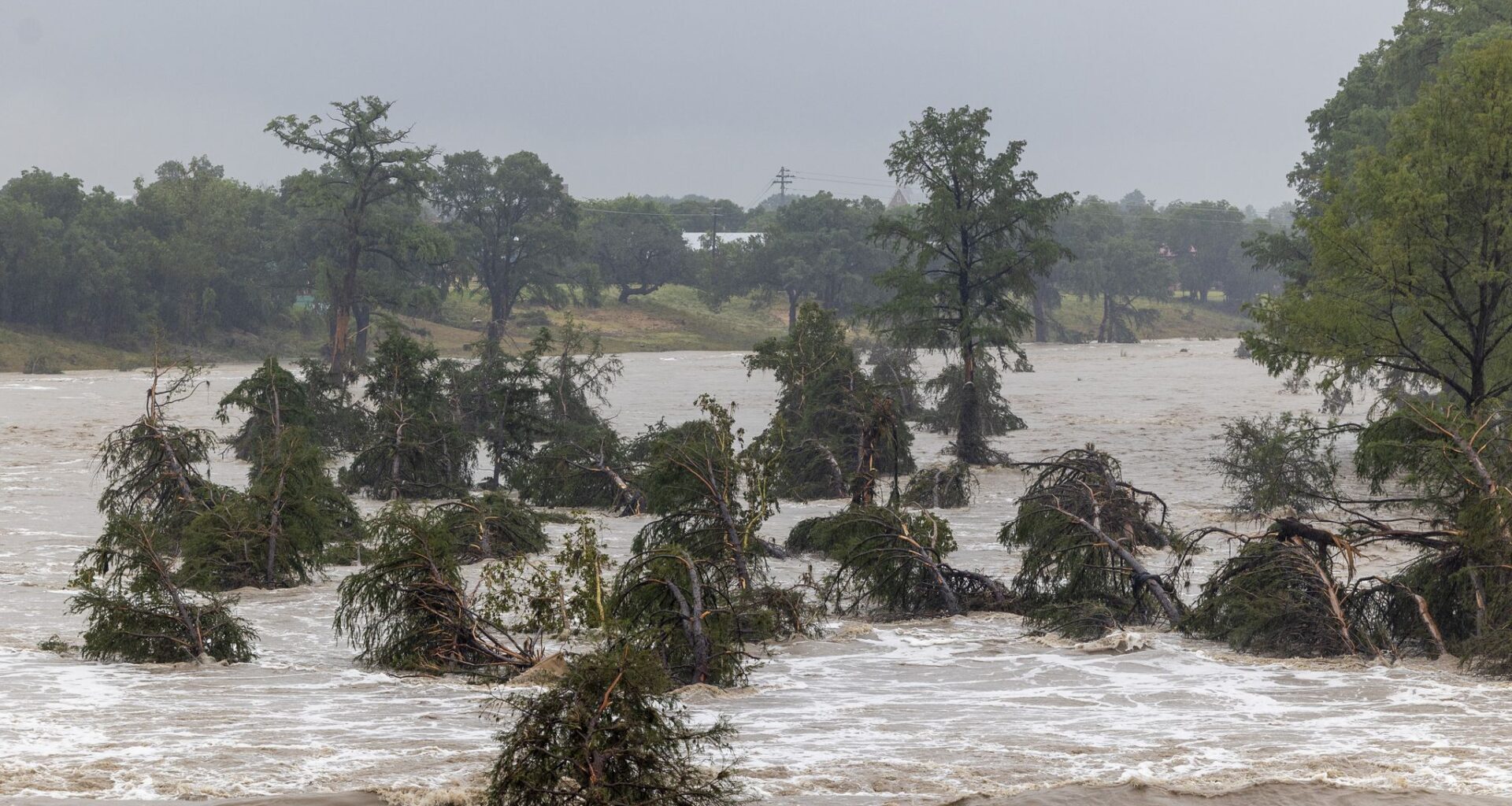
Rapids flood the Guadalupe River on Thursday in Kerrville. A massive flood wave on the river sent billions of gallons of water into Canyon Lake.
Andrew J. Whitaker/San Antonio Express-News
Canyon Lake water levels were surging Friday, reaching heights not seen in nearly four years as a massive flood wave moved down the Guadalupe River.

The flooding occurred after staggering rainfall totals fell across the Guadalupe River watershed late Wednesday and into Thursday morning. The heaviest rainfall centered on the river’s headwaters in Kerr County, where up to 20 inches of rain was recorded, from the west side of Kerrville into Ingram and Hunt.
Article continues below this ad
That extraordinary rainfall — equivalent to more than 50% of the area’s average annual rainfall — generated a massive flood wave early Thursday that traveled downstream across the Guadalupe River over the next 24 hours.
Shown are the radar-estimated rainfall totals this week. For the Guadalupe River basin, most of the rain fell late Wednesday and into early Thursday.
NWS Austin/San Antonio
The Guadalupe rose to major flood stage in Comfort, cresting at 37.08 feet, which was more than a foot higher than during the catastrophic July 4, 2025 flood. Farther downstream in Bergheim, the river climbed to 57.81 feet, exceeding the 2025 crest by more than 7 feet.
Late Thursday night, the flood wave finally arrived in Spring Branch, where the Guadalupe reached moderate flood stage just before midnight. The river’s flow rate also peaked at 69,900 cubic feet per second, which is nearly the average flow rate of Niagara Falls.
Article continues below this ad
Now on Friday, all of that floodwater is pouring into Canyon Lake, causing a massive spike in the reservoir’s water levels.
The Guadalupe River crested above 37 feet in Comfort on Thursday, reaching levels higher than during the catastrophic July 2025 floods.
NOAA
Canyon Lake water levels
As of 10 a.m. Friday, Canyon Lake stood at a surface elevation of 902.61 feet above sea level. That’s an increase of more than 14 feet over the past two days, including a rise of 8 feet in just the past 12 hours.
Article continues below this ad
Between 10 p.m. Thursday, and 10 a.m. Friday, the flood wave brought more than 56,000 acre-feet of water into the reservoir. This equates to an average of 425,000 gallons of water every second.
The reservoir is now 86.8% full — the first time it has exceeded 85% capacity since September 2022. It also sits just 6.39 feet below its capacity, which hasn’t been reached since November 2021.
Canyon Lake levels had hit an all-time low just over a year ago, in May 2025. At that point, lake levels had dropped to just 876.96 feet above sea level, leaving the lake just 45.1% full.
Boil-water notice
The flood wave has also brought large amounts of debris and sediment into Canyon Lake, along with the potential for disease-causing organisms such as viruses and bacteria. This threatens the many communities that rely on the Canyon Lake for drinking water.
Article continues below this ad
On July 16, Canyon Lake Shores failed to meet minimum treatment requirements set forth by the Texas Commission on Environmental Quality. As a result, the agency required a boil-water notice for several communities in the area, including Blanco, Bulverde, Bulverde Hills and Copper Canyon.
A complete list of the areas under the boil-water notice can be found at txwaterco.com/service-alerts.
Under the notice’s guidelines, any water used for drinking, cooking, or ice making should be boiled before consumption. The water should be brought to a vigorous rolling boil for at least two minutes to kill all harmful bacteria and other microbes.
Article continues below this ad