
South of Interstate 30, vacant lots with “No Trespassing” signs scar the Dallas landscape. Some are overgrown with weeds. Others serve as dumping grounds, littered with tires, debris and discarded couches.
They adjoin old homes and new construction sites on potholed streets with few streetlights, sidewalks and drains.
Many of these lots have sat neglected for decades in disinvested southern parts of the city. As of early July, about 62% of over 26,500 vacant land parcels across Dallas are in southern Dallas, which is predominantly Black and Hispanic, according to a Dallas Morning News analysis of data published by Southern Dallas Progress. The nonprofit tracks the use of real estate in the city on a dashboard, pulling information from the city of Dallas.
Article continues below this ad
Despite an economic boom in Dallas-Fort Worth, the persistence and volume of these vacant lots signal urban decay. Left to fester, research shows these neglected patches bring blight, rising crime rates and plummeting real estate values instead of growing families and community wellbeing.
Vacant lots are typically a feature of cities in post-industrial decline. In Dallas, however, many residents, builders and urban development experts regard these empty lots as a physical manifestation of the systemic racism the city still struggles to overcome.
Making It Count, Inc. nonprofit owner Rhonda Willingham walks past an overgrown city owned vacant lot on Metropolitan Avenue in the Mill City neighborhood on Dec. 5, 2025, in Dallas.
”This area was redlined for many years and it still is, even though they don’t say it,” said Monte Anderson, president of Options Real Estate, a firm in Dallas.
“Banks won’t lend in many parts of southern Dallas because it’s deteriorated so bad you can’t get a return.”
Article continues below this ad
The lack of infrastructure, such as water pipes, sewers and sidewalks, poses a fundamental challenge for the redevelopment of vacant lots in these historically disinvested neighborhoods, according to James McGee, president of Southern Dallas Progress.
Related: Vacant lots in southern Dallas could help ease region’s housing crisis
The city had previously either failed to fully develop the network or maintain it, leaving residents there to carry on without basic amenities, said Kevin Shepherd, CEO of Verdunity, a firm that studies the fiscal health of cities.
“We actually set policy and plans in place that are causing our demise,” Anderson said.
The city of Dallas said that as of May 2026, about 100,000 feet of new pipelines had been installed or approved for construction to make water and wastewater service available to 46 residential areas, primarily in southern Dallas, that previously did not have any.
Article continues below this ad
“These areas were primarily serviced by private septic tanks and some, but not all, had existing city water services,” according to a statement from Dallas Water Utilities. Work is on to plan and secure land access to extend service to three other areas.
The work on these projects is focused on serving existing residents, according to the city, but they make it possible for nearby vacant properties to receive water and wastewater service in the future when developed.
Related: Southern Dallas vacant lots show how redlining still shapes growth
But in the effort to revitalize these lands, the city of Dallas is looking to developers to take on the cost of that neglect — the cost of installing or improving the infrastructure.
“Developers are responsible for infrastructure-related items needed to develop projects they are interested in,” the city told the News, adding there are incentives to help with costs.
And developers are not having it.
Article continues below this ad
Small developers say installing the infrastructure will raise construction budgets beyond their funding capacities. Large-scale developers don’t see a return on investment for the level of work these small, disconnected vacant lots need.
Even so, some local builders The News interviewed still want to rehabilitate these lots. But they say red tape and bureaucracy are driving their efforts to a grinding halt.
City spokespeople responded to questions from The News with answers involving several departments.
For example, one statement from a code compliance perspective said properties should be maintained regardless of development.
Article continues below this ad
“Redevelopment is ultimately one of the most effective long-term solutions for reducing blight and returning properties to productive use,” however infrastructure, financing and development processes are outside of the department’s realm, according to the statement.
“Developers don’t develop for charity,” said Pastor Chris Simmons of Cornerstone Baptist Church in South Dallas.
Simmons initiated the Cornerstone Community Development Corporation to revive some of South Dallas’ most blighted areas. The organization has already acquired a number of vacant properties to build new affordable homes for residents to move back in.
On one of their projects, the infrastructure repairs amount to $40,000 to $50,000, he said, reiterating nonprofits like his, “already working with paper-thin margins,” cannot build affordably then.
“We cannot do this without the city’s help,” the pastor said. “Development will be stalled. It will not happen.”
Article continues below this ad
Water flows up out of the road from a busted water main on Baldwin Street near Collins Avenue in the Mill City neighborhood on Dec. 13, 2025, in Dallas.
Angela Piazza/Staff Photographer
Chris Lewis, president and CEO of Builders of Hope, another local nonprofit focused on housing, emphasized there is homebuyer interest in these neighborhoods. But even with financial backing, the infrastructure repair costs for such projects are too high.
“There’s no way nonprofit developers should have to cover that gap due to historical disinvestment,” Lewis said. “We just shouldn’t have to bear that.”
By the numbers
In a 2023 study of construction activity and vacant land across major cities in the U.S., Dallas topped the list with over 90,000 acres of vacant land. San Antonio and Houston also ranked among the top five.
This year, as of July 10, 2026, over 87,000 acres of land lie vacant in the city, according to the News analysis of city land use data published by Southern Dallas Progress. An additional 2,300 acres hold vacant structures.
Nearly 10%, or 2,652 of over 26,500 empty plots, are city-owned and about 62% of all vacant lots are in council districts of 1, 3, 4, 5, 7 and 8, south of I-30.
Vacant land can’t be addressed with a broad brush, said council member Lorie Blair, who represents the city’s southernmost District 8, which sprawls across Dallas from east to west. Some neighborhoods that are missing houses are gaining them. Others have residents who prefer a rural lifestyle and even raise livestock.
A man uses a well-worn footpath to cut through a privately owned vacant lot on Metropolitan Avenue in the Mill City neighborhood on Nov. 15, 2025, in Dallas.
Angela Piazza/Staff Photographer
About a third of vacant properties, or more than 10,300 vacant lots, lie in formerly redlined areas where homeowners faced discriminatory banking practices and disinvestment, according to a News analysis of land use data, demonstrating the long-lasting effects of discriminatory policies.
Tennell Atkins, who formerly represented Blair’s district, said the city does not have the budget to overhaul the infrastructure in the area of all vacant lots, so city officials take it up piece by piece.
Federal dollars in the past have led to infrastructure improvements in his district, he said, but the scope of work is so enormous, it has driven up vacancies and kept developers away. It’s difficult for developers to come if they’re having to spend most of their money on infrastructure, he said.
“They just ain’t gonna come,” he said, “They’ll go somewhere else.”
He added that in order to grow a strong Dallas, the city has to invest dollars on both sides of the Trinity River, to the north and the south. “They’ve got to be balanced,” he said. “We’re unbalanced.”
“Because you over-invested in the north, you have nowhere to go. You have all this land out here to grow.”
‘The stuff that will help residents every day’
In 2022, the Mill City Community Association partnered with Builders of Hope to erect fences on vacant lots and encourage urban renewal.
Now it’s up to the property owners to maintain them, said Alendra Lyons, the association’s founder. City-funded repairs are underway in many parts, she said, but more work remains. The area still needs more street lights, sidewalks and better roads.
Poor internet connectivity is another infrastructure issue, said Antong Lucky, who leads Good Urban Development, which aims to bring dozens of homes to Mill City.
The digital divide is real, he said, describing broadband problems around his mother’s house.
“You’ve got to just think how that affects children who are doing school work,” Lucky said, “How it affects you trying to log on and look for a job.”
Working on basic infrastructure is slower to fix, said Anderson, but more sustainable in the long-term.
“Dallas likes to spend money on big, shiny projects like convention centers and bridges,” Anderson said. “We don’t do the basics, the stuff that will help residents every day.”
As in most cities, he said, elected officials are under pressure to show quick successes.
“We’re working on the symptom of the problem instead of the problem itself.”
Mill City Community Association President Alendra Lyons stands in her living room and talks about items made during workshops at her nonprofit Mill City Teaching Farm on Dec. 5, 2025, in Dallas.
Angela Piazza/Staff Photographer
‘The problems keep coming’
In the Tenth Street Historic District in Oak Cliff, code violation notices litter several vacant lots. Some blocks show signs of revival with homes under construction and newer pavement. Others still have vacant lots.
Tenth Street’s collection of heritage dwellings is one of the few remaining intact freedman’s towns in the U.S., where enslaved African Americans, once liberated, settled after the Civil War.
Efforts to rebuild the district are underway. However, the city’s full attention to this nationally significant historic neighborhood is “still lacking,” said McGee of Southern Dallas Progress, who is working toward the community’s revitalization.
The enduring presence of vacant lots means continuous blight, McGee said.
“Continuous trash, homeless people, illegal activity – it attracts all that, and it makes it harder to sell or rent,” he said, adding some neighborhoods do still try to maintain their vacant lots despite the challenges.
“The problems just kept coming and coming,” said Porscha Kelley, an Oak Cliff resident, who took up ownership of five lots in South Dallas so “they’re just not vacant vagrant areas.”
For Kelley, it’s a challenge to maintain vacant lots that the city holds her responsible for.
Besides getting the yard cut on a regular basis, you have people ditching stolen cars, she said, “People dumping trash and construction debris. I’ve dealt with all those things.”
When people see the blight, they don’t buy, McGee said. Then there’s more blight.
Southern Dallas Progress President James McGee shows a photo of a home he rebuilt on Church Street in the Tenth Street Historic District on Nov. 14, 2025, in Dallas.
Angela Piazza/Staff Photographer
Southern Dallas Progress President and Board Chair James McGee walks out the backdoor of a home his organization is renovating on Church Street in the Tenth Street Historic District on Nov. 14, 2025, in Dallas.
Angela Piazza/Staff Photographer
Southern Dallas Progress President and Board Chair James McGee explains renovations on Church Street home in the Tenth Street Historic District on Nov. 14, 2025, in Dallas.
Angela Piazza/Staff Photographer
Southern Dallas Progress President and Board Chair James McGee exits a Church Street home his organization is renovating in the Tenth Street Historic District on Nov. 14, 2025, in Dallas. He said dirt was pushed into the front yard of the homes along Church Street partially burying front doors in some cases during street repaving.
Angela Piazza/Staff Photographer
Southern Dallas Progress President and Board Chair James McGee walks over to a Cliff Street home his organization is renovating in the Tenth Street Historic District on Nov. 14, 2025, in Dallas. McGee said the home was originally built over the property line on a neighboring lot and had to be moved about a foot and a half misaligning the steps which will be moved.
Angela Piazza/Staff Photographer
Southern Dallas Progress President and Board Chair James McGee walks into a Cliff Street home his organization is renovating neighboring a vacant lot in the Tenth Street Historic District on Nov. 14, 2025, in Dallas.
Angela Piazza/Staff Photographer
Southern Dallas Progress President and Board Chair James McGee enters a home his organization is rebuilding on Church Street in the Tenth Street Historic District on Nov. 14, 2025, in Dallas.
Angela Piazza/Staff Photographer
Southern Dallas Progress President and Board Chair James McGee looks over the edge of a historic building his organization will renovate at Cliff and Tenth streets in the Tenth Street Historic District on Nov. 14, 2025, in Dallas.
Angela Piazza/Staff Photographer
In 2015, the city engaged the Center for Community Progress, a national nonprofit dedicated to helping communities tackle vacancy and deterioration.
The organization came up with a Vacancy and Blight Action Plan, noting Dallas has “the expertise, capacity, focus, and commitment to wage an effective fight” on the problem.
The center said the city lacked good data on vacant lots and found the land bank to be limited in its capacity to add more such properties to its inventory, leaving several in limbo.
It recommended establishing a taskforce to tackle vacancy head-on and to overcome the poor interdepartmental coordination and data systems communication.
The News requested the city of Dallas to comment on the action it has taken since the report but has yet to receive a full response “since it was initiated and completed under different city leadership,” according to officials.
Infrastructure bills and construction costs
Even if the maze of ownership issues with vacant parcels can be resolved, poor infrastructure remains their second biggest hurdle, McGee said. On both counts, he argued, “the city of Dallas has no plan for redevelopment of the lots.”
He recalled two lots he almost bought near Exline Park in South Dallas, where the city said he would have to install fire hydrants and upgrade the roads and main water line for the entire street. The high costs led McGee to ultimately withdraw his application.
“There are existing houses on this street,” he said, which means the city should have already put in the amenities and upgrades for those residents. Instead, their demands for repairs were unrealistic, he said, adding it is an ordeal to find city-approved contractors for the job. “Nobody’s ever gonna build on those lots.”
When the city requires a builder to upgrade or install missing infrastructure, it blows up the project budget by thousands of dollars, Simmons said. “Then you do not have the ability to keep those properties low income or middle income.”
Community and city efforts to clean vacant lots in the neighborhood.
There are dollars to encourage the redevelopment of vacant lots, said Carolyn King Arnold, a former city council member representing part of Oak Cliff. She referenced the bonds dedicated to assisting developers with infrastructure costs if they commit to affordable housing.
The challenge, Arnold said, is that profit margins are capped. “They can’t have it both ways,” she said. “As a developer, you have to put on your big boy shoes or big girl shoes and incur that whole cost and then try to recoup some of that from the sale of the house.”
But infrastructure issues on vacant lots complicate the funding process for community developers, said Lewis of Builders of Hope.
The nonprofit receives federal, state and philanthropic funding to offset costs and build affordable housing for low-income families. The help of philanthropic partners bridges the gap when infrastructure costs rise above the budget.
“A lot of banks are not really going to cover that,” Lewis said. They look at the projected finances and say it’s just not going to work. “So, where do we get that subsidy from?” he asked.
Atkins said the city has to build a partnership with developers, like a bond package or “some kind of program to help these vacant lots have proper redevelopment around it with sidewalks and sewers.”
“It’s gotta be the private and the public working together,” he said.
Forrest Branam, managing partner of Sol General Contracting that is working with Cornerstone, said the city’s responsibility “definitely can be drawn” where infrastructure issues affect current residents. But federal and state grants, along with council members’ discretionary funds, could be useful in easing the impasse between the city and developers
“Like any partnership,” he said, “developers need to do their part, the city needs to do their part, and citizens in these neighborhoods need to bring this to council.”
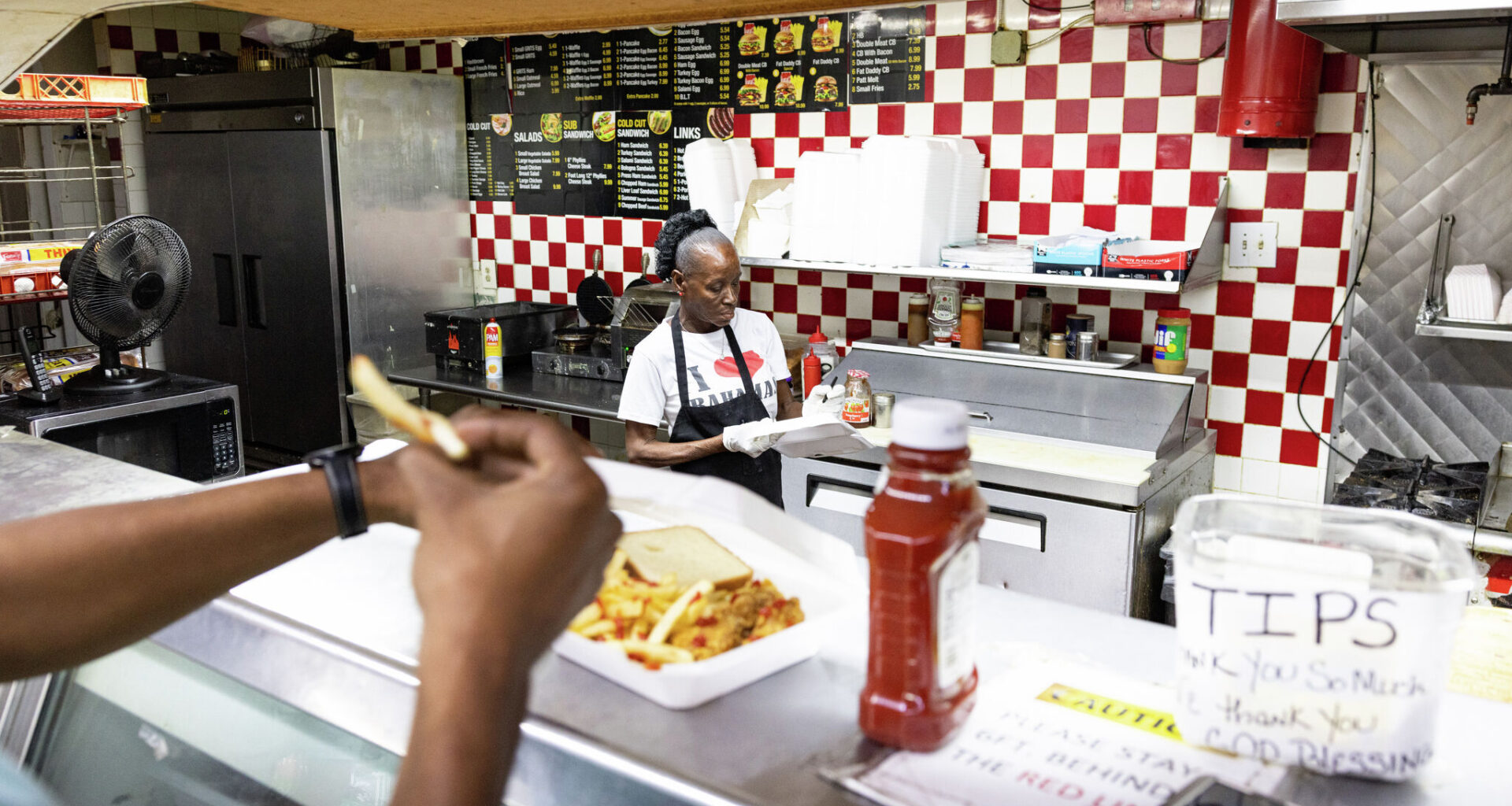
Mill City resident Linda Belt prepares food for another costumer while Robert Walker eats French fries at the Fair Park Grocery on Lagow Street near Metropolitan Avenue on Nov. 14, 2025, in Dallas.
Angela Piazza/Staff Photographer
Pay now or you pay later
Research on the Philadelphia Landcare Program shows revitalizing vacant lots could not only improve the aesthetics of disinvested neighborhoods, it could also reclaim some of the value they have lost.
“Cities can’t always build farther and farther out,” said Shepherd of Verdunity.
New developments in formerly rural areas farther away may appear attractive, especially in the short term when development is underway and revenues are in surplus as tax rates are lower. But 20 to 30 years on, the infrastructure put in will either need significant repairs or a complete rebuild.
“That’s when the cities lose a lot of money and get upside down,” he said, reiterating, “We have to reinvest in existing places.”
So if the city does its part that can carry over, Lewis said. “We can mitigate the blight, we can build more.”
Homeownership is about more than housing security, Lewis said, linking it to better health and educational outcomes and economic opportunities.
“Those families deserve a nice house,” he said. “We want that for our community.”
Simmons acknowledged some of this work is going to be “a lot of upfront cost” for the city.
“But look at the many years of disinvestment — of all the money that was saved,” the pastor said.
“People say, you either pay now or you pay later — unfortunately they’re having to pay later now — and it’s a large increase.”
A new home is being erected on Hamilton Avenue in the Mill City neighborhood on Nov. 14, 2025, in Dallas.
Angela Piazza/Staff Photographer
This reporting is part of the Future of North Texas, a community-funded journalism initiative supported by the Commit Partnership, Communities Foundation of Texas, The Dallas Foundation, the Dallas Mavericks, the Dallas Regional Chamber, Deedie Rose, Lisa and Charles Siegel, the McCune-Losinger Family Fund, The Meadows Foundation, the Perot Foundation, the United Way of Metropolitan Dallas and the University of Texas at Dallas. The News retains full editorial control of this coverage.