
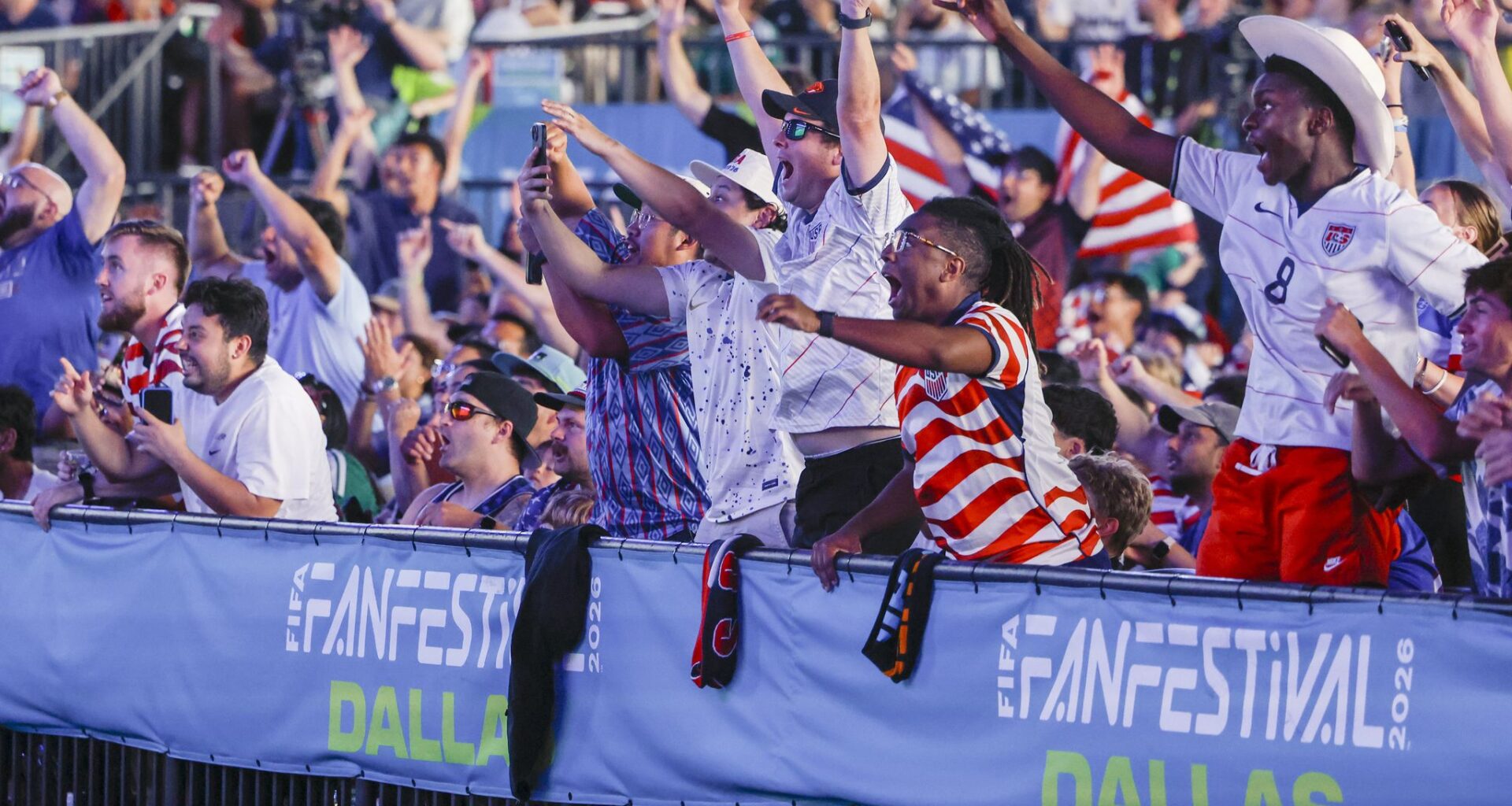
Fans react after a goal by United States defender Alex Freeman during a Group D match against Australia at FIFA Fan Festival at Fair Park on Friday, June 19, 2026, in Dallas.
Elías Valverde II/The Dallas Morning News
As Spain and Argentina prepare to meet in the 2026 World Cup final on Sunday in New Jersey, one question still hangs over American soccer: Will the United States ever reach the final stage of the world’s most‑watched sporting event?

For a moment this summer, the possibility felt tangible. The USMNT’s run — energetic, skillful, and unusually elegant for a program long defined by grit — stirred something rare within the American sporting landscape: a sincere investment in a sport in which the United States has never been a dominant force.
But on July 6 in Seattle, that momentum collapsed under the weight of a 4–1 loss to Belgium in the round of 16.
Article continues below this ad
Fox reported that 30 million people watched the match in the U.S., making it the most‑viewed soccer broadcast in American history. It had a larger average audience than last month’s NBA Finals between the New York Knicks and San Antonio Spurs, which averaged 20.6 million viewers on ABC and ESPN.
The stage was set for a breakthrough, a chance to convert curiosity into commitment, hype into habit.
Instead, the defeat extinguished the United States’ hopes of making a true leap forward.
The U.S. didn’t just lose heavily to Belgium; its performance fell short of the historic urgency of the moment.
Seattle’s stadium was packed to capacity — 70,000 raucous fans backing not only the team, but a project meant to elevate soccer in this country to another level.
Article continues below this ad
And yet, the question remains: How big was the opportunity the USMNT let slip?
RELATED: Nine World Cup matches. One lingering question: Why didn’t D-FW get the final?
A focusing event — and a mirror
To understand the long‑term impact, Matt Bowers, a professor at UT Austin’s McCombs School of Business and the managing director of the Business of Sports Institute, urges Americans to see the World Cup as more than a tournament.
“Anytime we have an event of this magnitude, it’s what we in policy‑making terms call a focusing event,” Bowers said. “It’s an opportunity to shine a light that everyone is looking at and allows us to ask questions of how we do things. Could we do them better?”
Article continues below this ad
For Texas — home to host cities Dallas and Houston — that spotlight was especially bright.
Bowers notes that while economic benefits are often overstated and “a lot less money tends to flow to the local economy than it does to FIFA,” the cultural impact is undeniable.
Visitors reported overwhelmingly positive experiences in both Texas cities, a meaningful counternarrative at a time when global perceptions of the U.S. are politically polarized.
But for Bowers, the most important legacy lies in athlete development — a system he has studied extensively.
“This was an opportunity for us to really look at the state of the soccer development landscape in the United States,” he said. “Nine of our 11 starters are playing in top global European leagues. That’s different than what we’ve seen in years past.”
Article continues below this ad
Progress, yes — but also a reminder of how far the U.S. still has to go.
“We still have a soccer development system in the U.S. that is pay‑for‑play,” Bowers said. “Parents and youth athletes pay thousands of dollars a year to access elite pathways. That closes off the system to millions of kids.”
He points to FC Dallas as a rare bright spot — “one of the crown jewels” of youth development — but stresses that the broader system remains fragmented, inequitable and incoherent.
Closing the gap
FC Dallas president Dan Hunt sees the moment through a similar lens — one that blends pride with frustration.
Article continues below this ad
“Here’s what I would say: the U.S. team performance was good, maybe not great. Had we advanced, you could have started to argue it was a great performance,” Hunt said in response to harsher criticism circulating online.
“You look at how much soccer has grown, the level we’re able to compete at,” he said. “When you look at that starting 11 and the clubs those players play for — Juventus, PSV, Crystal Palace, MLS clubs — we have come a long way. Major League Soccer has really helped contribute to this.”
If the Belgium match was a missed opportunity, was it also a setback?
Bowers doesn’t think so.
“I still think this is a watershed moment when you look at the viewership,” he said. “It is a net positive overall impact.”
Article continues below this ad
He believes the disappointment will fade quickly, especially among younger fans inspired by the team’s skillful group‑stage performances.
“That will still capture the imagination of an 8‑year‑old,” he said. “It will still inspire a 16‑ or 17‑year‑old to care even more the next time around.”
Bob Heere, professor of Sport Entertainment Management at the University of North Texas, agrees — but adds a twist.
“I don’t think they lost fans just because they lost this game against Belgium,” Heere said. “The United States, until that game, played really well and excited a lot of fans.”
But Heere believes the real damage came from the political controversy that erupted before the match following a phone call from President Donald Trump to FIFA that became known as “Belgium‑gate.”
“That phone call should’ve never happened,” Heere said. “A lot of the goodwill they gained was lost with that action.”
Heere was referring to President Trump’s call to FIFA president Gianni Infantino in which Trump asked that a suspension be reviewed — which was followed by the stunning reversal of Folarin Balogun’s red‑card ban that had initially been expected to sideline him for the Belgium match.
Local fans’ viewpoints
In North Texas, longtime supporters and first‑time World Cup spectators expressed a similar resilience — disappointment, yes, but not disillusionment.
On Wednesday, during an exhibition match between FC Dallas and Orlando held at Texas Health Mansfield Stadium, fans showed up in remarkable spirit.
Many in attendance wore jerseys from World Cup nations — Argentina, Sweden, Mexico, Colombia and the United States — turning the friendly into a small, colorful reflection of the global tournament.
Alice Salata, who has attended multiple FC Dallas matches, said the World Cup revealed something deeper about the country, a sense of discovery and connection that extended far beyond the games themselves.
“I think the U.S. did a pretty good job with the World Cup overall,” she said. “Every country that came really seemed to enjoy themselves. A lot of fans experienced a lot of discovery — especially Europeans discovering life in America.”
Watching the U.S. fall 4–1 to Belgium, she felt the sting.
“I didn’t feel good about the loss. I don’t think the team played very well,” she said. “If fans blame one game and turn away, they’re not really fans. You gotta give it another chance.”
Her husband, David Salata, noticed something else — a cultural shift.
“I saw a lot of people who never pay attention to soccer watch soccer, talk about soccer, even talk about the U.S. team like they’ve been big fans forever,” he said. “So yeah, I think it’s been good overall.”
He doesn’t believe the Belgium loss will scare newcomers away.
“World Cup games were phenomenal,” he said. “If people see soccer in that light, they’ll still come. They’ll want to come and watch.”
RELATED: Growing financial hurdles of youth sports highlighted by D-FW’s club soccer scene
What this means for local clubs
If the USMNT exit didn’t kill momentum, the question becomes: How should local clubs capitalize on what remains?
Bowers believes the answer lies in community identity.
He suggests FC Dallas and other North Texas clubs continue to engage international fan bases living in the region and create spaces where neighbors — whether Argentine, Norwegian, French or American — can gather around the sport.
Heere, meanwhile, offers a more traditional view.
“The only thing you can really do is make sure that if new people are coming through the gates, they have a really good time.”
Hunt sees another opportunity — one rooted in global perception.
“I think the World Cup was the commercial that soccer in this country needed — and that FC Dallas needed,” Hunt said. “It’s going to open up a lot more opportunities for players to come.”
That optimism reflects a larger truth about what this tournament unlocked.
After all, 30 million Americans watched a soccer match, and children saw a level of skill and creativity they had never witnessed from their national team.
North Texas hosted the world and offered it a welcoming face. And now local clubs stand at a crossroads — with a rare chance to turn fleeting curiosity into lasting loyalty.
Whether they succeed will determine whether this World Cup becomes a footnote — or a foundation.