
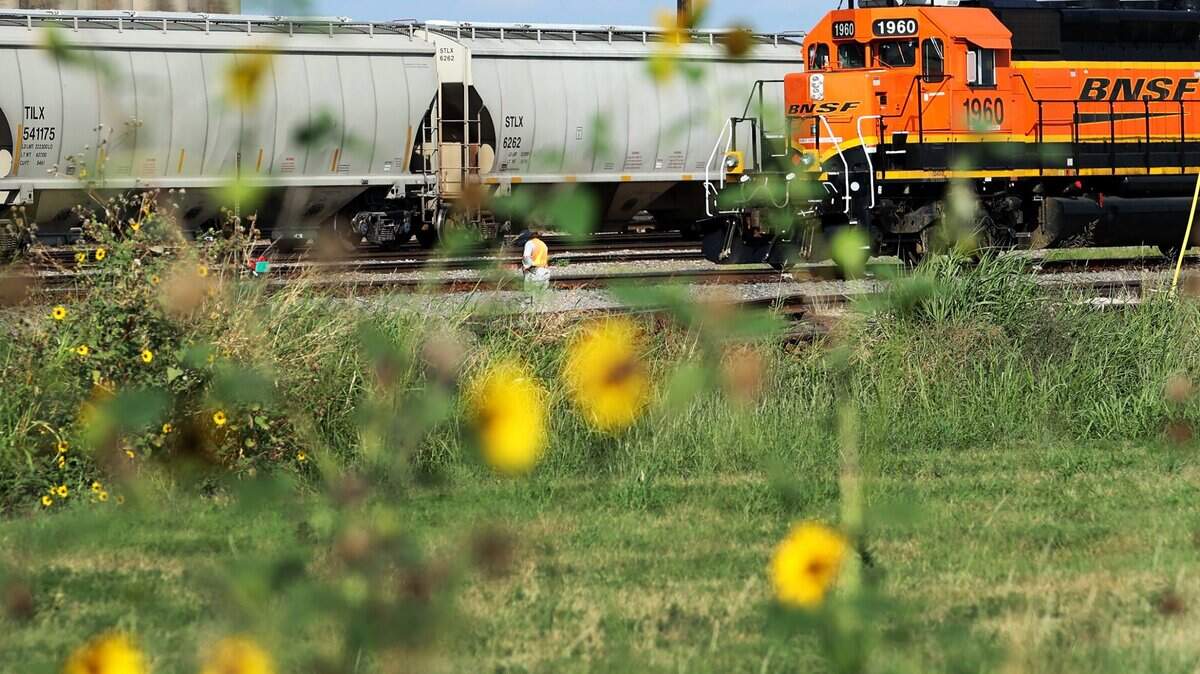
Fort Worth-based BNSF Railway and two of its unions mutually agreed to drop a legal dispute over time off rules, but not before getting an earful from U.S. District Judge Mark Pittman.
BNSF sued the unions on July 8 alleging a time off rule in a 2022 union contract resulted in too many workers taking the maximum amount of time off in between train runs, which led to disruptions in service.
The rule lets crew members choose 12, 24 or 36 hours of undisturbed rest between assignments on a BNSF corridor in Montana and the Pacific Northwest.
BNSF wanted to change that rule to limit guaranteed rest time to 24 to 27 hours, according to their lawsuit.
It also asked the court to classify the dispute as “minor” which would have legally prevented members of the Brotherhood of Locomotive Engineers and Trainmen and members of the Transportation Division of the International Association of Sheet Metal, Air, Rail, and Transportation Workers from striking.
Lawyers for the unions filed a countersuit claiming the rail company can’t change the terms of the contract unilaterally, and asked the judge to force BNSF into arbitration before making any rule changes.
However, after roughly a week of back and forth, both sides filed a motion agreeing to drop their lawsuits and asking Judge Pittman to dismiss the case.
Before granting the motion, Pittman said he wanted to address a matter beyond the scope of the case.
He expressed concern about an increasing pattern in railroad labor disputes in which one side will file an emergency motion only to drop the case days later.
He noted that courts are obliged to take emergency motions at face value rather than evaluating if they are truly emergencies, which often leads other important cases to be pushed aside.
He noted he once received a legal citation for taking four days to address an emergency order.
He also referenced a 2025 legal opinion from the 5th U.S. Circuit Court of Appeals when the judge had been chastised for not acting immediately on an emergency motion filed just after midnight.
“We seem to have forgotten that this is a district court — not a Denny’s,” Pittman said quoting Circuit Judge James C. Ho.
Pittman called on the lawyers from both BNSF and the unions to be honest with their clients about the appropriate use of the legal system.
Judges and courts are not here to provide strategic leverage in labor negotiations, nor are they meant to change the underlying laws that govern legal disputes around railroad labor relations, Pittman said.
The courts expect better, he said.
Representatives for the Brotherhood of Locomotive Engineers and Trainmen did not immediately respond to a request for comment from the Star-Telegram.
The Transportation Division of the International Association of Sheet Metal, Air, Rail, and Transportation Workers understands Judge Pittman’s frustrations particularly the impact on staff and resources, spokesperson Dan Banks said in an email to the Star-Telegram.
As the defendant, the union had no input on BNSF’s request, Banks said, while adding his union was happy the parties were able to resolve their differences within the framework set out by the union contract.
“We thank the court for its time in considering the parties’ positions regarding the dispute and their continued professionalism,” Banks said.
In an email to the Star-Telegram, a BNSF spokesperson said they thanked the court for taking the time to hear the company’s case.
This story was originally published July 16, 2026 at 2:22 PM.
.jpg)
Fort Worth Star-Telegram
Harrison Mantas has covered Fort Worth city government, agencies and people since September 2021. He likes to live tweet city hall meetings, and help his fellow Fort Worthians figure out what’s going on.