
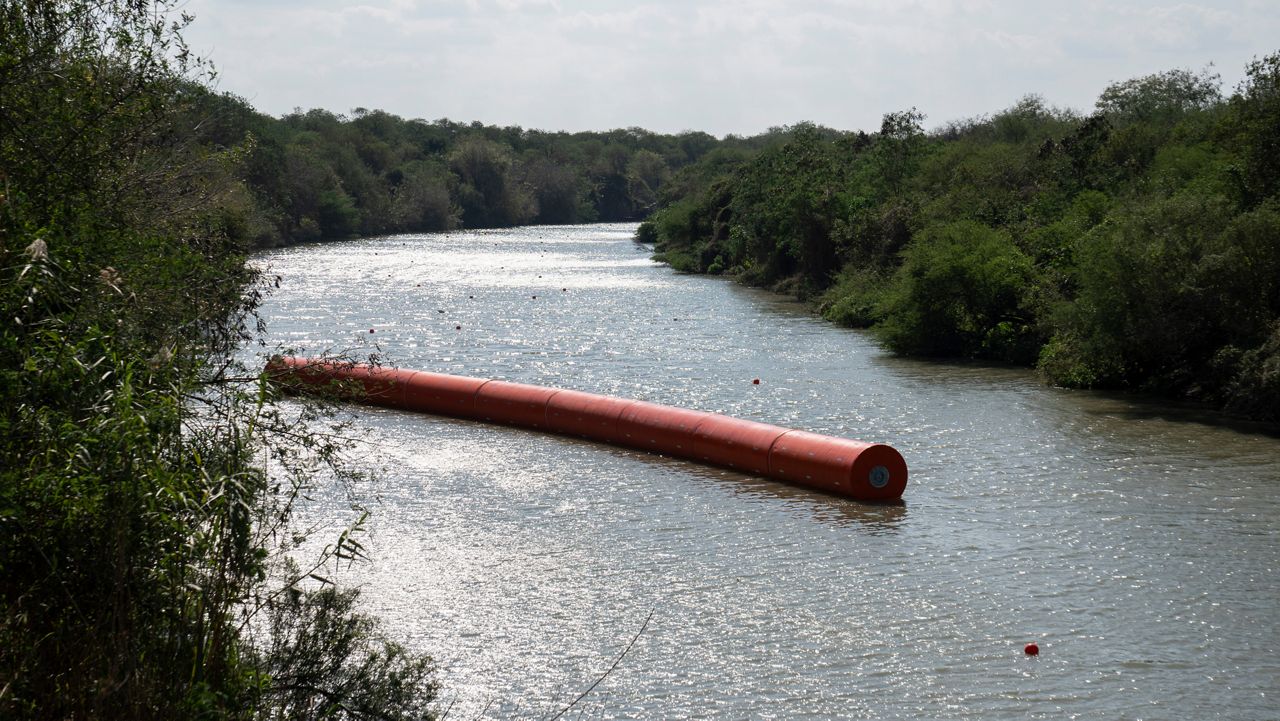
LAREDO, Texas — Buoys intended to deter migrant crossings along the Rio Grande River in Texas have dislodged and are floating downstream after heavy rains hit the region. According to officials, the buoys that have been drifting downstream were washed away from staging sites ahead of installation.
Aerial footage showed many of the 12-foot-long cylindrical buoys floating down the flooded river.
On Thursday, officials in Eagle Pass had to close both international bridges temporarily because hundreds of border buoys that had recently been placed came undone and were traveling downstream. Early Friday morning, one bridge was reopened, but officials said it could close again based on river conditions.
According to the Associated Press, U.S. Rep. Henry Cuellar said around 480 of the roughly 600 adrift buoys were recaptured by noon on Friday.
In Laredo, south of Eagle Pass, Mayor Dr. Victor D. Treviño said in a statement Thursday night that he was “closely monitoring conditions along the Rio Grande as debris from upstream is expected to reach our area.”
“Our emergency response teams are coordinating with state, federal, and local partners to assess conditions and respond if necessary,” Treviño said.
The mayor said that an emergency declaration had been issued.
Buoys were first installed in the Rio Grande by Texas Gov. Greg Abbott in 2023 to deter migrants from crossing when President Joe Biden was in office. The Biden administration sued Texas over the buoy barrier.
After President Donald Trump took office for a second time, the Trump administration moved forward with its own floating barrier system in the Rio Grande, which drew criticism from environmental advocates after the Department of Homeland Security (DHS) waived environmental laws when the project first started.
DHS plans to install over 500 miles of connected buoys along the Rio Grande.
The Rio Grande International Study Center commissioned a study of the border buoy project, and its initial findings warned that the buoys “straightjacket the river” and could increase flooding concerns and cause more debris to build up.
Back in April, a U.S. Customs and Border Protection (CBP) spokesperson said in a statement that the design requirements for the buoys mandate that they “withstand a 100-year flood event.”
Eagle Pass native Amerika Garcia Grewal, co-director of the Frontera Federation, has been a vocal critic of the buoys and other immigration enforcement tactics by the state of Texas and the federal government.
Grewal spoke with Spectrum News 1 Friday morning, saying the Rio Grande was still expected to rise further in Eagle Pass and could wash away more buoys.
“This is not a political debate. This is a public safety emergency. These buoys are each a ton. There are thousands of them, and they are floating battering rams, threatening the international bridges and Eagle Pass all the way down to Brownsville,” Grewal said.
A CBP spokesperson later confirmed that buoys that hadn’t been installed yet were swept into the river at Shelby Park in Eagle Pass due to fast-rising water:
“As a result of the heavy rains in Eagle Pass, Texas, this week, buoys under the responsibility of control of the contractor that were staged at nearby Shelby Park, were swept into the river due to the fast-rising water. These were not buoys that were already deployed and anchored in the river. CBP is working with its contractor to retrieve these buoys.
“Waterborne barriers are intended to create a safer border environment for patrolling agents, as well as deter migrants from attempting to illegally cross the border through dangerous waterways. In addition, they provide effective impedance and denial capabilities that enhance natural barriers and complement land based, steel bollard border wall systems nearby.”
State Rep. Eddie Morales Jr., D-Eagle Pass, said in a statement that he was informed Thursday night by local officials that “buoys were beginning to be washed downstream from staging sites North of Eagle Pass.”
“There is also deep concern regarding the hundreds of miles of razor wire that were placed on the riverbank that may be dislodged, move downstream and/or may now be stuck in the riverbed,” Morales said.
Morales said that the Texas Division of Emergency Management moved some of the state-owned border barriers in Shelby Park, including shipping containers and buoys, further inland.
“I always had concerns regarding the buoys in our region and their price tag compared to effectiveness. Simply put, we are not dealing with the issues we saw three years ago – the buoys, shipping containers, and razor wire never should have been intended as a permanent fixture,” Morales said. “I have always been an advocate for a safe and secure border, but right now I think it past time to begin the conversations to move on from these types of barriers and begin investing in our communities through needed infrastructure, personnel, and technology that won’t pose risk to our communities from future acts of Mother Nature. This is not the first time we have seen floods like this occur and will not be the last.”