
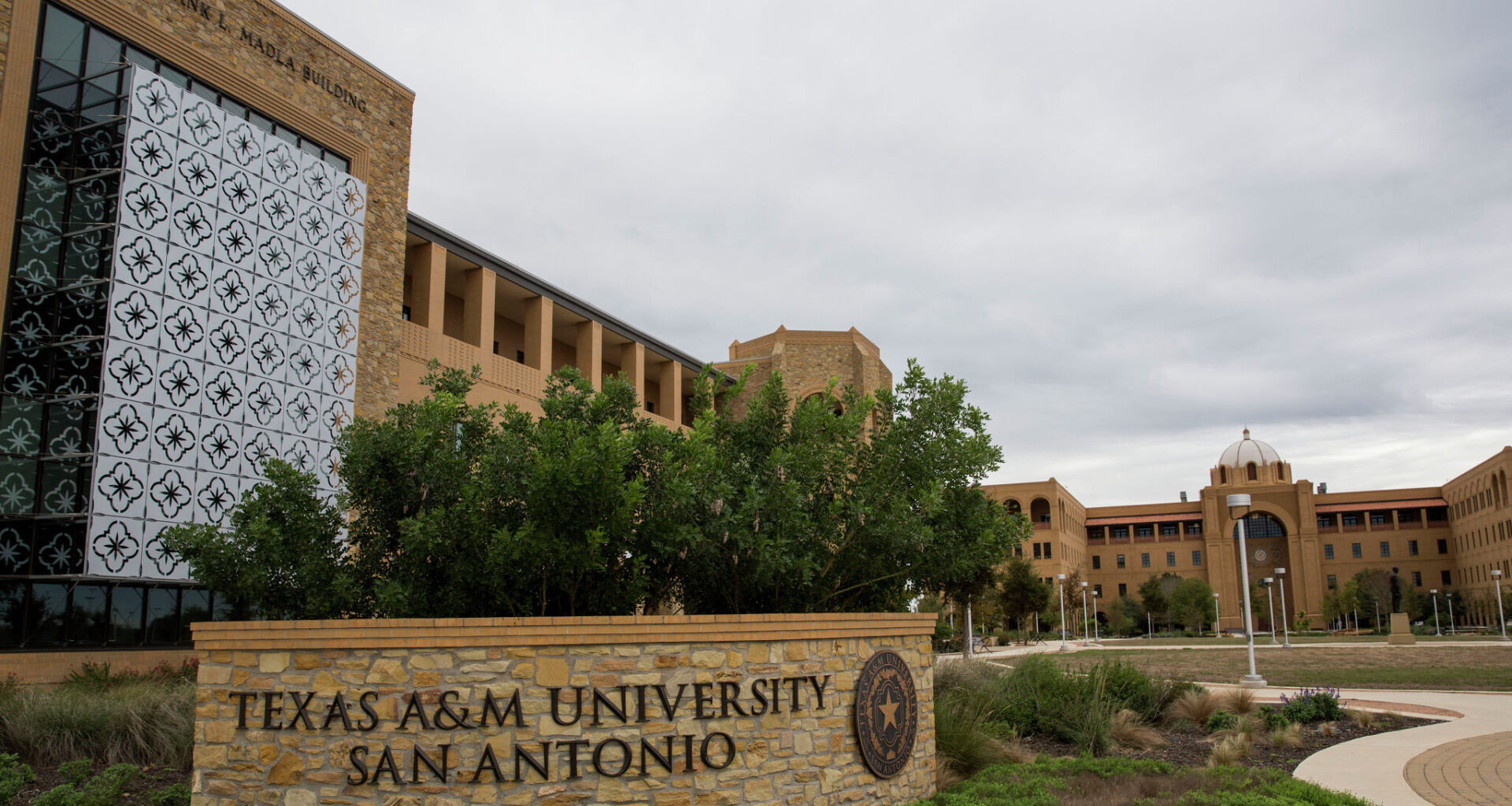
Texas A&M University-San Antonio campus was a bold investment in the South Side. The vision for the university continues to evolve.
Carolyn Van Houten
Model homes in the VIDA subdivision, located next to the growing Texas A&M University-San Antonio campus. The campus is turning into a place where people can live and learn.
Sam Owens/San Antonio Express-News
The land surrounding Texas A&M University–San Antonio was once home to generations of farmers and laborers and known more for cacti, javelinas, and the occasional wandering donkey than for opportunity.

Today, that same stretch of terrain offers a real-world blueprint for how a university can anchor economic growth and community transformation.
Article continues below this ad
Nearly two decades ago, the Texas A&M University System made a decision to invest in an area of the city that had long been overlooked. What began as a vision for expanding access to higher education on the South Side has evolved into a thriving live-learn district where education, healthcare, housing and industry intersect.
As the University helps drive regional growth — generating nearly $300 million in annual economic impact for Bexar County — a growing number of public and private institutions across the country are facing demographic challenges and severe financial pressures. During the past five years, about 50 colleges have closed or announced closures, while at least 40 others have merged. A&M–San Antonio has charted a different course.
Since its establishment in 2009, A&M-San Antonio’s rapid growth has signaled to public and private partners that the South Side is not speculative ground, but a strategic asset. The University’s presence provides the critical mass that developers, health systems and manufacturers seek when deciding where to invest.
VIDA, the new 600-acre community adjacent to campus, illustrates that momentum. Designed to meet the needs of students, employees, and a growing workforce, VIDA is bringing diversified housing options, parks, and commercial development to the area.
Article continues below this ad
Since construction began in 2021, the community has grown to more than 3,000 residents and includes apartments, duplexes, townhomes and single-family homes. New restaurants and retail destinations are expected to open in 2027.
Complementing that residential growth, University Health recently opened University Health VIDA across the street from the A&M–San Antonio campus. The facility offers urgent and primary care, pediatrics, specialty care, and behavioral health services.
VIDA is also home to University Health’s Institute for Public Health, which brings together nonprofit organizations to address issues such as food insecurity, financial literacy, and mental health support.
The new health and wellness center is only the first phase of University Health’s South Side expansion. On the same 68-acre campus, University Health Palo Alto Hospital will open next spring as a full-service hospital that will provide quality care while creating good-paying jobs and new opportunities for career advancement.
Article continues below this ad
At the same time, A&M–San Antonio is developing the workforce needed to support the region’s growing health care ecosystem. Through initiatives such as the new Public Health and Education Building, scheduled to open in fall 2026, the University is expanding educational pathways, research opportunities, and experiential learning programs. The facility will enable growth in health and science programs while preparing the next generation of public health professionals.
Together, these projects illustrate a collaborative approach to addressing longstanding disparities in South Bexar County, where life expectancy can differ by as much as 20 years compared with communities on the North Side.
At a time when many institutions are asking how to remain relevant, the transformation unfolding on San Antonio’s South Side demonstrates that when strategic partners align around a shared vision, they can become engines of economic mobility and regional renewal.
Article continues below this ad
A&M–San Antonio, VIDA and University Health each play distinct roles, but together they are creating a connected ecosystem. While the South Side is still evolving, it already offers cities across the country a model for creating sustainable growth and communities where people can live, learn, work and thrive for generations.
Salvador Hector Ochoa is president of Texas A&M University-San Antonio. Thad Rutherford is president and CEO of Southstar. Christopher Mendoza is CEO of University Health Palo Alto Hospital.