
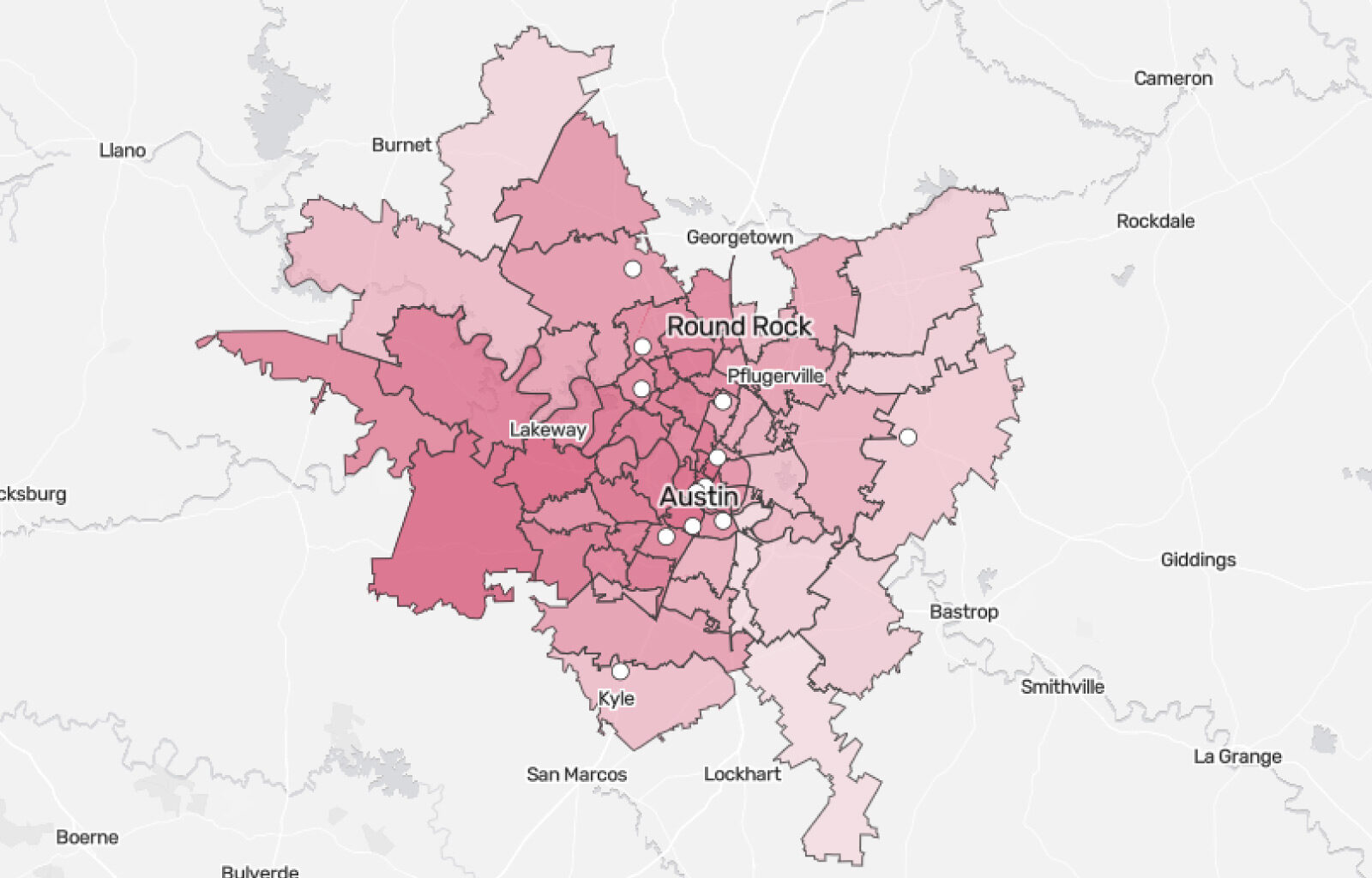
An east-west educational divide remains in the Austin area, despite the city having a higher concentration of highly educated people than national and state averages.

East Austin had a higher share of people who either didn’t graduate high school or didn’t pursue higher education, according to an analysis of Census data for people ages 25 and older. In 2024, the most recent data available, far more people with bachelor’s, graduate or professional degrees lived west of I-35 and close to universities.
Click through or search for your address in the map below to explore the share of people with different levels of educational attainment in the Austin area.
Article continues below this ad
Lila Valencia, Austin’s city demographer, said the division reflects how Austin has not overcome its exclusionary history and systemic barriers in schools, despite being a highly educated city.
“The demographic makeup of East and West Austin is shaped by historical policies of forced segregation and redlining and disinvestment,” she said. “So those east-west differences, in terms of education, don’t represent just differences in home prices or differences in living preferences, but they’re really a compounding and a lingering effect of all of those policies together.”
Despite the divide, Austin is the sixth-most educated metro area in the country, according to Valencia.
Article continues below this ad
Nearly one in three people in the Austin area had a bachelor’s degree as their highest level of education completed. That’s 10 percentage points higher than national and state averages. Nearly one in five Austinites also had a graduate or professional degree.
Austin had a smaller population of people who didn’t finish high school compared to state and national averages, and the area also had far fewer people who only had a high school diploma.
Some might expect Austin’s high level of educational attainment to come from the variety of school opportunities in the area. The city is home to the University of Texas’ flagship campus, St. Edward’s University, and Huston-Tillotson University, as well as 10 Austin Community College campuses, plus one in Round Rock. But Valencia said students don’t always stay in the area or even the state after graduation.
Article continues below this ad
“There is some research that suggests that students who graduate from a flagship, highly selective four-year universities are actually more likely to move away from the area of their college because they just have more options,” she said.
According to the Office of Institutional Research and Analysis at the University of Texas System, 59% of former students from all UT System schools worked in Texas in 2023. In comparison, 49% of former UT Austin students were in the Texas workforce.
Valencia said community colleges are “stickier” though. About 85% of ACC graduates stay in Texas, according to Austin Community College.
But the Austin area has a smaller share of people with associate degrees than state and national averages.
Article continues below this ad
These trends reflect Austin’s industry makeup, according to Valencia. More people are moving here for industries that require college and advanced degrees.
“Now [Austin’s] really evolved into the nation’s 12th largest city, and it continues to attract college students, but it’s actually attracting larger shares of slightly older young adults,” she said.
Valencia said educational attainment often goes hand-in-hand with income; the average person who pursues higher education is likely to make $30,000 more than someone with only a high school diploma.
“Because Austin is such a sought after place to live, and it’s really created this sort of competitive atmosphere, the people who are losing out are oftentimes those people who have the lower educational attainment levels and have lower household incomes,” Valencia said.
Article continues below this ad
About the data
The Statesman analyzed educational attainment in the U.S. Census Bureau’s 2024 American Community Survey five-year estimates to find how educated people in the Austin area are and where they live.
Austin area ZIP codes were determined by choosing all ZIP codes within and near Travis County. Estimates for ZIP codes with a margin of error larger than 85% of the estimated total were excluded.
Article continues below this ad