
In an aerial view, a dock overlooks a dried up portion of Lake Corpus Christi on May 07, 2026 in Mathis, Texas. After falling to its lowest levels ever in March 2026, recent rains have caused Lake Corpus Christi to rebound to about one-third full as of July.
Brandon Bell/Getty Images
In March, the Most Rev. Alberto Aviles, bishop of the Diocese of Corpus Christi, called on the faithful to pray for rain in a region on the verge of a water catastrophe. Within weeks, those prayers were answered when spring rains blanketed the Coastal Bend. The wet weather gave the region a minor reprieve by pushing the date of a projected Level 1 water emergency back to September 2027, according to Corpus Christi Water.

But Corpus Christi’s water woes are far from over. Across Texas, communities are facing tough realities when it comes to the resilience of their water supplies. Years-long drought, explosive population growth, increased demand from large volume water consumers and international policy disputes have all played a role.
Article continues below this ad
Drought, industrial users and ineffective government take Corpus Christi to the brink
In early March, Corpus Christi City Manager Peter Zanoni said Lake Corpus Christi had not seen any “meaningful” rainfall in five years. At the time, the Coastal Bend was nearing a Level 1 water emergency by December 2026.
While the years-long drought definitely took a toll — causing Lake Corpus Christi and Choke Canyon Reservoir to plummet to historic lows of about 8.7% combined in March, it’s not the only strain on the region. Industrial users have sucked the region dry. Energy and chemical companies, like Valero, Citgo and LyondellBassel are fighting the city’s efforts to raise industrial water fees after years of what Zanoni called “not paying their fair share,” according to Houston Public Media.
Article continues below this ad
Even as crisis looms, city leaders have failed to agree on solutions. Last fall, a divided Corpus Christi City Council killed plans for a $1.2 billion desalination plant. Another proposed by private industry led, in part, by former Corpus Christi water officials, has also stalled due to inaction by city leaders. The constant waffling has prompted comments from Gov. Greg Abbott, who called Corpus Christi “a victim because of a lack of ability to make a decision.”
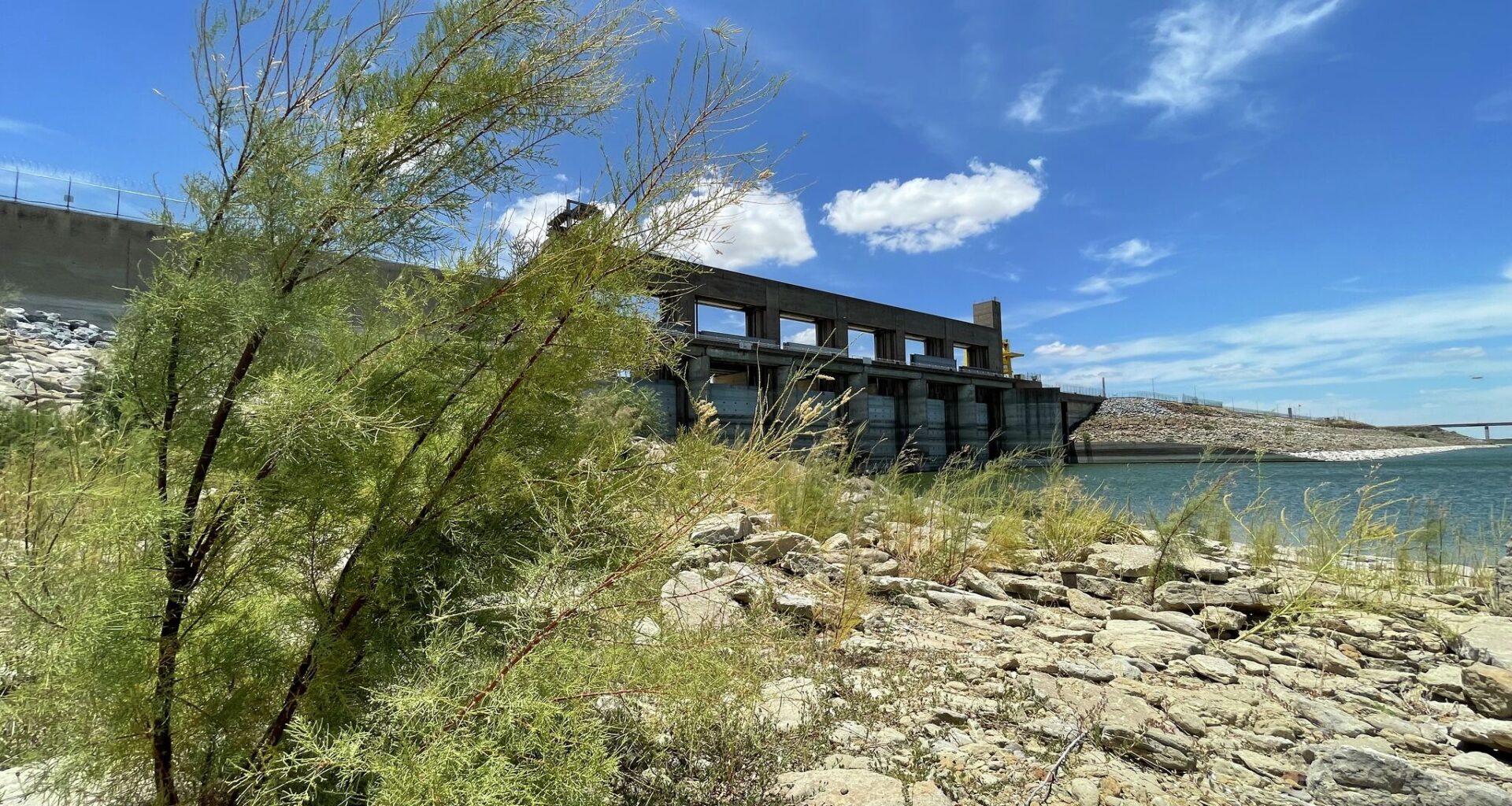
A portion of Falcon International Reservoir that should be submerged by water is seen at the base of Falcon Dam, in Starr County, in August 2022. While recent rains have bumped lake levels up slightly in 2026, it’s still less than 25% full as of July.
Dina Arévalo
International dispute with Mexico threatens water in the Rio Grande Valley
More than 100 miles south, the Rio Grande Valley faces its own water crisis. Agriculture accounts for about 75% of the region’s water use, and border communities from Fort Quitman down to the Gulf of Mexico rely heavily on the Rio Grande, which is fed by six tributaries located deep in Mexico. But Mexico has spent the last three decades flouting a 1944 water-sharing treaty with the United States. Things came to a head in 2024, when Amistad and Falcon reservoirs fell to record lows, which prompted the demise of the Texas sugarcane industry.
Article continues below this ad
Jacob’s Well in 2026 shows very low to no flow as drought and growing groundwater demand continue to impact the iconic Hill Country spring
Courtesy of Hays County Parks and Natural Resources
Explosive growth strains the Edwards Aquifer in South-Central Texas
The Edwards and Trinity aquifers supply water to millions from Austin to San Antonio. But overpumping, breakneck development and insufficient recharge have exacerbated a long-term drought that last year left the Edwards aquifer at its lowest levels since the 1950s. The Greater Edwards Aquifer Alliance, a San Antonio-based non-profit, says “assault from urban sprawl” as well as high-volume water users like AI data centers, are putting it at risk.
A rendering of the Bastrop County data center campus is displayed at a meeting with consultants and staff from EdgeConneX at the Bastrop County Community Center on Thursday, June 18, 2026 in Bastrop, Texas. Advocates like the Greater Edwards Aquifer Alliance say a proliferation of data centers is straining South Central Texas groundwater supplies.
Austin American-Statesman/Hearst/Austin American-Statesman via Ge
The growing role of climate change on Texas water
Nearly every region of the state is also grappling with the growing role of climate change. While Mexico has failed to timely deliver the water it owes to the Rio Grande, for example, the river’s domestic tributaries have seen sharp declines over the last few decades.
Article continues below this ad
Water from the Devils and Pecos rivers has declined “by about 30% since the 1980s,” Dr. Maria Elena Giner, former commissioner of the International Boundary and Water Commission, said in 2024. The ground is also becoming hotter and drier as “evapotranspiration” — or the amount of moisture that evaporates from the ground into the atmosphere — increases.
According to the Texas Comptroller’s Office, water demand in some parts of the state could outpace supply by 2070. Those shortages, in turn, could cost the Lone Star State as much as $160 billion in economic losses by 2030, according to Texas 2036, a nonpartisan public policy think tank.