
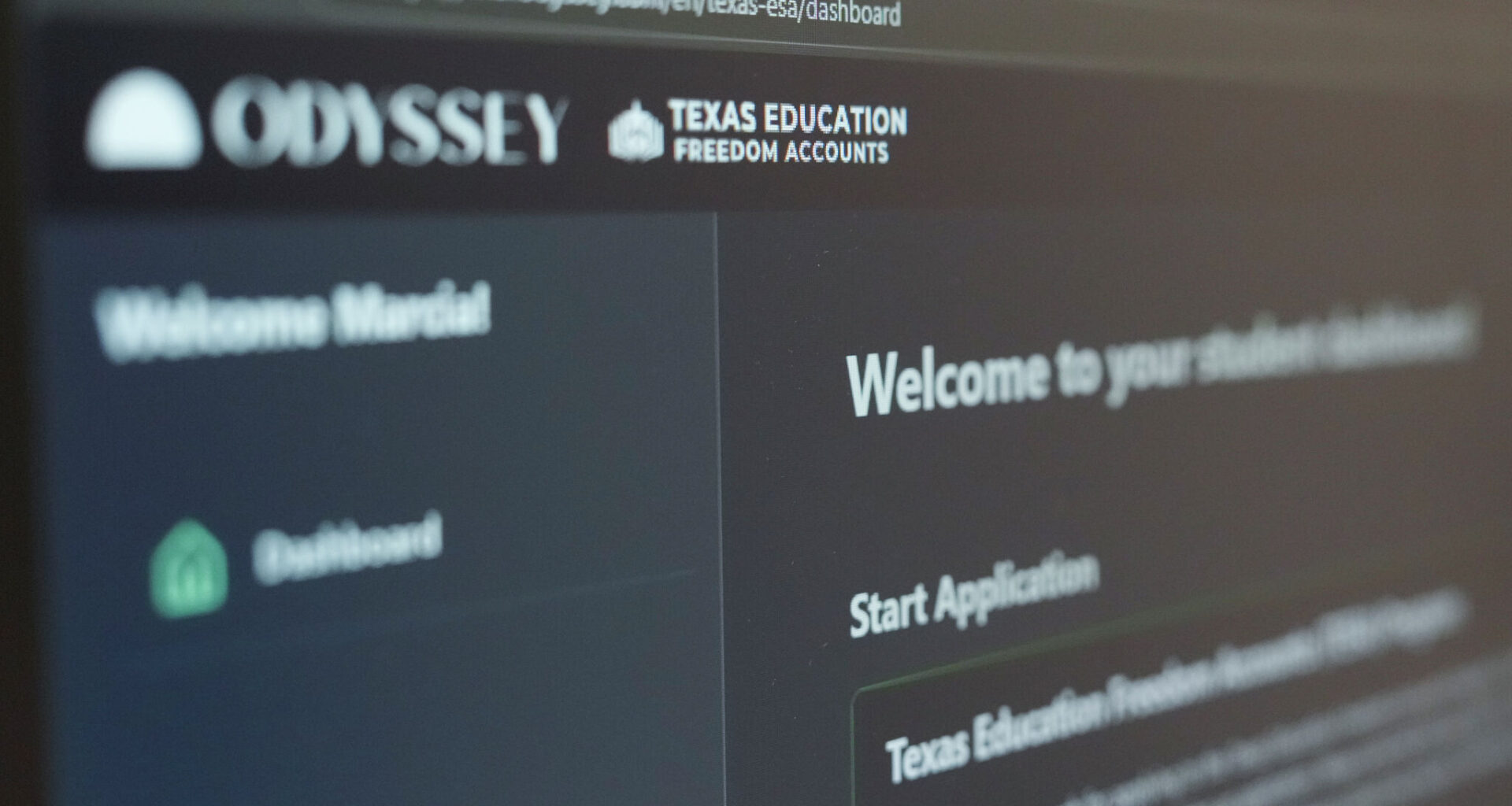
Marcia Pena works to apply for a Texas Education Freedom Account voucher for her daughter’s Catholic school in Houston on Feb. 4, 2026.
Jason Fochtman/Houston Chronicle
Technology company Odyssey has a lucrative, yet daunting, job: rolling out Texas’ school voucher-like program. It will have to dodge the missteps that have plagued similar programs across the country.

As more states launch school choice programs, they’re turning to a crop of young companies, like Odyssey, to run them. The Texas Education Freedom Accounts, a $1 billion program launching this fall, is the largest one yet under Odyssey’s operation. The five-year-old company has provided platforms for school choice programs across the country, including Iowa, Idaho and Missouri.
But it’s also faced allegations of poor oversight and swelling costs, according to media reports. Its history raises questions about how the company will serve nearly 110,000 Texas students awarded education savings accounts, which fund their private or home schooling with taxpayer dollars.
Article continues below this ad
The Texas Comptroller of Public Accounts selected Odyssey last year to administer TEFA. Its two-year contract is worth $26 million, records show.
Here’s what to know about the company — from its founding, its contract and its history.
What is Odyssey?
The company provides an automated platform for families to spend state aid. It processes applications and purchases, and handles customer support and marketing. Eight states, including Iowa, Georgia and Nebraska, use its product.
Joseph Connor, a former teacher and attorney, started the company in 2021. As more states started implementing education savings account programs, Connor believed that governments needed more efficient ways of distributing funds, according to an article published by the University of Notre Dame, where he studied law.
Article continues below this ad
Before launching Odyssey, Connor expanded a network of microschools across the Northeast. He raised $8.1 million to support these small, one-room schools.
Related: Could Texas’ school voucher program help the microschool movement gain traction?
As a lawyer, he wrote an amicus brief in Espinoza v. Montana Department of Revenue. The landmark U.S. Supreme Court case decided that a state’s school choice program cannot prohibit funding to religious schools.
What will Odyssey do in Texas?
Odyssey was tasked with distributing funds, organizing a list of vendors, publishing a website where families could shop for products and services, and more, according to its contract.
Article continues below this ad
Raising awareness about TEFA was among its chief responsibilities. Each fiscal year, Odyssey must allocate $2.01 million from its compensation to marketing, per the contract.
The document also outlines benchmarks for Odyssey’s performance. For example, the customer service workers must answer 95% of calls within 90 seconds after the voice automation is complete. They can’t abandon more than 5% of calls. Also, 99% of complaints must be resolved within 30 days. At least 90% of customers must indicate “acceptable or better service” in surveys.
Odyssey must submit quarterly performance reports to the state, according to the contract. It is also subject to independent and state audits. If Odyssey does an inadequate job, the state can reduce its pay.
If Texas renews the contract for an additional two years, Odyssey could make a total of $52 million.
Article continues below this ad
What is Odyssey’s track record?
Odyssey has faced criticism in other states for its rollout of school choice programs.
In 2022, Odyssey won a contract to run Idaho’s now-defunct Empowering Parents program, a $30 million program providing eligible families with grants to use toward educational expenses. However, some of the money went toward eyebrow-raising purchases, such as gift cards, TVs, and a gun holster, according to media reports.
An audit later revealed that up to $180,000 went to improper purchases, which constituted less than 1% of total purchases. Odyssey was ordered to pay back roughly $478,700 to the state. Families, business owners and state officials also complained about customer service issues, like an inability to access funds, high shipping costs and owed payments, according to ProPublica.
In 2024, Idaho ended its contract with Odyssey and picked a competitor that offered services at a cheaper cost. In a statement, an Odyssey spokesperson said reports in Idaho “are a complete misrepresentation of the facts.”
Article continues below this ad
In its application to administer TEFA, Odyssey listed the Idaho State Board of Education as a reference, according to documents provided to and verified by The Dallas Morning News. On the form, Matthew Reiber, then an official with the board, indicated that the overall satisfaction was “excellent.”
Iowa contracted Odyssey to run its education savings account program, which is expected to cost $330 million this year. Later, Robert Sand, the Democratic state auditor, raised concerns about ballooning payments to Odyssey.
In the initial contract, Iowa planned to pay Odyssey about $682,300 in the first year and $729,600 in following years. But an amendment introduced a transaction fee that by fiscal year 2027, would add an additional $852,750, according to Sand’s audit.
Who is tied to Odyssey?
Odyssey attracted millions of dollars from venture capital firms Tusk Venture Partners, Andreessen Horowitz, Bling Capital and Cubit Capital, according to a company post.
Article continues below this ad
Top proponents in the national school choice movement have been tied to Odyssey. In 2023, the company was recognized as a finalist for the Yass Prize and received $500,000. The award was established by Jeff Yass, a Pennsylvania billionaire who has aggressively pushed for the expansion of school vouchers.
The DMN Education Lab deepens the coverage and conversation about urgent education issues critical to the future of North Texas.
The DMN Education Lab is a community-funded journalism initiative, with support from Bobby and Lottye Lyle, Communities Foundation of Texas, The Dallas Foundation, Dallas Regional Chamber, Deedie Rose, Garrett and Cecilia Boone, Judy and Jim Gibbs, The Meadows Foundation, The Murrell Foundation, Ron Steinhart, Solutions Journalism Network, Southern Methodist University, Sydney Smith Hicks, and the University of Texas at Dallas. The Dallas Morning News retains full editorial control of the Education Lab’s journalism.