
Department of Biological Sciences faculty Peter Keyel and Kai Zhang have received
a roughly $600,000 grant to investigate the Leishmania parasite.
CREATORS

Texas Tech University faculty Peter Keyel and Kai Zhang are teaming up to build foundational knowledge concerning leishmaniasis, a common,
but neglected protozoan parasitic disease.
They’re doing so with support from the National Institutes of Health’s National Institute
of Allergy and Infectious Diseases, in the form of roughly $600,000 to be used over
three years.
Leishmaniasis is a term that covers numerous tropical diseases transferred to humans,
dogs and other mammals by tiny, infected phlebotomine female sandflies and affects
millions of people worldwide, from Brazil to India to countries in Central Africa.
The cutaneous form is the most common; mucocutaneous leishmaniasis can lead to disability
and disfigurement, and the visceral variation is over 90% fatal if left untreated.
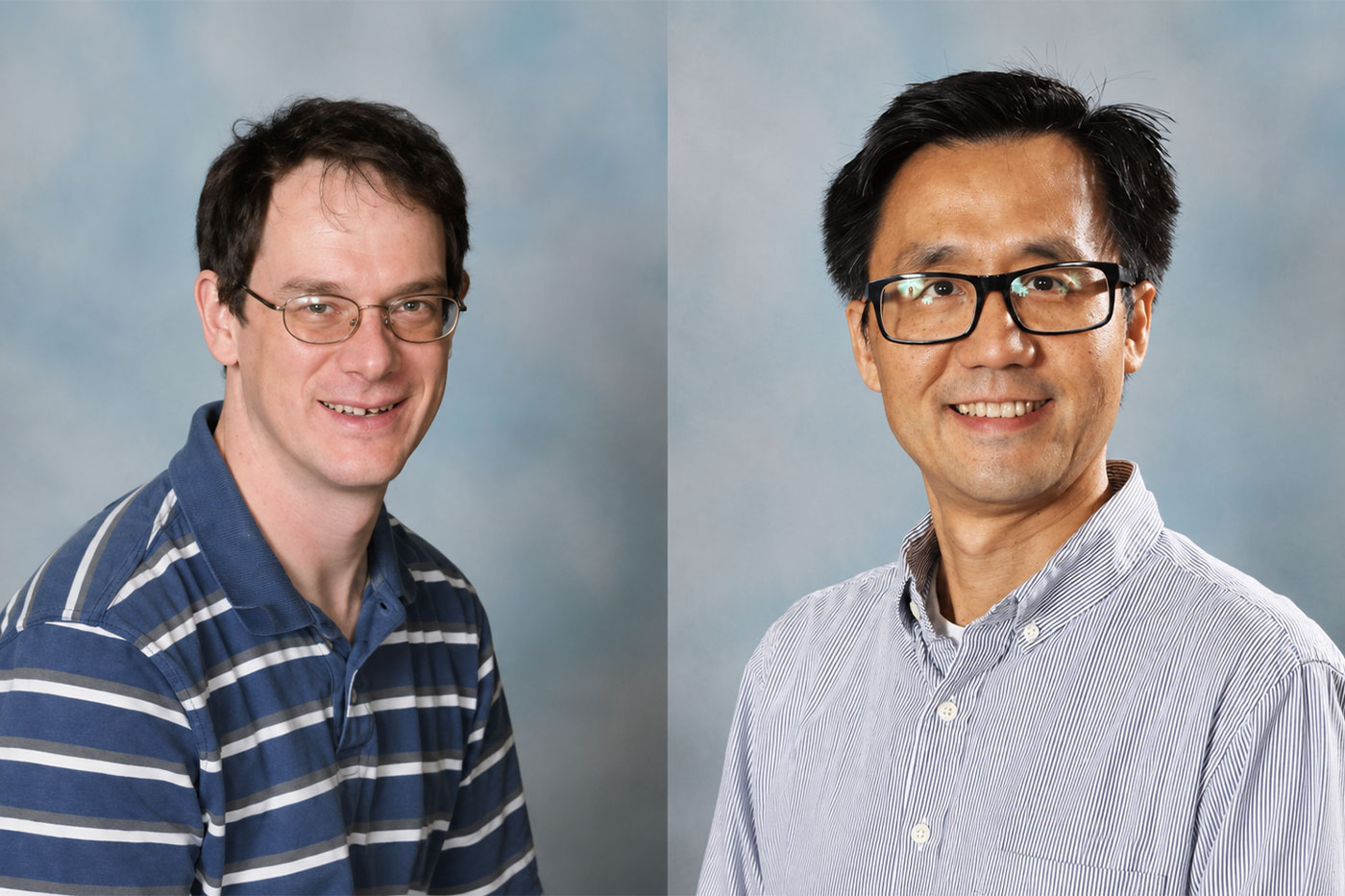 Peter Keyel and Kai Zhang
Keyel and Zhang both teach in the College of Arts and Sciences’ Department of Biological Sciences as an associate professor and professor, respectively. The project combines Keyel’s
research into the cell biology of membrane repair with Zhang’s parasitology knowledge.
Keyel’s typical research centers on how cells reseal after they get damaged.
There are several stressors that damage cells regularly, which require a membrane-repair
process to avoid a cell leaking its contents and dying. Keyel has focused on pore-forming
toxins (PFTs), capable of attacking immune cells, destroying cell barriers and promoting
the spread of bacteria, since his postdoctoral days.
In the infancy of the duo’s collaboration, they looked at using PFTs to put holes
in Leishmania cells. They found the toxins they used didn’t work without the removal
of the parasites’ key lipid component that contributes to the membrane structure.
“We built on that to try to figure out, ‘Why are these guys protected? What are the
mechanisms of damage?’” Keyel explained. “That’s moved into, ‘Do they repair membranes
the same way?’”
The main restoration mechanisms in humans include linking enzymes and proteins to
seal a hole, donating internal membranes to patch the external one, and sequestering
and shedding toxins from the cell.
During this project, Keyel and Zhang will look for commonalities between mammalian
cells and the Leishmania’s unicellular eukaryotic structure and aspects that can be
found in all Leishmania, as well as differences that will inspire new questions about
the where and why.
After the study establishes a base understanding, then comes the translational phase
of selectively targeting changes in repair, followed by the clinical process of using
an inhibitor or other solution and determining its efficacy and safety.
“We certainly have an eye out for translation and clinical development,” Keyel said.
“But even if we don’t get something right this round, if we learn more about these
processes, they give us that next round of questions, and then we build up the mechanisms
more.”
He anticipates having a graduate student help kick off the project in the fall by
leading training of undergraduates in biomedical techniques, with the cohort to participate
in subprojects over the course of the research.
Keyel emphasizes giving undergraduates ownership of their ideas and the ability to
explain their work.
“The goal is to get them involved and help them learn the assays, get the techniques,
and then, ‘Here’s the why and how we’re building it within that framework,’” Keyel
said.