
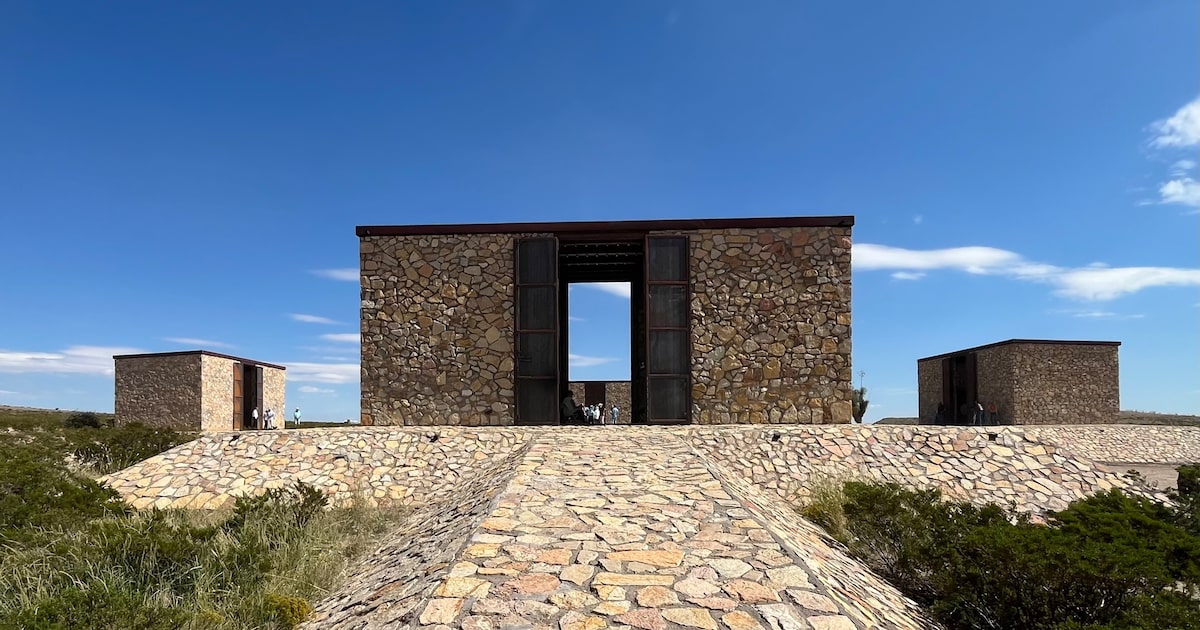
About 70 miles east of El Paso, isolated in the arid landscape of the Chihuahuan Desert, you will find one of the more remarkable, inscrutable and idiosyncratic works of 21st-century American art and architecture. If you are not familiar with the Hill, as it is called, you are not alone. The remote location and its maker’s reticent nature have largely kept it under the public’s radar. A writer for The New York Times claimed it “may be the most important artwork most people have never heard of.”
A visit requires an act of pilgrimage, one that entails a journey to West Texas and then a walk of more than a mile along a winding dirt road that tends to wash out in the rain. For those who travel up that path, the Hill’s striking forms gradually emerge on the horizon: a composition of four sharply defined block-like stone structures that looks like it might have been left by some ancient tribe of perfectionist builders. Within each structure are installations made of industrial materials — crushed glass, ball bearings, steel parts — that are abstract but exhibit vague religious associations.
Though it may appear to be the product of a mythical, long-vanished society, the Hill is the work of a single person, the artist James Magee, who built it virtually by himself over the course of nearly four decades before his death last year at the age of 79.
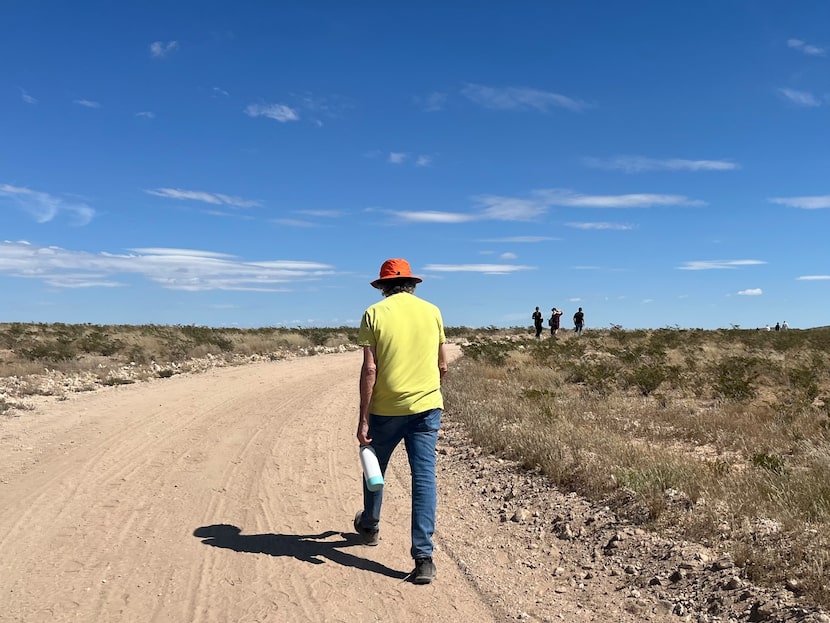
Visiting James Magee’s the Hill, in the desert east of El Paso, is a pilgrimage.
Mark Lamster / Mark Lamster
News Roundups
“It feels like this kind of monastic retreat for the postindustrial age,” says Jed Morse, a friend of Magee and the chief curator of the Nasher Sculpture Center. In the words of the late art historian and former Dallas Morning News art critic Rick Brettell, “anyone who has visited the Hill divides his or her life into two new parts — before and after the Hill.”
While the Hill was Magee’s singular masterpiece, it was incomplete when he died, and it is only a part of the complex legacy of an artist who defies easy categorization. Magee was not one artist but several, producing work as three distinct individuals: Magee himself, whose works were largely sculptural; Annabel Livermore, a painter of spiritually inflected canvasses; and Horace Mayfield, an artist and writer of profane homoerotic works.
“We all, and Jim in particular, contain multitudes,” says Morse of Magee’s personas and genders. “Jim wanted to do a lot artistically to speak to the incredible variety of the experience of life, and to him it didn’t make sense for it to be through a single artist, so he allowed himself to explore those artistic possibilities most fully as different personas.”
Taken together, they created a catalog of works, studios, homes and even a museum. Their wildly diverse characters have left Magee’s heirs with difficult questions regarding what can be preserved, what can be made accessible and how to support that legacy financially.
Magee vacillated over the future of his works, at one point considering a permanent closure of the Hill after his death. “The experience of the place is impossible without him because it was about him,” says Dallas architect Gary “Corky” Cunningham, a close friend of the artist who consulted on the Hill’s design and maintenance. Negotiations with friends and family conducted in the last years of Magee’s life convinced him that the Hill should be made accessible with certain conditions regarding crowds and photography.
“He was very controlled about how and where his art would be seen,” says his sister, Susan Wente. “We want to now take it and share it with the world, to start opening it up to visitation and getting people to know about him.”
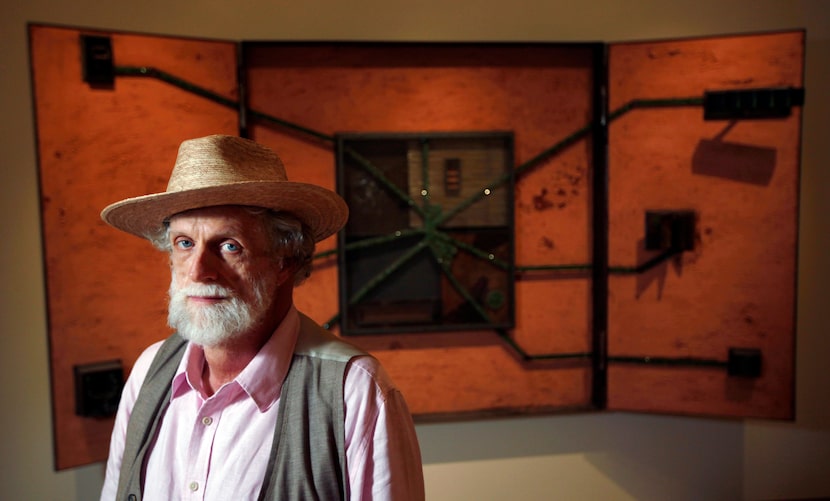
James Magee of El Paso combined steel, glass, rubber and other industrial materials in his artworks.
SONYA N. HEBERT/Staff Photograph
A special love
Magee’s life was as varied and itinerant as his art. Though his work is centered in and around his adopted home of El Paso, he was not originally from Texas, but rural Fremont, Mich. His father owned a Ford-Lincoln-Mercury dealership, which goes some way to explaining his use of automotive parts in his work. He was trained as a lawyer, and built a successful career in that field working for the United Nations in New York. But he was inherently restless and had the resources to do as he wished. He gave up his law career to work as, among other things, a welder, a security guard, an art historian, a poet, a cab driver and a roughneck in the oil fields around Odessa.
He landed in El Paso by chance in the early 1980s, after a train derailment left him stranded in the area. It was kismet; he immediately fell for El Paso’s quirky charm, dramatic landscape and sense of possibility. “Jim loved El Paso, and El Paso loved him,” says Eric Pearson, a longtime friend of Magee and the president of the El Paso Community Foundation, one of several local organizations charged with maintaining his legacy. “He chose this as the place where he wanted to do what he and many around him considered his life’s work.”
Magee endeared himself to the El Paso community not just as an artist but as a philanthropist. As Annabel Livermore, he endowed a fund that places fresh flowers in the chapel of the University Medical Center of El Paso. Magee had health problems of his own over the years; both his legs were amputated in the early 1990s due to complications from HIV/AIDS.
“He managed to engage hundreds of people in ways that people wanted to serve him,” says Chris Cummings, board chair of the Cornudas Mountain Foundation, the nonprofit Magee founded to support the Hill. “There was a special love of Jim that people developed whereby they would go out of their way to a sometimes ludicrous extent to help him.”
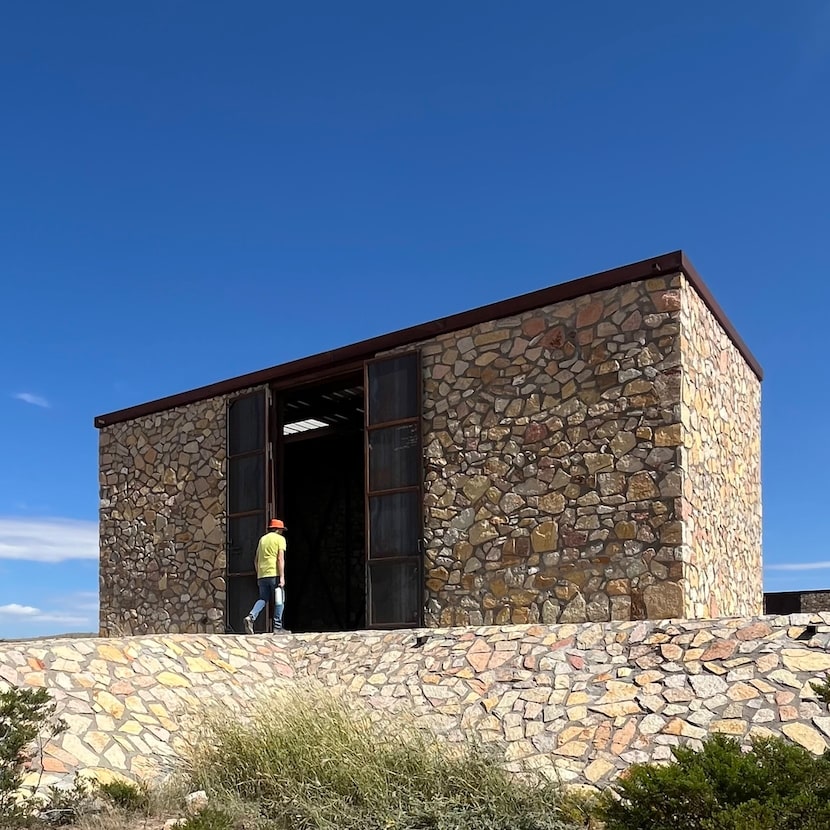
Architect Corky Cunningham enters the west building at James Magee’s the Hill.
Mark Lamster / Mark Lamster
The Hill
Magee began acquiring the scrubby desert land that would become the site of the Hill soon after his arrival in El Paso, the idea being to create a remote and almost sacred space to exhibit his own work, a place so secluded that no development would intrude on it. Over the ensuing years, he continued to acquire land around the project to protect its viewshed. As Rick Brettell noted, “there are no generators, no power lines, no telephone poles, no water lines — none of the tentacular connections that link ‘nowhere’ to ‘civilization.’”
On this tabula rasa, he began to assemble the four structures that define the Hill, using blocks of beige-colored native stone. The construction technique is simple, borrowed from vernacular building around El Paso, making it familiar for the day laborers who would occasionally assist him, though he liked to work by himself, even after his legs were removed. He wore prosthetics and was fairly nimble.
With little around them to provide a sense of scale, the size of the buildings is hard to measure until you are up close to them, and even then it is challenging, as they are elevated about six feet above ground level on splayed stone foundations. Their metal roofs appear flat, but are in fact slightly raked, and have flush skylights to bring natural light to their interiors. Although he did not consider them works of architecture, their proportions (40-by-20 feet, and just over 16-feet high) and crisp, minimal lines recall the best works of Philip Johnson, in particular the brick house at his Glass House compound in New Canaan, Conn.
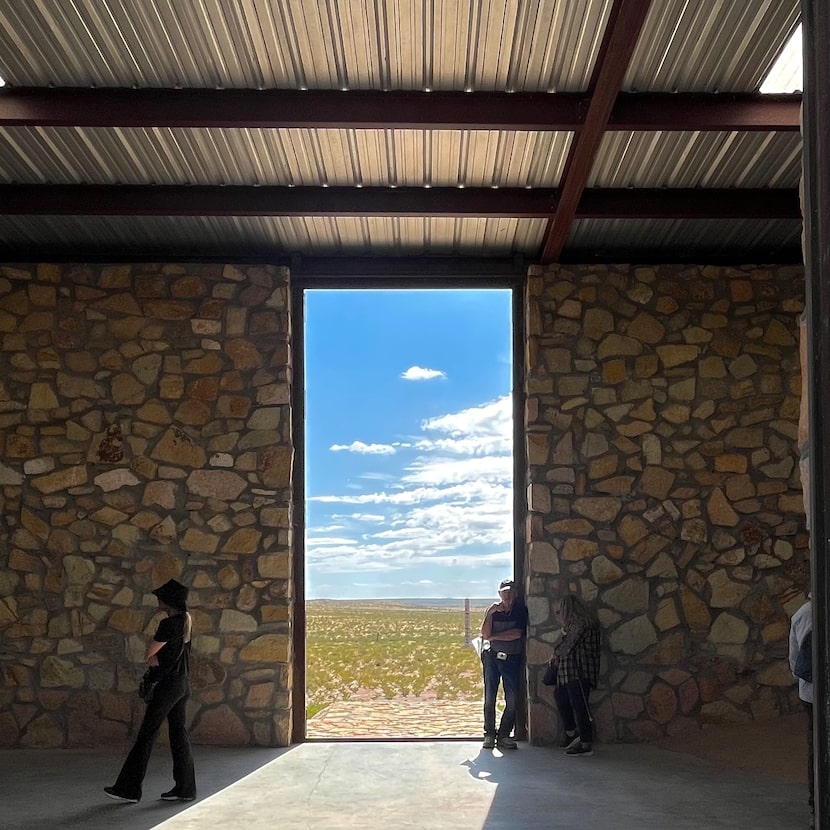
Interior of James Magee’s south building of the Hill.
Mark Lamster / Mark Lamster
The four buildings sit roughly on the cardinal points of the compass (Magee was his own, imperfect surveyor), linked by raised causeways. From the air, the site looks like a giant plus sign or Greek cross. Each building has massive steel doors on both of its long sides, such that someone standing at the center of the cross can look straight through them to the desert beyond.
Magee finished three of the buildings, but was still tinkering with the interior of the fourth, the west building, when he died. “He had enormously ambitious ideas for the fourth building that were constantly changing,” says Morse. “He just didn’t have time to get all of it worked out.” Those plans included a glass floor that could have been mechanically raised and lowered.
The unfinished floor was a preservation conundrum. Leaving it untouched would have made the building inaccessible, but completing it seemed impossible, given Magee’s ever-shifting plans. “We didn’t want to make assumptions about what Jim would’ve decided, because we’re not Jim,” says Morse.
The solution came from Cunningham, who suggested simply covering the unfinished space with plywood boards that would not be confused with Magee’s work. They were installed this fall, along with one of Magee’s large installation works. “The boards cover up about 50,000 pounds of steel and hydraulics that he abandoned because he couldn’t get it to work,” says Cunningham. “He was getting a little bit out of control with this stuff.”
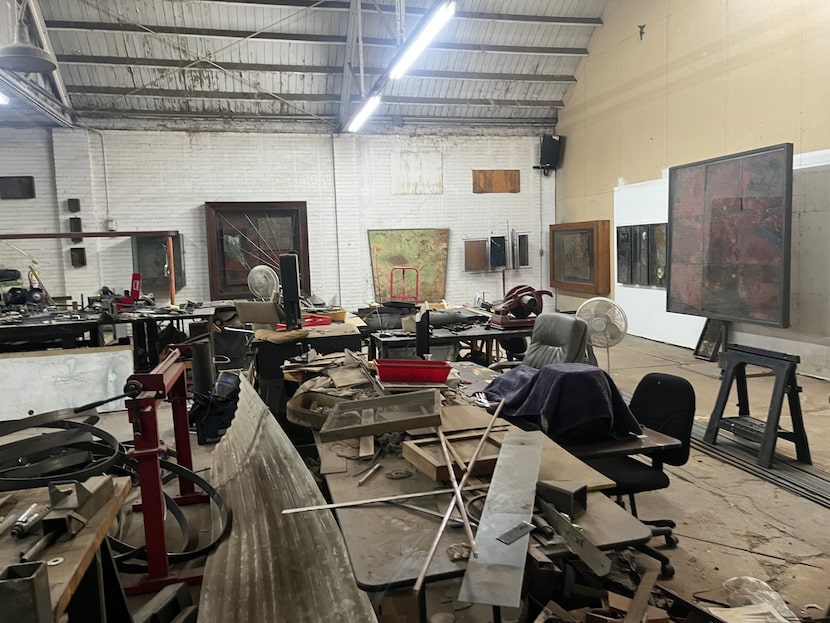
James Magee’s El Paso workshop, in a repurposed auto body shop.
Mark Lamster / Mark Lamster
Other personas, other spaces
A sense of Magee’s unruly imagination is evident on a visit to his studio workshop, a repurposed auto body shop in a historic industrial neighborhood in south El Paso. Here, finished and incomplete works share space with piles of scavenged material — glass bottles, automotive parts, industrial scrap — that were the fuel of Magee’s artistic practice. Sitting in one corner of the shop is a makeshift crane Magee designed so he could be hoisted up to see his works-in-progress from above.
Among the objects left behind is a scale model of the Hill’s fourth building adorned with Magee’s final vision of what would occupy that space: an all-over painting of abstract purple veins that would have spread across its floor and up its walls, looking more like the work of Annabel Livermore than James Magee. “This is Annabel,” says Cunningham. “He told me this driving back from the Hill one day. I said, ‘Jim, Annabel is messing with your stuff.’”
Plans are to retain the workshop and open it to the public, with sections preserved as Magee left them, and other rooms meant for the presentation of his works and those of Livermore and Mayfield.
Livermore also has a small museum dedicated to her work that will remain open. El Museo Livermore, as Magee named it, is in a nondescript bungalow on a street of working-class homes in eastern El Paso. It is barely more than 750 square feet, with the better part of that space occupied by a cycle of nine quasi-surrealist paintings titled The Journey of Death as Seen Through the Eyes of the Rancher’s Wife. Displayed in a darkened room with walls of deep crimson, the paintings achieve an almost spectral power, with dripping phantasms animated by explosions of red, gold and yellow.
The poetic title of the series was characteristic of Magee in all of his personas; he would often recite them to those viewing his (or rather, their) works. “He would stand behind you and you had to face the pieces and you couldn’t face him,” says Pearson. “There was always some theater involved.”
To fund the maintenance and preservation of the Hill and Magee’s other spaces, the El Paso Community Foundation (which oversees the Cornudas Mountain Foundation) intends to sell off the homes in El Paso that Magee had bought as residences for himself and for Livermore. Among the foundations’ immediate plans are a new walking path at the Hill, to keep visitors off the maintenance road, and a new roof for El Museo Livermore.
According to Pearson, this will require about half a million dollars annually, of which the foundations can currently cover 70%. That leaves a significant but not insurmountable funding challenge. “He left us with a legacy that we want to protect not only for El Paso to enjoy, but for people around the world to be exposed to,” says Pearson. “That’s our charge, and we take it very seriously.”
 Letters to the Editor — Pros and cons of keeping Dallas City Hall, Medicaid, education
Readers debate about Dallas City Hall; comment on Medicaid; and remeber what used to work in education.
 Lamster: Keep your hands off Dallas City Hall
Why demolishing I.M. Pei’s iconic building would be a financial boondoggle and an architectural travesty.