
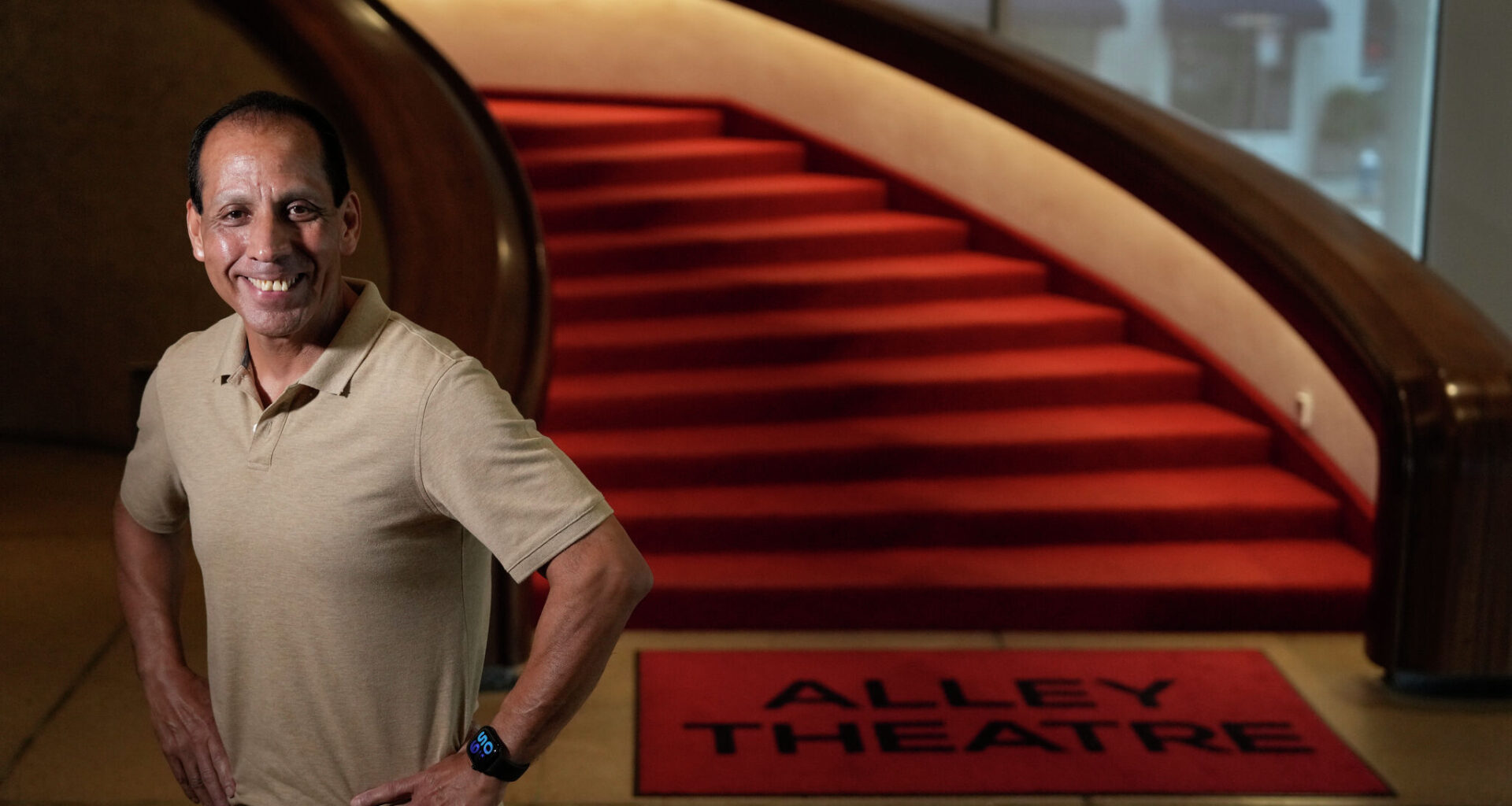
Daniel Naranjo, chief engineer, is shown at the Alley Theatre in Houston Wednesday, July 15, 2026.
Melissa Phillip/Houston Chronicle
Daniel Naranjo, chief engineer, talks about the flood water wall at the Alley Theatre in Houston on Wednesday, July 15, 2026. The upper line marks the 2017 Hurricane Harvey high-water level, while the lower line marks the 2001 Tropical Storm Allison high-water level.
Melissa Phillip/Houston Chronicle
Daniel Naranjo, chief engineer, talks about the flood water pumps located in the prop room at the Alley Theatre in Houston Wednesday, July 15, 2026.
Melissa Phillip/Houston Chronicle
Daniel Naranjo, chief engineer, is shown at the Alley Theatre in Houston Wednesday, July 15, 2026.
Melissa Phillip/Houston Chronicle
There is something delightfully and appropriately Shakespearean about Daniel Naranjo, chief engineer of the Alley Theatre. A slim man with a catlike way of moving through the venue’s labyrinthian back passages, he appears much younger than his 57 years when giving a tour. Few would guess he is now the longest-tenured employee, having first come to the Alley as an engineer in 1990 from FMS- Facility Maintenance Service at just 21 years old.
Thirty-six years of hanging around actors has rubbed off on him. He oversaw the renovations to the Alley following both Tropical Storm Allison and Hurricane Harvey and is quick to point out markers where the floodwaters crested in his beloved building. At each one, he gives a little, slightly heartbreaking monologue, sounding like a soldier recalling a war.
“Everything you see was literally destroyed,” he says, gesturing to a room filled with electrical equipment. “The water didn’t come in a rush. It seeped in between the cracks throughout the night, filling up the spaces. During Harvey, my engineers sent me videos as they walked through the tunnels. The flood flowed down the walls like a waterfall.”
Article continues below this ad
The Alley is unique in the Houston theater district in that it’s the only building actually owned by its performing arts organization. The Brutalist structure was built between 1966 and 1968 and gifted to the theater company thanks to the Houston Endowment, the Ford Foundation, and money raised from private donors. Maintaining it has been an internal job ever since.
Naranjo knows almost nothing of his early life before moving to Houston as a baby, not even the exact year of the move. Born in Sinton, Texas, he was already a licensed engineer as a teenager in 1986. Back then, the Alley hired outside contractors for their maintenance, only developing an in-house team in 1990. Naranjo was one of the first hired thanks to a reputation for hard work and competence.
At first, he didn’t know what to make of the theater business. Years working with the hard reality of buildings and maintenance had not prepared him for professional make-believe. His first day wandering around the building, the actors perplexed him.
“I would walk through there and I would hear the actors in the lobby talking to themselves,” he says. “Then I realized he’s rehearsing. I was just not a theater person.”
Article continues below this ad
A fortress against floods
That changed in his first year. In 1990, the Alley debuted the musical “Jekyll & Hyde,” a lavish production that would soon take Broadway by storm. It remains one of the Alley’s brightest successes, and Naranjo fell in love with the theater watching it take form.
“People were lined up outside the box office when I got to work,” he says. “The singing. The dancing. It’s one of my favorite things of all time.”
Naranjo dedicated himself to preserving that theater magic. He’s risen through the ranks over seven regimes. Noone knows the building like he does. His greatest accomplishment has been overseeing the protection of the Alley for the next inevitable storm.
Throughout the tour, Naranjo explains how the Alley is now a fortress against floods. Every wall has been rebuilt and reinforced with steel supports. The welds on the latter are large and bold, trading any aesthetic beauty for raw power.
Article continues below this ad
Two massive sump pumps that can run on backup generator power stand ready for the next wave of water. Meanwhile, every portal that leads to the parking garages, tunnels, or loading dock now has a flood door worthy of a battleship. His team is regularly drilled in how to deploy them when the next major storm is predicted to hit the city. The process takes hours and is all done by hand. Some of the doors in the public facing parts of the building are so cleverly hidden that no one would notice them if not pointed out.
When Naranjo puts his hand on one of the heavy, watertight doors, he smiles like a fighter who has trained hard and is confident of victory.
“It won’t be like that again,” he says.
Protecting the space
Despite his long employment, Naranjo has no plans for retirement. He’s grown used to the hectic world of theater, clocking in on opening nights when needed. After every show closes, he goes over the dressing rooms with a careful eye, quick to repair any blemishes or scratches on the walls.
Article continues below this ad
For him, the Alley building is a place for people to discover stories and live their lives. He maintains and protects the space as an act of care, with a love nurtured and tended across almost four decades.
“We literally come here every time there’s a show over because we recognize the actors are actively important,” he says. “We know them. They’re co-workers, and they’re friends. I just want to make sure this is a nice place for everyone.”