
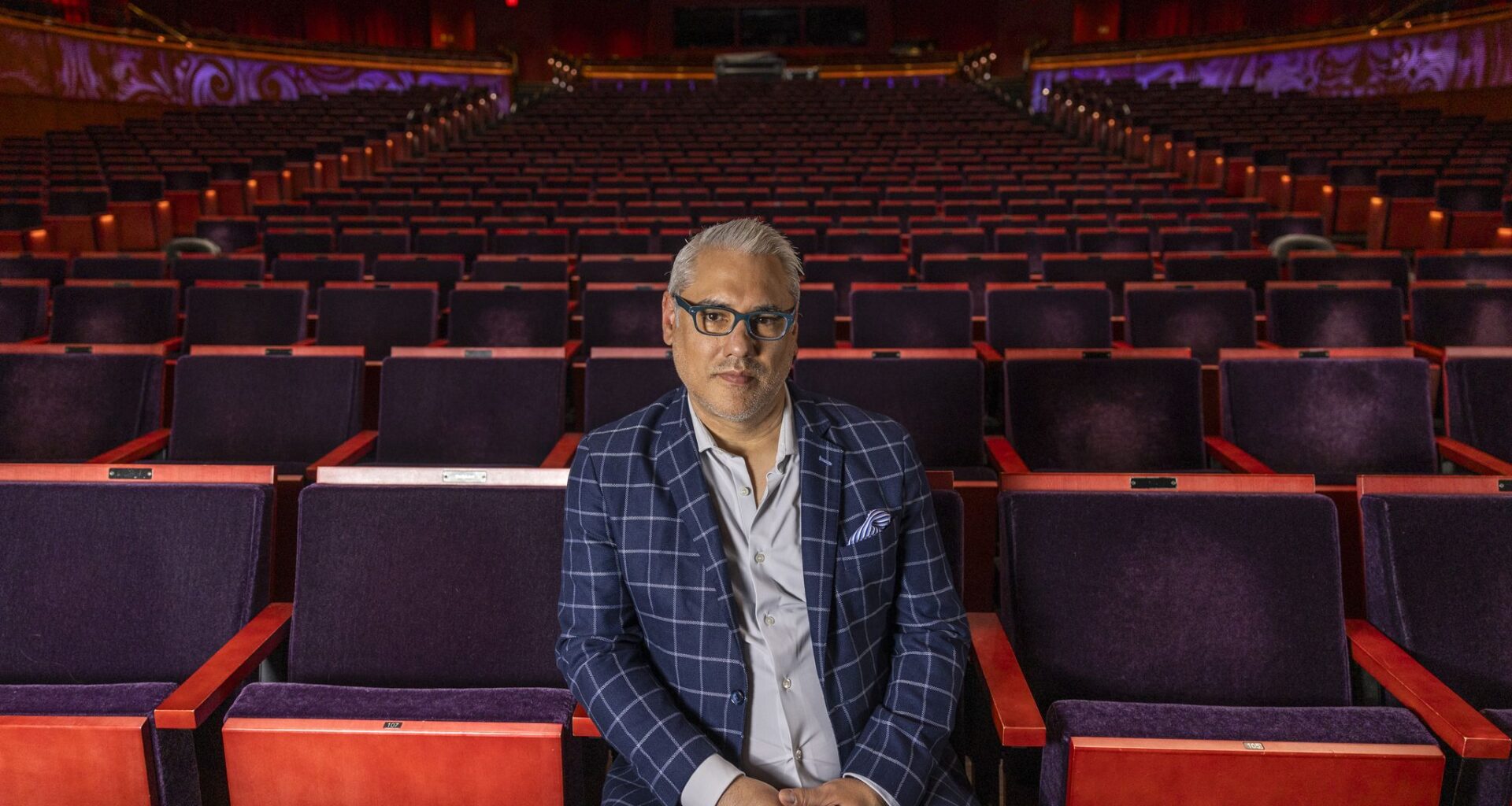
Paul Montalvo, president and CEO of the Orchestra San Antonio, resisted practicing the piano as a child. Classical music didn’t do much for him. Years later, he developed a passion for it.
Andrew J. Whitaker/San Antonio Express-News
On the last Friday in March, the lobby of the Tobin Center for the Performing Arts was packed with people eager to spend an evening listening to the Orchestra San Antonio.

As might be expected, many were older, classical music buffs who likely developed a taste for Shostakovich and Beethoven in their youth. But there were 20- and 30-somethings in the mix, too, as well as a few families. Music lovers crowded into the Feik Family Rotunda for a lively pre-concert discussion with Music Director Leonardo Pineda, composer Daniel Freiberg and trumpeter Pacho Flores about the music they were going to present.
Article continues below this ad
Paul Montalvo, who co-founded the classical music nonprofit and serves as its president and CEO, was in the lobby, warmly greeting people.
When the concert began, the H-E-B Performance Hall was nearly full. The audience responded enthusiastically to the music, played by a diverse ensemble of musicians, most at the start of their careers.
Evenings like that are important to Montalvo, a retired firefighter and lifelong metalhead who developed a passion for classical music in his 20s. But he wants to do more than stage concerts. He sees classical music as a force for change. And that’s why educational programming is central to everything Orchestra San Antonio does. The aim is to show youngsters a world of possibilities they might not otherwise see.
Article continues below this ad
“Our north star is to give opportunity at the highest level where there is no opportunity,” Montalvo said. “That is my mission until I’m done with this earth. There isn’t a more beautiful way to do it than through music.”
The path to classical music
Montalvo, 54, got his first taste of music education when he was 7 and his parents signed him up for piano lessons.
MORE CLASSICAL MUSIC: Youth Orchestras of San Antonio is losing its longtime music director
Article continues below this ad
“I think they realized, even though they didn’t have backgrounds in music, they realized the importance of it,” he said.
Montalvo did not. He wanted to be outside with his friends, and getting him to practice was always a fight. So, when he was about 11, his parents let him quit.
Freed from his lessons, he focused on soccer and basketball. He took up tennis in the eighth grade, but an arm injury forced him to give it up. After he graduated from Lee High School, he went to the University of Texas at San Antonio, where he felt adrift.
“I didn’t really take to anything,” he recalled. “I was bored. I took accounting, electrical engineering, whatever. Nothing stuck. It wasn’t that I was bad at it. I just didn’t really care.”
Article continues below this ad
His father, a physicist who worked for the Southwest Research Institute for 43 years, had been footing the bill for all those classes and decided he was done. So Montalvo left school and went to work, first in restaurants and then with Security Service Federal Credit Union.
His older brother was a firefighter and suggested that he give that a try. He did, joining the San Antonio Fire Department in 1995.
About a year later, something clicked with classical music in a way he can’t quite explain. Maybe a seed was planted in those piano lessons he didn’t like as a kid. He had always been a heavy metal fan (he still listens to Metallica and Iron Maiden). But he started exploring classical music in a big way. He began collecting CDs and eventually amassed more than 12,000.
Listening to the music wasn’t enough. He wanted to make it, too. He bought a piano, and he went back to school at UTSA at 26 in hopes of becoming a conductor.
Article continues below this ad
He majored in music composition with a minor in conducting. He often pulled double shifts on weekends at the fire station to make his work and class schedules jibe.
“I was working full time and also taking 21 hours a semester, and that was tough,” he said. “I don’t think I could do it now.”
Eugene Dowdy, who led the university’s orchestral studies and instrumental conducting programs at the time, recalled Montalvo as something of a perfectionist.
“He does not like messing around,” said Dowdy, who retired from UTSA and now teaches at Schreiner University in Kerrville. “I remember telling him, ‘OK, you’re going to want to get an ensemble, you’re going to conduct it,’ because I wanted him to have real world experience.
Article continues below this ad
“And I remember, even back then as an undergrad, he was like, ‘Well, are our students good enough players?’ And I’m like, dude! I think you’re skipping a step!”
Montalvo was 30 when he earned his degree. “I wanted to be a conductor still,” he recalled. “I didn’t have the chops, and it was so late. So I was kind of in limbo for a few years.”
Creating an orchestra
In 2008, he was talking to some fellow classical music lovers about San Antonio’s live music scene.
Article continues below this ad
“There wasn’t a professional chamber orchestra, so we said, ‘Let’s put some repertoire out there that’s not heard so often, have a nice group, come up with an education program later,’ ” he said. “So we did that.”
Montalvo read up on fundraising and applied what he learned, networking at every opportunity. The Chamber Orchestra of San Antonio debuted in the fall of 2012.
It was one of the original resident companies at the Tobin Center, along with the San Antonio Symphony, Opera San Antonio and Ballet San Antonio. It was re-branded the Classical Music Institute in 2017, a change that reflected the organization’s commitment to education.
By 2020, Montalvo started to think about other pursuits. The following year, he retired from the fire department and began reducing his role with the Classical Music Institute.
Article continues below this ad
Then the San Antonio Symphony folded. Classical music boosters worried the city was looking at a future with no professional orchestra. In addition to silencing the symphony, the collapse had the potential to hurt the opera and ballet, which relied on symphony musicians for many of their productions.
FLASHBACK: San Antonio Symphony board pulls the plug on 83-year-old orchestra
There were concerns the ripple effects would reach well beyond the Tobin Center, making the city less appealing to people and businesses weighing a move here.
Donors step up
Montalvo, who was still planning to hand over leadership of the Classical Music Institute, thought the organization could help by accelerating its plan to add an orchestra to its offerings. He came up with a $560,000 proposal to put musicians in the pit for ballet and the opera performances. Those groups wouldn’t have to pay a penny.
Article continues below this ad
He shared the plan with a couple of donors in hopes of securing their financial support.
“They said, ‘We’ll only do that if you come back and work full time,’ ” he said. “And then they each wrote a $50,000 check. And that started us on this road.
“That’s when we went from being a $310,000 organization in ’22 to $1.6 million in fiscal year ’23. Looking back on it, it’s kind of surreal.”
Paul Montalvo, president and CEO of the Orchestra San Antonio, resisted practicing the piano as a child. Classical music didn’t do much for him. Years later, he developed a passion for it.
Andrew J. Whitaker/San Antonio Express-News
Another key source of support was Bexar County, which gave the organization $300,000 to get the orchestra started.
Article continues below this ad
“I want to make sure a symphony survives,” said former Bexar County Judge Nelson Wolff, who was honored for his support at an Orchestra San Antonio gala last fall. “It’s really, really important for the community. Thank goodness he stepped up, because we had to do something.”
Wolff also liked that Montalvo wanted to create an ensemble that reflected the ethnic diversity of the city.
The newly formed CMI Orchestra initially played solely with the ballet and the opera. It gave its first standalone concert as the Orchestra San Antonio before a sold-out house in April 2025, followed by a three-concert 2025-’26 season, which wrapped up June 9.
The entire organization – including chamber music and symphony orchestras and the education program – is now known as the Orchestra San Antonio. It is slated to announce its 2026-’27 season in mid-August. Frost Bank is the headline sponsor for the concert series, an arrangement that will run through the 2029-30 season.
Article continues below this ad
MORE LIVE CLASSICAL: Yo-Yo Ma headed to San Antonio this fall
“On the artistic side, they had really stood in the gap as what I call the symphonic resource of our community,” said Phil Green, chairman and CEO of Frost Bank, who also is a musician. “But I think the thing that really caught our attention and really drew our commitment was the way they approach music education for young people in the city.”
Green said he was particularly taken with Ascend, Orchestra San Antonio’s free after-school strings program. It models its approach on El Sistema, the famed Venezuelan program that uses free music training to help lift youngsters out of poverty.
Ascend started with a trial run in March 2024 at Stafford Elementary School, an Edgewood Independent School District campus on the West Side. It was back at Stafford for a full school year that fall, and then expanded to Japhet Elementary School, a San Antonio ISD campus on the Southeast Side. Plans are being made to add a third school this fall.
Article continues below this ad
Several Ascend teachers are products of El Sistema, including music director Pineda, who is a conductor and violinist. Montalvo encouraged him to make the leap to conducting, and he considers him a mentor.
A different vibe
Pineda said that when they talk through music programs, Montalvo always asks a question that gets to the heart of what he wants the Orchestra San Antonio to achieve: Why would anyone care?
“It’s been the best question that anybody can ask an artistic leader, because it forces you to think why would anybody support it, why would anybody go to this concert?” Pineda said. “It shapes the DNA of the organization so it doesn’t look exactly as a traditional orchestra would look.”
Article continues below this ad
That also gives the orchestra’s concerts a distinctive feel. They draw large crowds of all ages, including the very young.
“You’re going to hear a baby crying, because they’re inviting families in,” said Mike Fresher, president and CEO of the Tobin Center. “They’re inviting folks from the entire community. And so it’s a different experience. People cheer, people laugh, people clap.
“It’s not only this exceptional musical experience, but he has this goal of just enriching the community with classical music,” Fresher said of Montalvo. “And whether that’s doing it at the school level or doing it at the Tobin Center level, it’s important for him that what he’s doing embraces the entire community.”
That approach is reflected in comparatively low ticket prices: $19 to $95 for Orchestra San Antonio concerts last season.
Article continues below this ad
Dowdy said he has heard at least three works at Orchestra San Antonio performances he didn’t recognize and was excited to discover. That included Juan Pablo Contreras’ mariachi-inspired piece “Mariachitlán” and Arturo Márquez’ “Concierto de Otoño.” The Márquez work was written for trumpeter Pacho Flores, who played it at the concert.
“Normally, I’ll at least know the name — and I know a lot of modern composers — but these were even beyond that,” he said. “That’s the kind of artistic leadership that’s there. It’s like being an investigative journalist. You have to kind of go after the story. It’s not going to always come to you. And they’re going after it. That group is really looking for beautiful, connecting, exhilarating music.”
Into the future
Montalvo devotes much of his time to TOSA, but when has a break, he enjoys sipping a single malt scotch, smoking a cigar and reading a good book — ideally, all at the same time. He also is settling into marriage. He and Mariana Vela marked their first anniversary in May. They got to know each other through the group. She has worked with it for more than 10 years, and now serves as vice president of media and marketing.
Article continues below this ad
The couple and the rest of the organization have seen it grow swiftly.
Its budget has grown from $1.6 million to $3 million in the past four years. Next season, the orchestra will offer a four-concert season. Each program will be performed once. When it makes sense financially, programs will be repeated at a different venues to expand the orchestra’s reach.
Long-term plans call for Ascend to be available from elementary through high school on campuses across the city.
Montalvo and his team are aware of the financial problems that brought down the San Antonio Symphony, and they know its successor, the San Antonio Philharmonic, has struggled to find its footing. They’re also aware that a third orchestral organization, Harmonium of Texas, will make its debut this fall.
Article continues below this ad
Montalvo wishes them all well. But he’s not concerned about what other orchestras are doing.
“It doesn’t really keep me up at night,” he said. “Because I know our path, our team knows our path, and we’re going to stick to it no matter what happens.”