
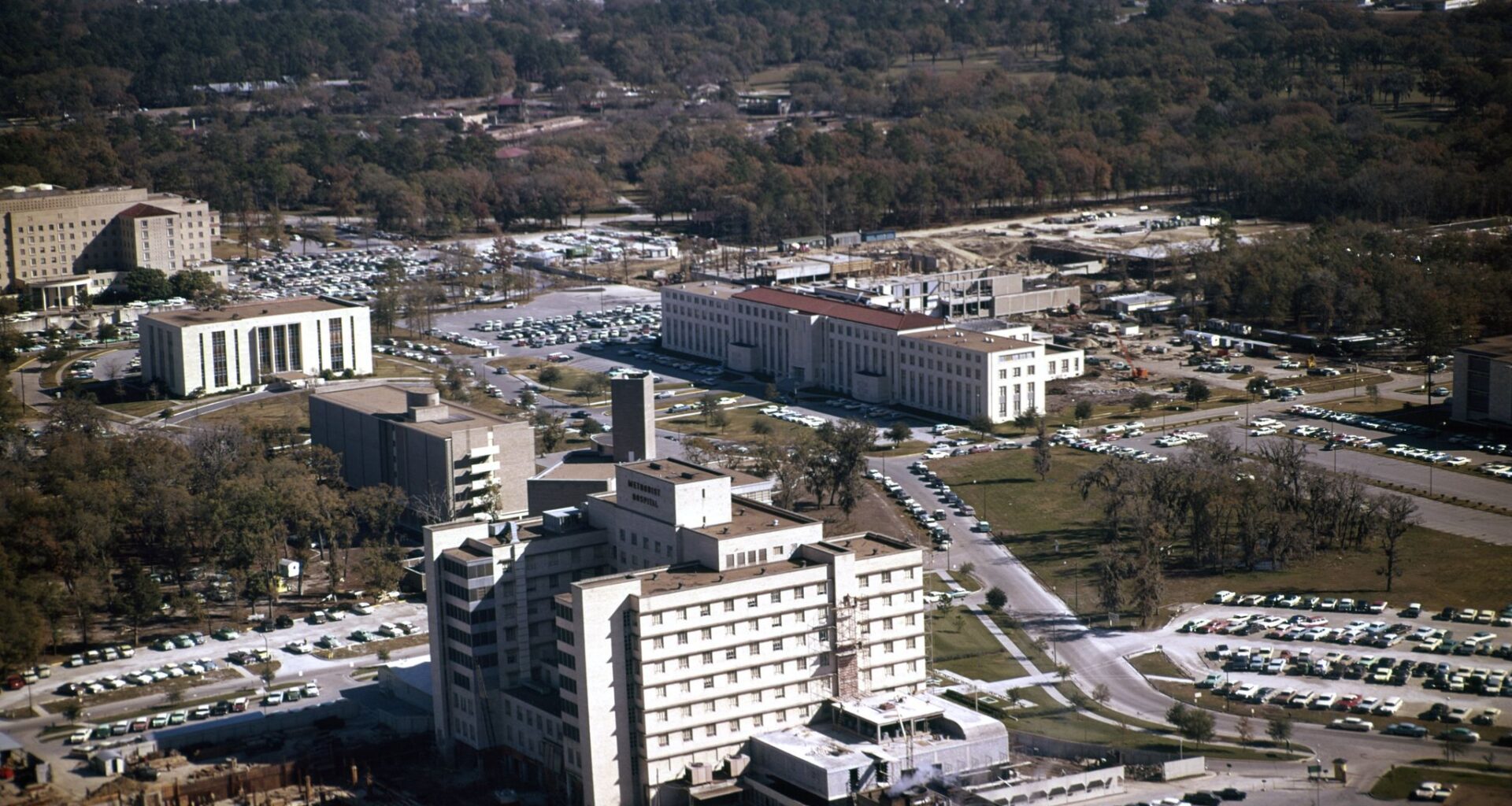
An aerial view of the Texas Medical Center and Methodist Hospital, now Houston Methodist, in 1960
Houston Chronicle
The TMC3 Collaborative Building opened in Helix Park in October 2023.
Annie Mulligan/Texas Medical Center
David Vetter, known as the Bubble Boy, was able to venture outside at age 6 in his space suit designed by NASA engineers. It was his first walk outside of his plastic sterile environment in 1978.
James de Leon Jr./Baylor College of Medicine
Sam Haynes, a member of the TIRR Memorial-Hermann Hotwheels wheelchair basketball team, shoots the ball during warm-ups before a 2023 scrimmage.
Jon Shapley/Staff photographer
Dr. Michael E. DeBakey and a team of Baylor surgeons implanted a patient with an artificial heart pump in 1965 in a televised surgery.
AP/AP Wirephoto
Dr. Denton Cooley, 78, operates on a patient in 1999. In 1968, Cooley earned acclaim for performing the first successful heart transplant in the nation and on April 4, 1969, became the first surgeon anywhere to implant an artificial heart in a human.
DAVID J. PHILLIP/AP
An aerial of Texas Medical Center in 1947. The arrow at right points to the location of the proposed MD Anderson Hospital.
Houston Chronicle
Texas Children’s first patient was 3-year-old Lamaina Leigh Van Wagner in 1954.
Texas Children’s Hospital
Over the past century, the site of what is now the Texas Medical Center has grown from just one hospital to the world’s largest medical complex.
Most of the land that would become the medical center was designated as a city park when the old Hermann Hospital became the first to open in the area in 1925. Voters approved the sale of that land for a medical center in 1943, and construction boomed after World War II.
The medical center is now home to 49 member institutions, including the largest children’s hospital and cancer hospital in the world. There are more than 120,000 employees working in the complex, which handles about 10 million patient encounters every year.
Article continues below this ad
Here’s a look at some of the key milestones that shaped the development of the Texas Medical Center.
1925
Hermann Hospital opens
Hermann Hospital, named after 19th century civic leader and philanthropist George Hermann, opens in the neighborhood that would later become the Texas Medical Center. The Hermann Hospital School of Nursing opened the same year and operated until 1973.
The hospital, which affiliated with the University of Texas in 1968, now serves as the primary teaching hospital for UTHealth Houston.
Article continues below this ad
Hermann Hospital merged with the Memorial Healthcare System, a network of suburban hospitals, in 1997 to become the Memorial Hermann Healthcare System.
1942
MD Anderson Hospital of Cancer and Research established
The University of Texas establishes the MD Anderson Hospital of Cancer and Research, the first member institution of the Texas Medical Center. Named for the civic leader, banker and cotton trader Monroe Dunaway Anderson, the hospital opens in 1944 in downtown Houston before moving to its current location in 1950.
The hospital earned a reputation for world-class cancer treatment, with the National Cancer Act of 1971 designating it as one of three comprehensive cancer centers in the United States. MD Anderson has been either first or second for cancer care since U.S. News & World Report debuted its Best Hospitals rankings in 1990.
Article continues below this ad
1943
Voters approve the medical center
The city of Houston and the MD Anderson reach an agreement on the purchase of 134 acres of land next to Hermann Hospital to establish a medical center. The deal required voter approval in the fall of 1943 because the land had previously been designated a city park.
Baylor University College of Medicine also moves to Houston from Dallas to become a member institution. It moved into its current site, the first building completed in the Texas Medical Center, in 1947.
In 1969, the college separated from Baylor University to become the independent Baylor College of Medicine.
1946
Future VA hospital opens
The U.S. government opens a hospital on a 118-acre site at Old Spanish Trail and Alameda Road. It operated as a naval hospital until 1949, when it was transferred to the Veterans Administration and renamed the United States Veterans Administration Hospital.
Article continues below this ad
The VA opened its current facility on the same site in 1991. The hospital is now known as the Michael E. DeBakey VA Medical Center, in honor of the renowned cardiovascular surgeon and U.S. Army veteran who played a key role in establishing what would become the Veterans Health Administration system.
1949
Blue Bird Circle clinic opens
The Blue Bird Circle opens its clinic for pediatric neurology. The clinic is associated with Methodist Hospital until 1998, when it forms a new association with Texas Children’s Hospital.
The Blue Bird Circle began in 1923, supporting various causes until it decided to focus on research and treatment of children’s neurological conditions in 1952.
1951
Methodist Hospital, Baylor medical school relocate
The Methodist Hospital opens in the Texas Medical Center. It was formally chartered in 1919, when Dr. Oscar Norsworthy transferred his Norsworthy Hospital to the Methodist Episcopal Church. Methodist Hospital was previously located at San Jacinto and Rosalie downtown.
Article continues below this ad
The hospital is renamed Houston Methodist in 2013, in part to differentiate itself from other Methodist hospitals across the U.S.
1952
Welch Foundation funded
Robert Alonzo Welch, a South Carolina native who had amassed a substantial fortune in Houston’s oil and sulfur business, died at age 80. He left an estate of approximately $25 million to be used to create a charitable foundation to support research in chemistry. The Houston-based Welch Foundation supports chemical research; in 2026 it will award $31 million to support Texas researchers.
1954
Texas Children’s and St. Luke’s open
Texas Children’s Hospital opens and welcomes its first patient, a 3-year-old girl named Lamania Leigh Van Wagner. Over the years, the hospital has grown from a three-story building with 106 beds to an internationally recognized children’s hospital that is the largest in the United States.
St. Luke’s Episcopal Hospital also opens with 354 beds. It has been known as St. Luke’s Health since Catholic Health Initiatives, a Colorado nonprofit that was one of the nation’s largest faith-based health systems, bought St. Luke’s Episcopal Health System in 2013.
1959
TIRR is established
The Texas Institute for Rehabilitation and Research opens in the Texas Medical Center. Dr. William A. Spencer founded what would later be known as TIRR in 1951 as the Southwestern Poliomyelitis Respiratory Center, one of the first polio treatment centers in the nation.
As polio became less of a threat, the hospital focused more on treating a broader range of catastrophic injuries and illnesses. It adopted its current name, TIRR Memorial Hermann, after joining the Memorial Hermann Health System in 2006.
1962
Texas Heart Institute is founded
The Texas Heart Institute is founded by cardiac surgeon Dr. Denton Cooley as a research and education center affiliated with St. Luke’s Episcopal Hospital and Texas Children’s Hospital.
Cooley and the THI soon earn recognition for a series of milestones, including Cooley performing the first successful heart transplant in the United States in 1968 and the world’s first implantation of an artificial heart in 1969.
1963
Ben Taub Hospital opens
Ben Taub Hospital, named for the prominent Houston philanthropist who helped develop the medical center and the University of Houston, opens next to Baylor College of Medicine. Houston voters approved plans for the public charity hospital in 1958, intending it as a replacement for the aging Jefferson Davis Hospital.
In 1965, Harris County residents voted to establish the Harris County Hospital District to oversee Ben Taub and Jefferson Davis, which closed in 1989. The entity is now known as Harris Health System and continues to oversee Ben Taub and Lyndon B. Johnson Hospital in northeast Houston.
Ben Taub opened a new, 575-bed hospital next door to the original facility in 1990.
1965
DeBakey performs televised surgery
Dr. Michael E. DeBakey performs the first surgery that is televised by all three national networks. He inserts an artificial aortic valve into a patient’s heart at The Methodist Hospital.
DeBakey, the former president of Baylor College of Medicine who is known as the father of modern cardiovascular surgery, is one of the most influential health care figures in Texas history. His accomplishments include the creation of the Dacron graft that is used to repair blood vessels weakened by aneurysms; pioneering the development of artificial heart pumps; and performing the first successful coronary artery bypass in 1964.
1968
DeBakey leads multi-organ transplant
DeBakey leads the first multi-organ transplant at The Methodist Hospital. Five surgical teams comprised of 70 doctors, nurses and surgical technicians are needed to transplant a heart, lungs and kidneys from one deceased donor into four patients.
The operations mark the first heart transplant at The Methodist Hospital, as well as the first lung transplant in Houston (and only the sixth in the world).
1969
Cooley implants artificial heart
Dr. Denton A. Cooley makes history by being the first surgeon to implant an artificial heart into a patient April 4 at St. Luke’s Episcopal Hospital. The 47-year-old patient survived the operation and received a donor heart three days later, but he died less than two days after the transplant.
The surgery made headlines around the world but sparked controversy in Houston. The device, invented by Dr. Domingo Liotta, had been developed at Baylor College of Medicine, but Dr. Michael E. DeBakey believed it needed more work before it could be used in patients. Liotta took the device to Cooley for the surgery. Cooley and DeBakey had a falling out and would not speak for decades, but they reconciled shortly before DeBakey’s 2008 death.
1970
McGovern Medical School opens
McGovern Medical School welcomes its first class of 19 students. The Texas Legislature established the medical school one year earlier, with an agreement for Hermann Hospital to serve as its primary teaching hospital.
McGovern joined the University of Texas Health Science Center at Houston structure in 1972 and saw its first class of 19 medical students – the original 19 and three transfer students – graduate in 1973.
1971
Texas Children’s treats the Bubble Boy
Texas Children’s Hospital partners with NASA to develop a plastic isolator bubble for a baby born with a severe immune disorder.
The child, David Vetter, becomes known as the Bubble Boy and plays, sleeps, eats and attends school inside the protective shell. His name is not revealed to the public until 10 years after he dies in 1984 at the age of 12.
1976
Woman’s Hospital of Texas opens
The hospital opened in the spring of 1976, founded by a group of male doctors who brought their booming obstetrics and gynecological practices to the facility on Fannin at Old Spanish Trail, on the fringe of the TMC. The staff has delivered more than 200,000 babies since it opened. It is consistently the state’s highest-volume maternity facility, delivering more than 10,000 babies a year, averaging more than 800 per month. The hospital, acquired by Nashville-based HCA, serves as a major regional center for multiple births.
1976
Life Flight launches at Hermann Hospital
Hermann Hospital establishes Life Flight, the first air ambulance service in Houston, Aug. 1. The crew makes three flights on its first day and 45 in the first month.
Today the service has a fleet of six helicopters equipped with advanced emergency equipment.
1977
Texas Medical Center’s first Nobel laureate
Baylor College of Medicine neuroscientist Dr. Roger Guillemin is one of three winners of the Nobel Prize in Medicine, becoming the first Texas Medical Center physician or scientist to be named a Nobel laureate. Guillemin and the other winners were honored for their “discoveries concerning the peptide hormone production of the brain.”
Other Nobel laureates from Houston include Rice University chemists Richard Smalley and Robert Curl in 1996; University of Texas Health Science Center at Houston pharmacologist Dr. Ferid Murad in 1998; and University of Texas MD Anderson Cancer Center immunologist Jim Allison in 2018.
1996
Health Museum founded
Originally named the Museum of Health & Medical Science, the museum opened in 1996. Its initial funding came as a result of an epidemic. Here’s the backstory: Houston and Texas were exceptionally hard-hit by the polio epidemic in the first half of the 20th century. Houston researchers played key roles in polio treatment and vaccine development. Local “Victory Over Polio” campaigns kick-started the city’s first health education effort; and leftover campaign funds plus a grant provided seed money for the impressive building.
The museum’s mission is “to foster wonder and curiosity about health, medical science and the human body” through exhibits and programs for children and adults. To recognize Dr. John P. McGovern’s vital contributions to the success of the museum, in 2001 it was renamed the John P. McGovern Museum of Health & Medical Science. In 2006, this Smithsonian Affiliate adopted the nickname being used by its fans: The Health Museum.
2012
Perkins sextuplets born at Texas Children’s
Texas Children’s Hospital delivers the Perkins sextuplets, the first surviving sextuplets in the Houston area, on April 23. They were delivered prematurely at 30 weeks.
Parents Lauren and David Perkins took their three sons and three daughters — Benjamin, Allison, Levi, Leah, Andrew and Caroline — home to Pearland one or two at a time over the next five months.
2014
Launch of TMC Innovation
The Texas Medical Center launches TMC Innovation, the first of five planned institutes to foster collaboration across its member institutions. TMC Innovation provides resources to medical device, digital health and cancer therapeutics companies.
2023
Helix Park opens
The Texas Medical Center opens Helix Park, a massive biomedical research campus on 37 acres of land between Brays Bayou and Old Spanish Trail. The medical center, Baylor College of Medicine, Houston Methodist, Texas A&M University Health Science Center, UTHealth Houston and the University of Texas MD Anderson Cancer Center collaborated on the project. The campus, anchored by the TMC3 Collaborative Building, is designed to encourage partnerships between healthcare, life science and business professionals. The campus also features research and office spaces and there are plans to a hotel, residential tower, conference center and retail space.
2025
First U.S. robotic heart transplant
The first fully-robotic heart surgery in the United States is performed at Baylor St. Luke’s Medical Center. Dr. Kenneth Liao, a cardiothoracic surgeon at Baylor College of Medicine, used a robotic to give a new heart to a 45-year-old man from Texas. The first fully-robotic heart transplant in the world took place one year earlier in Saudi Arabia.