
Dr. Anil Menon — staff physician at UTHealth Houston, NASA astronaut and colonel in the U.S. Space Force — is heading to space on July 14 as a Flight Engineer for Expedition 75.
UTHealth
Dr. Eric Bershad, left, conducts an ultrasound study on a subject in various degrees of physical inclination. Positioning an individual with a slight head-down tilt simulates some of the effects of reduced gravity on the body. Bershad is a professor in the Baylor College of Medicine Departments of Neurology and Neurosurgery and Center for Space Medicine.
Baylor College of Medicine
Curtis Trey Lowery III is the second space medicine fellow at UTHealth Houston.
UTHealth
Dr. Eric Bershad, left, associate professor of neurology at Baylor College of Medicine and a faculty member in Baylor’s Center for Space Medicine, and Dr. Dorit Donoviel, center, associate professor and director of the Translational Research Institute for Space Health at Baylor College of Medicine, and their research colleagues demonstrate how an ultrasound exam would be conducted in space by measuring the internal jugular vein in a healthy volunteer using ultrasound in different positions on a tilt table, to determine the body angle that matches the weightless position in spaceflight.
Contributed/Baylor College of Medicine
Dr. Natacha Chough teaches during UTMB’s Principles of Aviation & Space Medicine course, connecting medical operations, clinical decision-making, and the realities of caring for people in aviation and spaceflight environments.
UTMB
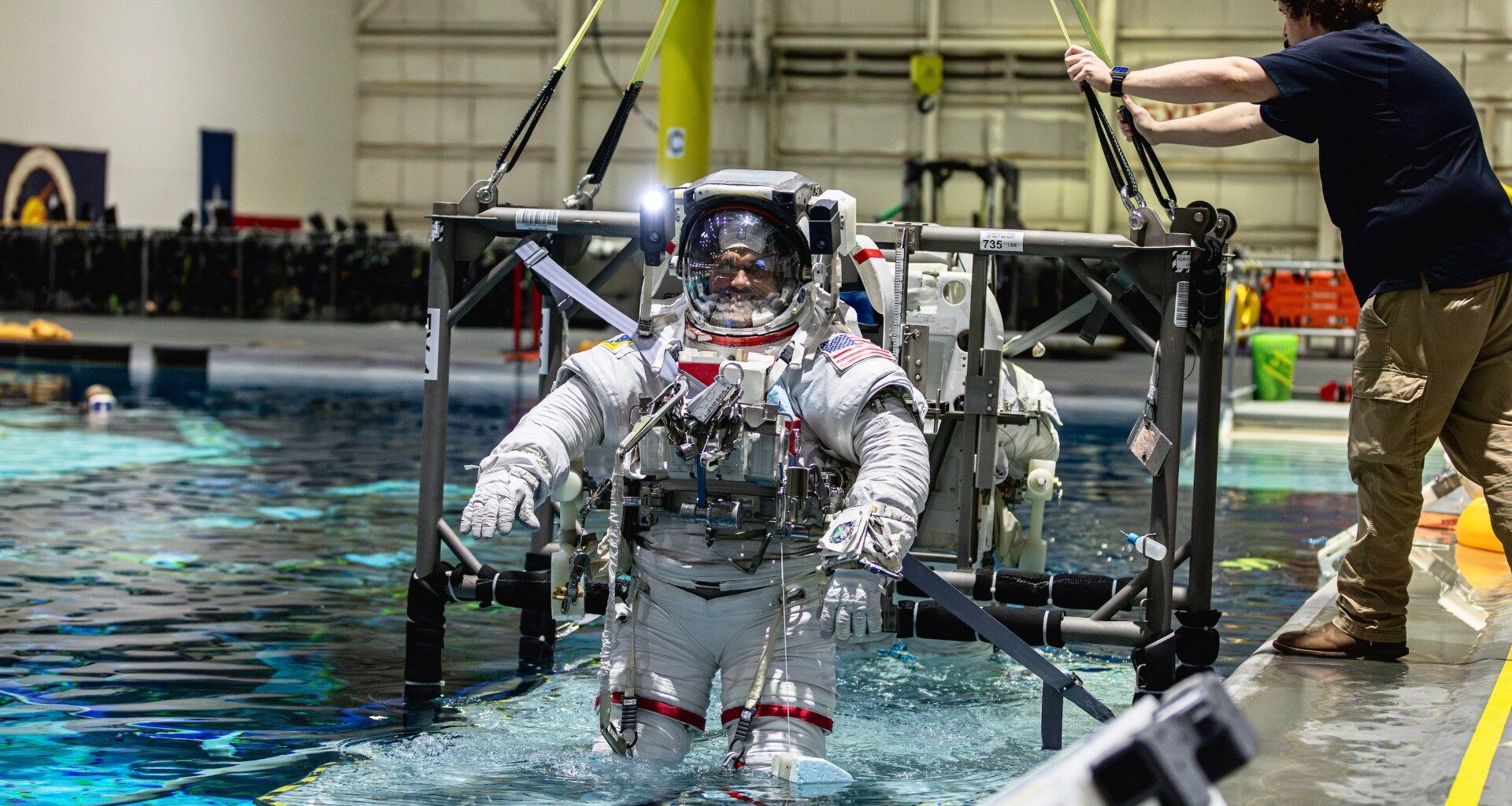
NASA astronauts Rex Walheim, left, and Mike Fossum are aided by divers as they work in a mock up of the space shuttle’s payload bay as the crew of STS-135 trains for a space walk in the Neutral Buoyancy Laboratory near the Johnson Space Center in 2011.
Smiley N. Pool/Houston Chronicle
Before the launch of Artemis II, more than 50 years had passed since the last manned flight, Apollo 17 in 1972.
Still, when Artemis successfully splashed down this spring, NASA’s mission was far from over. Plans call for additional shuttle launches, a lunar landing in 2028 and eventually a base on the moon’s surface.
A new global space age seems to have blasted off, with China’s Chang’e 7 heading to the lunar south pole and the European Space Agency’s Hera en route to the asteroid Dimorphos.
Article continues below this ad
NASA is launching the Nancy Grace Roman Space Telescope, promising even greater views into distant galaxies, and the number of commercial spaceflight companies continues to grow.
The next giant leaps for mankind, however, are only possible if measures are in place to ensure astronaut health and wellness.
With a rising demand for space medicine, academic institutions are heeding the call. And what better place for a resounding response than Houston, with Johnson Space Center on the horizon and the thriving Texas Medical Center at its core.
UTHealth Houston awards a two-year fellowship focused on acute medical care in space, while Baylor College of Medicine’s Center for Space Medicine provides a pathway for students to earn a doctor of medicine degree in the field. The University of Texas Medical Branch offers the only civilian board-certified aerospace medicine residency in the country.
Article continues below this ad
UTMB offers residency program
“In the era of going back to the moon, we’ve got something really cool in our own backyard with UTMB,” said Dr. Ronak Shah, the college’s director of aerospace medicine.
“Interest in space medicine as a whole has gone up logarithmically since I came to UTMB,” added Shah, who has been at the program’s helm since 2022.
Since the aerospace residency was founded in 1993, 80 individuals have graduated. This year, five residents have enrolled..
Most of the residents have gone on to work at NASA and commercial spaceflight companies, while others went into aviation medicine. Six became astronauts, and a few established private practices.
Article continues below this ad
The late Dr. Charles Berry was one of UTMB’s first professors of aerospace medicine. He worked at NASA from 1959 to 1974, serving in key positions including director of medical research.
“Dr. Berry played a pivotal role in the NASA program in the 1960s and laid the foundation for what UTMB has built since,” Shah said. “We’re really talking about a legacy from the earliest astronauts to the next generation of explorers.”
Dr. Amy Kreykes serves as the program director for UTMB’s aerospace medicine residency and director of the aerospace medicine master of science. She is also a flight surgeon at Johnson Space Center.
UTMB offers three residency options: an aerospace medicine program or the two combined programs (aerospace paired with either internal or emergency medicine).
In the past, the academic requirements led to a master of public health degree but has since transitioned to a master of science in aerospace medicine.
In the fall, UTMB is opening its aerospace master’s program to students in other specialties, increasing access to education in the field. “We’re always expanding our opportunities,” Kreykes said.
Article continues below this ad
In addition, UTMB offers the Principles of Aviation & Space Medicine course every summer, open to medical students, nurses, physicians and researchers.
Shah enrolled in the course himself in 2006. “That course was pivotal for my career,” he said. He views it as another way UTMB can prepare providers for a “a field that’s growing faster than ever.”
“As the missions become longer and perhaps go further, we are trying to equip professionals who not only respond to challenges but who create solutions to shape the next era of exploration,” Shah said.
Research leads to Baylor’s Center for Space Medicine
Space medicine addresses the unique stressors that emerge from exiting our orbit, such as microgravity, space radiation and lunar dust.
Article continues below this ad
Dr. Jeffrey Sutton, founding director at BCM’s Center for Space Medicine, said that the resulting health concerns affect every organ, from cardiovascular disturbances and blood clots to loss of muscle mass, impairment of eye sight and damage to the brain.
Discovering the best methods for delivering health care to astronauts and spaceflight passengers has been a focus of the Center for Space Medicine since its foundation in 2008.
The Center traces its roots to NASA’s 1997 establishment of the National Space Biomedical Research Institute.
Baylor was competitively awarded a cooperative agreement from NASA to lead the Institute and also serve as its headquarters.
In 2001, Sutton would become the Institute’s second director. Research was performed by “virtual science and technology teams, with leading scientists, physicians and engineers from across the country working collaboratively on important problems for NASA,” Sutton said.
But there was one issue, he said: “We didn’t have an academic home. We were doing fine, but we wanted to take things to the next level.”
Baylor established the Center for Space Medicine as a solution. Sutton said Baylor became “the first medical school or university to elevate space medicine as a separate discipline at the level of a department or academic center.”
In 2012, the Center established the Space Medicine Pathway. More than 60 have completed the program, and more than 1,200 have enrolled in courses.
Graduates pursue a variety of careers in various specialties of medicine and surgery, working in hospitals, clinics and private practices.
While not all will practice outside of Earth’s atmosphere, Sutton said, students will still have acquired extensive knowledge, which could become increasingly important as more people try space flight.
“Now there’s a whole new generation of graduating med students who are not space naive,” he said. Students also gain unique skills that translate to medical care on our own planet.
In 2016, Baylor College of Medicine received a new award from NASA, which led to the establishment of the Translational Research Institute for Space Health. At the end of this summer, the center will relocate to the school’s new Cullen Tower.
“We are honored to be co-located with the medical school, the medical and health profession students, fellow scientists, leaders and other collaborators, all in close proximity to BCM teaching hospitals, patient care and clinical studies,” Sutton said.
Space medicine is critical discipline at UTHealth
Texas has the ideal infrastructure for the field of space medicine, said Dr. Bentley Bobrow, professor and executive director of UTHealth Houston’s Space Medicine Program.
In addition to NASA’s presence, the Texas Medical Center and commercial space companies in the state, the formation of the Texas Space Commission in 2023 brought needed funding to support growth of aeronautics.
“Everything is coalescing in Texas,” Bobrow said. “And we’re very fortunate to sit at the convergence of all of that.”
UTHealth Houston’s Space Medicine Program is a campus-wide interdisciplinary initiative, bringing together expertise from medicine, dentistry, nursing, public health, biomedical informatics and human performance research.
During the past decade, UTHealth Houston’s Department of Emergency Medicine has helped train astronauts in medical procedures and operational healthcare. The effort has since expanded into interdisciplinary research and translational space health initiatives.
Four years ago, UTHealth Houston launched one of the nation’s first dedicated space medicine fellowships. The program trains future physician leaders in human performance, operational medicine and healthcare in extreme environments.
“Space medicine is not speculative,” Bobrow said. “It’s happening now. And it’s becoming a critical medical discipline.”
He added that understanding space medicine can have applications to healthcare in extreme environments on Earth, including remote locales and even rural medical systems.
Bobrow collaborates with the University of Texas System’s Health Intelligence Platform on rural health initiatives that apply advanced healthcare delivery and technology solutions.
“How do we monitor and take care of people in the remote areas of space? That’s directly related to how we take care of people in rural Texas,” Bobrow said.
UTHealth Houston’s mission is to eventually develop a dedicated space medicine institute that integrates expertise across AI, biomedical informatics, radiology, cancer research, orthopedics, neurology, nursing, dentistry, public health and rehabilitation medicine.
“Space medicine is really about the very future of health care,” he said. “Space is the perfect way to bring people together to solve problems.”