
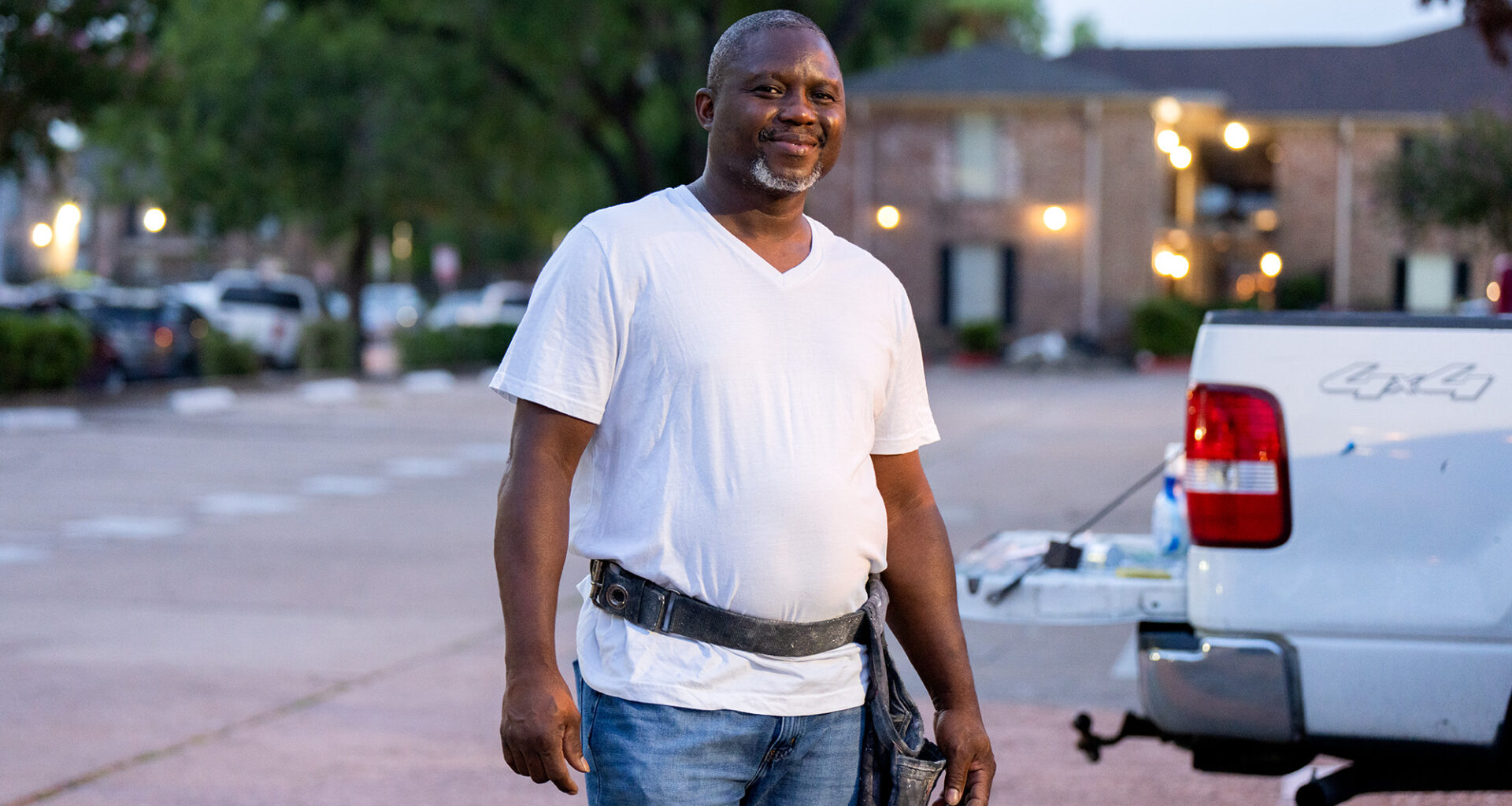
Candido Batiz poses by his truck after a day’s work remodeling a house in Houston, TX on August 23, 2024. Batiz has suffered health consequences from working in the Texas heat. The U.S. Department of Labor has released a proposed rule to protect millions of workers from health risks due to extreme heat.
Sharon Steinmann
It’s hot. Dangerously hot. Especially for the millions of workers who labor outside. Now, Congress wants to make it more dangerous.
In Houston this week, highs climbed well above 100, with feels-like temperatures approaching 115 degrees. But hey, it’s air-conditioned inside the Capitol.
Inside that cool dome, dozens of Republican representatives, including Houston-area Rep. Brian Babin and Rep. Monica de la Cruz, who is facing a tough reelection fight in her fajita strip district that stretches from the Hill Country to the border, are trying to prevent the federal government from instituting new protections for workers exposed to potentially deadly heat on the job. Introduced in late 2025, their bill, HR 6213, has now made it out of committee — right as temperatures across the country are breaking records.
Article continues below this ad
According to estimates from the Department of Labor, hundreds of workers die every year due to heat, thousands more are sickened — and both those numbers are likely undercounts. Studies show that even when external temperatures are in the 80s, workers’ internal temperatures can easily break 100 degrees, and as a result, they regularly suffer from blood in their urine and kidney stones.
With that in mind, the Biden administration proposed a new rule that would, among other things, require that outdoor workers get a 15-minute break every two hours once the heat index hits 90 degrees.
The rule would have been a significant step forward in a warming world where some of our most vulnerable workers are left without enough protections.
Workers like Houston’s Candido Batiz Alvarez, a construction worker and father of three, can end up seriously dehydrated, with chills, headaches and vomiting. But laborers often push through these dangerous conditions.
Article continues below this ad
“If you don’t work, you don’t get paid,” Batiz told us in Spanish in 2024 — when we hoped that the proposed rule might bring him relief.
Some companies already provide the bare minimum because they recognize that a healthy workforce is better for productivity, but plenty of companies don’t. We worried then that with a shift in federal leadership, the rule would disintegrate. That seems to be the case now.
Other Houston-area representatives are pushing back against Babin and de la Cruz’s side. Rep. Sylvia Garcia, who as a child picked cotton in sweltering Texas summers, has long fought for even stronger heat protections.
Proponents of HR 6213 argue that it stops burdensome, one-size-fits all regulation and that states already have the power to implement their own protections. Texas hasn’t done nearly enough with that power. The state even bans local jurisdictions from implementing their own heat-related worker protections.
Making matters worse, HR 6213 wouldn’t just kill the 2024 rule. It would also prevent future administrations from crafting “any substantially similar standard.”
Article continues below this ad
The country is in the midst of a record-breaking summer. Heat-related deaths are on the rise, and it’s getting hotter.
It makes no sense to kill a rule that protects the workers who build our homes, power our industry and pick our food.
Think a 15-minute break is excessive? We invite you to do one of those jobs for a summer and get back to us.