
Jonae Walker-Ferrell plans to apologize to her son.
She could not understand why she sometimes had to tell him the same word again five minutes later while helping him with homework. Then, at the end of third grade, he was diagnosed with dyslexia. He is now beginning dyslexia services.
Walker-Ferrell, a Fort Worth ISD mom and a manager at software company McKesson Technologies, was among the parents, educators and Fort Worth leaders who participated in a dyslexia simulation, hosted by Literacy Roundup, July 14 at Fort Worth ISD’s Leadership Academy at John T. White.
She tried to read unfamiliar symbols, followed garbled instructions and completed assignments as teachers hurried and corrected her.
“I’m sorry to him because I had no idea,” Walker-Ferrell said. “I didn’t understand.”
For about an hour, elected officials and parents became seventh graders again. A bell sent them shuffling between classrooms with worksheets in hand. Their teachers warned them to stay quiet in the hallway, work faster and prepare to lose recess.
The exercises did not replicate dyslexia itself. Instead, they disrupted skills adults, and children without dyslexia or other learning disabilities, normally take for granted — hearing directions, recognizing letters, writing and remembering words — while instructors applied pressure familiar to many classrooms.
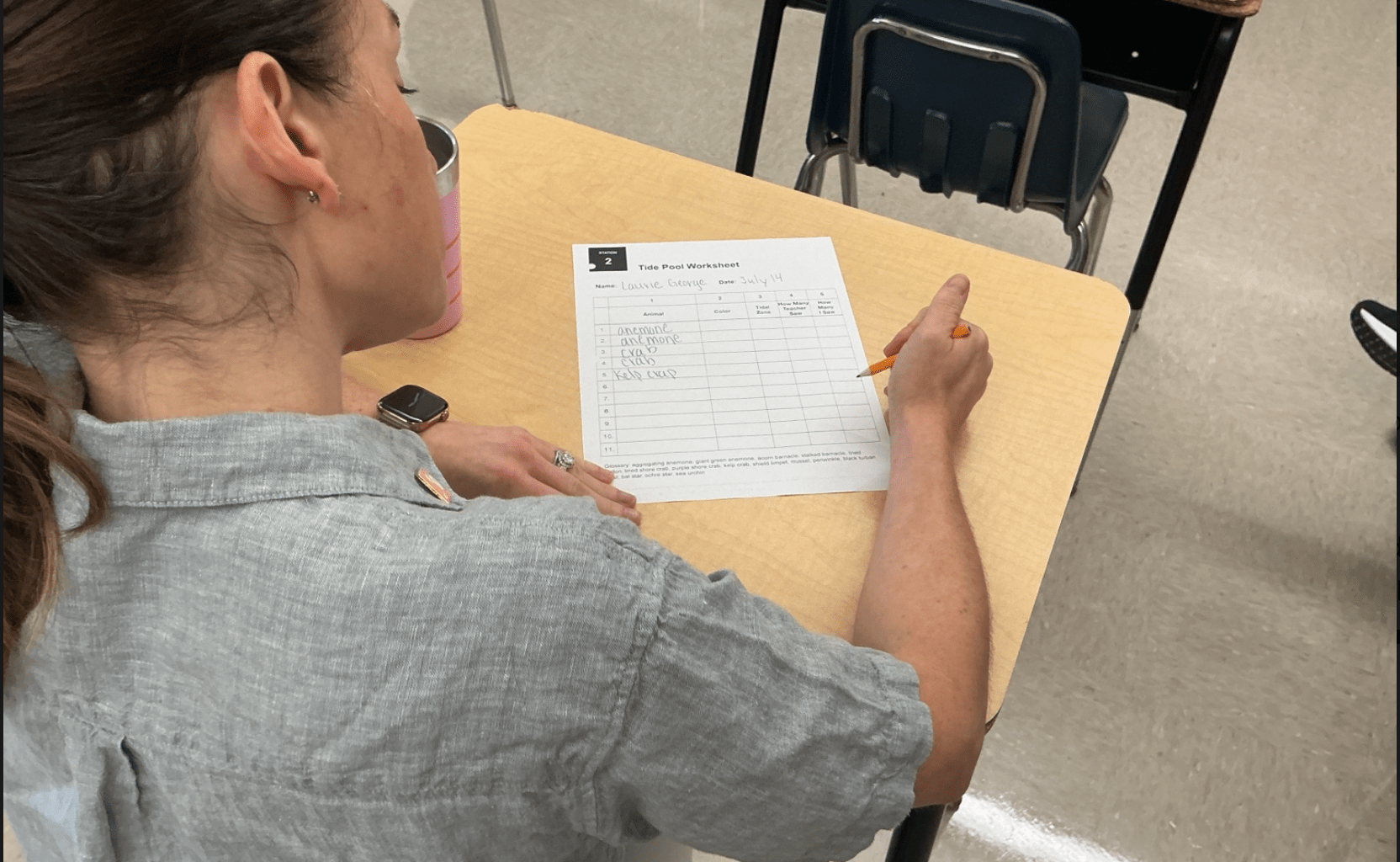
Participants rotated through six stations. In one, they attempted to fill out a worksheet on tide pools while listening to a recording of overlapping, muffled voices that dissolved into a blur of numbers, colors and sea creatures. In another, they covered their writing hand and traced letters by watching their movements through a mirror.
One participant flipped through the glossary and pretended to work. Another announced that she might as well go to sleep.
They read a story printed backward, decoded a picture book written in unfamiliar symbols and took a spelling test through distorted audio. At another station, they used their nondominant hands to copy designs, write the alphabet and trace a pattern while counting aloud from 975 to 1,032.
“Raise the hand that you write with,” instructor Courtney Spitzer said. “Say goodbye to it.”
Across the hallway, adults hunched over school desks, tilting tabletop mirrors and twisting their wrists as pencils strayed outside thick black lines.
The adults were repeatedly told to move faster, listen more carefully and try harder. Instructors compared them with classmates, threatened to take away recess and announced that sloppy assignments could not be displayed at open house.
The criticism was scripted.
The frustration was not.
The simulation was not new to state Sen. Taylor Rehmet, who has dyslexia.
He remembered hoping teachers would not call on him to read aloud. He searched for reasons to leave the room before he could be embarrassed.
He was identified early, which he said spared him the worst of it.
“I don’t know what I’d be without my teacher who helped me work through that,” Rehmet said.
When Tarrant County Commissioner Roderick Miles finished the spelling exercise, he asked, “Did I get a 100?”
He had not.
Miles said the simulation showed how academic struggles can become behavioral problems, especially when one student receives praise while another is repeatedly singled out.
“It just kind of reinforces the message: ‘You’re dumb,’” Miles said.
A student who feels humiliated in class may later direct that anger toward the classmate who appeared to succeed, he said.
“This just gave me perspective,” Miles said. “That felt terrible. That felt frustrating and embarrassing.”
Caroline James, leader of Literacy Fort Worth, said educators do not usually intend to humiliate students. But phrases such as “try harder,” “focus” and “you can do better” can punish children for difficulties they have not yet learned to manage.
“There’s nothing more torturous to a student with dyslexia than to be told to just try harder,” James said.
James acknowledged that few students would encounter every problem packed into the simulation in one day, but each interruption, unclear worksheet and public correction added another layer of pressure.
Literacy Roundup has screened more than 500 children for signs of dyslexia this summer and identified about 140 who may be at risk, James said. The organization plans to help their families seek full evaluations and services from their school districts.
Texas schools screen students for dyslexia in kindergarten and first grade. Students who arrive later or whose symptoms are missed can spend years falling behind, masking their difficulties or being labeled uncooperative, James said.
Her own son’s dyslexia was not identified until middle school. She said it took him two or three years to feel safe at school again.
Laurie George, a member of the Fort Worth ISD board of managers, said she relied almost immediately on coping strategies during the simulation. She studied the worksheets for clues and tried to appear productive even when she could not complete the work.
At the tide pool station, George followed the competing voices as long as she could. Then she opened the glossary and made herself look occupied so the teacher would move on.
Those strategies can make girls particularly difficult to identify, she said, because they may conceal their struggles by pleasing teachers and quietly adapting.
George also thought about her son, who has dyslexia.
“I understood the frustration that my child felt and the reasons why maybe he was so squirrely and had some of the behavioral issues that he had when he was younger,” George said. “It’s hard.”
Support can give students tools to read, spell and navigate school more successfully, George said. But those tools do not erase the additional effort.
“You’re digging in there looking for tools that come naturally to other kids,” she said. “So your school day is harder. You come home tired.”
The simulation helped shape how George thinks about the board of managers’ role in addressing the city’s literacy crisis, she said. Managers can respond by making literacy a district goal and holding Superintendent Peter Licata accountable for measurable results beyond year-end test scores.
The simulation produced a more immediate assignment for Walker-Ferrell.
Her son spent the hour at a library nearby. She went to pick him up.
She had something to tell him.
Matthew Sgroi is an education reporter for the Fort Worth Report. Contact him at matthew.sgroi@fortworthreport.org or @matthewsgroi1.
Disclosure: FWISD manager Pete Geren leads the Sid W. Richardson Foundation, a financial supporter of the Fort Worth Report. FWISD manager Laurie George is a member of the Report’s reader advisory council. News decisions are made independently of our board members and financial supporters. Read more about our editorial independence policy here.
This <a target=”_blank” href=”https://fortworthreport.org/2026/07/19/what-a-dyslexia-simulation-showed-fort-worth-parents-about-their-kids-school-days/”>article</a> first appeared on <a target=”_blank” href=”https://fortworthreport.org”>Fort Worth Report</a> and is republished here under a <a target=”_blank” href=”https://creativecommons.org/licenses/by-nd/4.0/”>Creative Commons Attribution-NoDerivatives 4.0 International License</a>.<img src=”https://i0.wp.com/fortworthreport.org/wp-content/uploads/2021/04/cropped-favicon.png?resize=150%2C150&ssl=1″ style=”width:1em;height:1em;margin-left:10px;”>
<img id=”republication-tracker-tool-source” src=”https://fortworthreport.org/?republication-pixel=true&post=677410&ga4=2820184429″ style=”width:1px;height:1px;”><script> PARSELY = { autotrack: false, onload: function() { PARSELY.beacon.trackPageView({ url: “https://fortworthreport.org/2026/07/19/what-a-dyslexia-simulation-showed-fort-worth-parents-about-their-kids-school-days/”, urlref: window.location.href }); } } </script> <script id=”parsely-cfg” src=”//cdn.parsely.com/keys/fortworthreport.org/p.js”></script>