
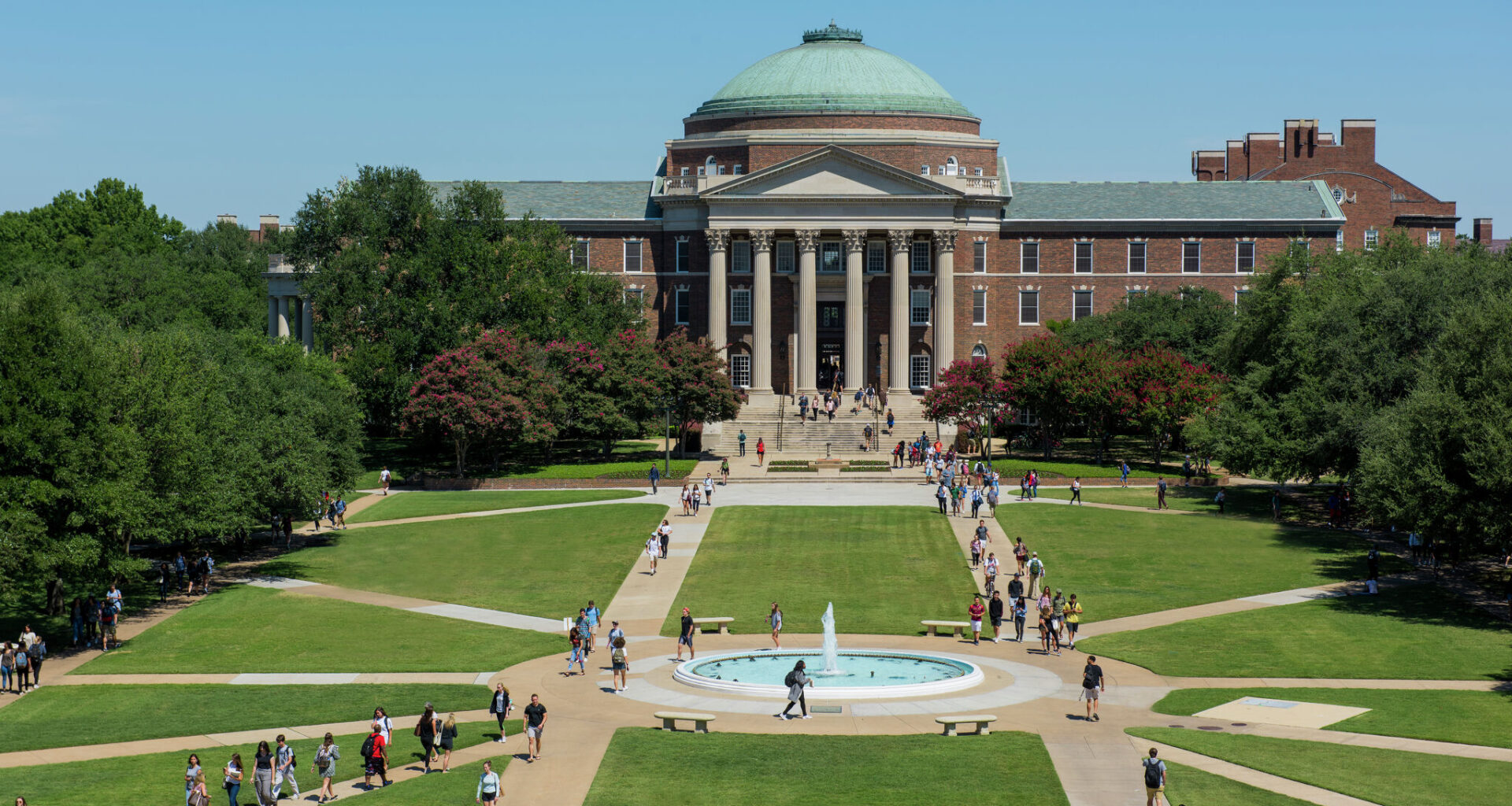
The Southern Methodist University Main Quadrangle on September 7, 2017.
Guy Rogers III/Dallas Morning News
The number of Texas borrowers who have fallen far behind on paying back their federal student loans has doubled in less than a year, data shows.

Between September 2025 and March 2026, the number of Texans who have defaulted on student loans jumped from about 461,000 to 878,000, according to Federal Student Aid data analyzed by the Associated Press and The Dallas Morning News.
The recently released data, which shows that defaults across the United States have reached record levels, indicates that borrowers have struggled to resume payments after the federal government’s yearslong pandemic-related collection freeze.
Article continues below this ad
Higher education advocates and experts said they expected many to miss their student loan payments after such a long pause, during which the federal government made major changes to student loan policies and borrowers got out of the habit of paying.
In Texas, at least one in five borrowers are in default, meaning they are more than nine months behind on payments. Entering default can trigger serious long-term financial consequences, including garnished wages or tax refunds, and lower credit scores.
More people could fall behind on loan repayments as the federal government overhauls the student loan landscape, and many, especially low-income families, continue to struggle in today’s stressed economy.
“It’s the perfect storm for borrowers to be confused and not really know their options or just be unable to make these payments,” said Roxanne Garza, director of higher education policy at EdTrust, an educational equity advocacy group.
Article continues below this ad
Why are so many borrowers falling behind on payments?
In recent years, borrowers faced frequent and complex policy changes as the federal government issued pauses, introduced new repayment plans and attempted relief measures.
Until June 2025, borrowers had a five-year reprieve on penalties for missing student loan repayments.
The Trump administration first paused loan repayments in March 2020 in a move meant to provide relief during the pandemic. The Biden administration extended the pause multiple times, technically resuming payments in 2023 and providing a one-year on-ramp when loans could not enter default.
Starting in fall 2024, borrowers could once again be penalized for missing loan payments. Nine months later in June 2025, borrowers began defaulting for the first time since the pandemic-era pause.
Article continues below this ad
During that time, the Biden administration rolled out the SAVE plan, an income-driven repayment program that slashed monthly payments for millions of Americans. A group of Republican attorneys general sued to block the plan, leaving borrowers in limbo for two years.
A Biden-era proposal to forgive millions of loans offered borrowers hope of relief, but the Supreme Court struck down the plan in 2023.
All the changes during this period created an uncertain environment, where borrowers strained to figure out which policies impacted them, which repayment options were the right fit and whether they were going to see relief, said Travis Evans, senior Texas director at Young Invincibles, a nonprofit advocacy group focused on young adults.
As a result, the number of student loan borrowers in default surged to more than 9.5 million in March nationally — past a pre-pandemic peak of about 8.1 million defaulted borrowers in late 2019.
“Not being educated, not understanding what their options are has been the biggest concern,” Evans said. “The federal government has been so up and down, all over with decisions.”
Article continues below this ad
Recent challenging economic conditions also help explain why borrowers aren’t making payments. In 2025, Texas saw a marked downshift in employment growth after years of adding jobs, according to a projection by the Federal Reserve Bank of Dallas. Grocery and housing costs are rising, and economists have pointed to a growing disparity between higher-income and lower-income households.
Some borrowers may have been counting on their loans being forgiven, Garza said. Others might not be able to build an additional payment into their monthly budget after years without routinely accounting for it.
“Student loan payments are one of the only areas where you can miss a payment, and a thing isn’t necessarily taken from you,” said Dominique Baker, associate professor of education and public policy at the University of Delaware. “If people are struggling economically, then one of the places that it actually makes the most practical sense to miss a payment, if it’s between your car and your student loan, is your student loan.”
The Trump administration’s gutting of the Education Department — including staffers who troubleshooted borrowers’ complaints, held loan servicers accountable or helped people whose loans should have been forgiven — also likely contributed to students’ challenges in repaying their loans, Baker said.
What happens when a student loan borrower defaults?
A borrower is considered in default if they have missed payments for at least nine months. At that point, the federal government can garnish wages and Social Security payments, or withhold tax refunds.
Article continues below this ad
In most cases, student loans cannot be discharged through bankruptcy.
“This is debt that lingers,” Baker said.
Student loan defaults have hit record numbers across the U.S. Has student loan debt affected you or someone you know? How?
The number of Texas borrowers who have fallen behind on paying back their federal student loans has doubled since fall 2025.
Defaulting on student loans can also lead to plunging credit scores, which can make renting a home, buying a car or saving for retirement harder, Garza said.
A surge in poor credit scores doesn’t just affect individual borrowers. A slowdown in consumer spending, small business formation or real estate purchases impacts the rest of the economy.
Article continues below this ad
“They’re less likely to do things that require more financial stability, things that we all know helps spur communities and economies,” Garza said.
Who are the borrowers falling behind in Texas?
In Texas, about 22% of student loan borrowers who entered repayment between January 2020 and May 2025 were at least 90 days behind on their payments as of May 2026.
That breakdown varies significantly based on the type of school the borrower went to.
Nearly 38% of Texas borrowers who attended for-profit schools were behind on their payments, about double the rate of those who attended public or private, non-profit schools.
“A large chunk of this is because of what [for-profit schools] charge, what students earn after they go and how long it takes students to complete,” Baker said.
Research shows that students who graduate from for-profit schools see smaller returns on their investments than their counterparts who attended community college, where tuition is typically cheaper.
Students who do not complete their degree, meaning they don’t have the credential to boost their earnings, and Black students, who face higher unemployment rates and a wage gap compared with their white peers, are also at greater risk of falling behind on student loan payments, Baker said.
As of March 2026, defaulted Texas student loan borrowers held a balance of $19.7 billion — the largest amount of any state. But Texas’ volume of borrowers plays a factor. The defaulted balance per borrower was about $22,500, the eighth lowest of all 50 states.
More borrowers projected to default
Higher education experts and advocates say they expect more borrowers to fall behind on their student loan payments as the federal government dismantles existing repayment plans, including the SAVE plan.
Millions of borrowers who were on the SAVE plan have to pick a new plan and will likely face higher monthly payments. New borrowers will only have access to two new repayment plans.
Related: Don’t wait: What Texans need to know about changing student loan plans
“Researchers sometimes ignore the psychological costs,” Baker said. “If there was this plan that saved me so much and helped me, and then all of a sudden it gets snatched away two years later, that’s going to make it less likely that I make my payments on time.”
Evans said he fears the federal government could strike down other federal loan relief initiatives, such as public service loan forgiveness, which cancels government and nonprofit employees’ remaining debt after a decade of service.
“Young adults are wondering: Is college an option for me? They’re extremely nervous about whether their future kids will have an option for higher education,” Evans said. “…They want to understand like there’s some relief or there’s some hope here, but a lot of them are feeling defeated.”
The DMN Education Lab deepens the coverage and conversation about urgent education issues critical to the future of North Texas.
The DMN Education Lab is a community-funded journalism initiative, with support from Bobby and Lottye Lyle, Communities Foundation of Texas, The Dallas Foundation, Dallas Regional Chamber, Deedie Rose, Garrett and Cecilia Boone, Judy and Jim Gibbs, The Meadows Foundation, The Murrell Foundation, Ron Steinhart, Solutions Journalism Network, Southern Methodist University, Sydney Smith Hicks, and the University of Texas at Dallas. The Dallas Morning News retains full editorial control of the Education Lab’s journalism.