
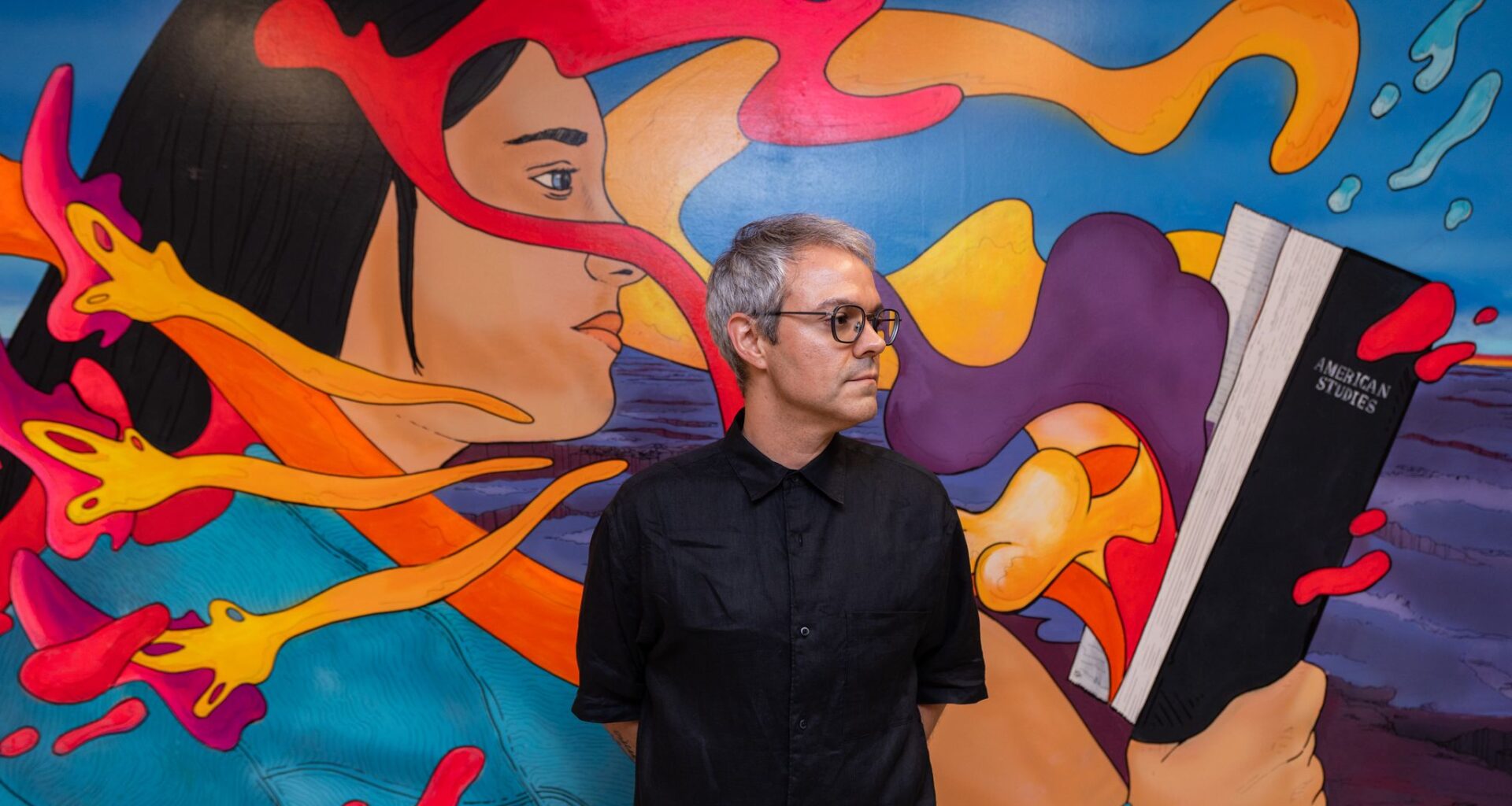
Iván Chaar López, a University of Texas scholar on border surveillance, is shown in his office this month. The denial of his tenure without an explanation will deter quality professors from building their careers at UT, the Editorial Board writes.
Mikala Compton/Austin American-Statesman
Years of work. A book published. Peer-reviewed articles printed in respected scholarly journals. Awards won. Research funding secured. Other promising opportunities let go along the way.

Normally that would add up to tenure for a highly respected professor like Iván Chaar López — but it didn’t, and the University of Texas won’t explain why.
Article continues below this ad
Chaar López, a professor in the American Studies department, saw six years of work scrapped in February when a committee appointed by UT President Jim Davis denied him tenure despite the nearly unanimous recommendations he had received from his peers in the university and nationwide. As the Statesman’s Lily Kepner reported, Chaar López had been a finalist for tenure track positions in two UT departments and other universities when he was hired, and he published award-winning articles and secured multiple grants and fellowships.
Worse, UT did not even give Chaar López the courtesy of an explanation — a departure from previous occasions, when UT instructors who were denied tenure received detailed letters explaining why. That silence has stoked speculation that Chaar López was denied tenure because of his research into the intersections of immigration enforcement, surveillance technology, race and history at the U.S.-Mexico border — a field that rankles Texas conservatives.
“I’ve helped build things here, so the university is losing a catalyzer,” Chaar López told us, pointing to the relationships he created with researchers both in the UT system and at institutions worldwide. “It’s hard not to think that there is a political reason behind their decision.”
ALSO READ: If UT wants to restore public trust, leaders must earn it
Article continues below this ad
The fallout extends beyond the blow to Chaar López’s career. Texas’ flagship university is losing an accomplished, sought-after scholar. Its reputation has taken a hit, and more alumni are raising concerns that politics are driving key decisions. And an institution designed to advance knowledge and inquiry is left less equipped to do so.
UT declined to comment on the specifics of Chaar López’s case, but said the decision-making process was guided by fairness and professionalism.
“Tenure is a privilege, not a right, and UT does not rubber stamp decisions of such importance,” UT spokesperson Mike Rosen told us. The tenure review process in general, he said, “is handled thoughtfully, fairly, and professionally with a thorough system of checks and balances to ensure the highest standards of teaching and research.”
Yet UT has offered no explanation for why an overwhelming consensus in favor of Chaar López’s tenure was rejected. If the university expects faculty and the public to trust its process, it must be willing to explain why such an extraordinary outcome occurred. A denial that leaves an accomplished professor in the dark after six years of hard work and high marks is not a fair process at all.
Article continues below this ad
Such treatment of a faculty member would be concerning enough on its own. But the case amplifies the growing perception that political pressures are reshaping UT — undercutting the flagship’s mission of providing a challenging education that best equips the next generation of leaders.
Davis, who became president last year, has overseen significant changes to campus policies, department organization and faculty representation. The university has restricted classroom discussions of “controversial topics” and consolidated gender and ethnic studies — including the American Studies department where Chaar López taught — narrowing the scope of academic debate and inquiry at an institution that should be expanding it.
The chilling effect spilled over to the alumni organization Texas Exes, which last year rejected a $100,000 endowment to fund a pharmacy studies scholarship because even the hint of supporting a student from a diverse background was politically untenable.
RELATED: UT didn’t sign Trump’s higher ed compact. But it’s acting like it did
Article continues below this ad
Last October, UT considered signing President Donald Trump’s “Compact for Academic Excellence in Higher Education,” which included provisions to ensure “a broad spectrum of viewpoints” by protecting conservative voices on campus. We recognize the concerns many have about ideological diversity on college campuses: More than three-quarters of Americans say college campuses have a liberal bias, and an even larger share worry about free speech, according to a 2025 University of Rochester survey. Universities must strive to create classrooms where competing ideas can be debated openly.
But that goal is undermined when universities appear to punish scholars whose work falls outside the prevailing political winds. Fairness in the marketplace of ideas is achieved by welcoming diverse perspectives and robust debate, not by denying tenure to an accomplished professor without explanation.
Even if Chaar López is given a reason for not receiving tenure, the damage to UT’s reputation is done. Professors assessing their opportunities at the top universities will surely view the Texas flagship with justifiable skepticism. They could do everything asked of them, accomplish all of the standards required for tenure, and still be denied for no stated reason.
Academic tenure is a two-way street. It not only shields professors from termination without cause, it also ensures the university attracts and retains qualified educators who set high bars for the quality of instruction and the prestige of the institution.
Article continues below this ad
Other professors at UT are feeling demoralized following the decision, according to Dr. Karma Chávez, a professor of Mexican American and Latina/o studies at UT and president of the campus’ chapter of the American Association of University Professors.
“It doesn’t really matter if you hit all the marks,” she told us, “Jim Davis can arbitrarily make a decision about your career.”
High standards make for a quality education. They make a university stand out from the rest. But they do little to improve instruction and to broaden the spectrum of viewpoints on campus if no one knows what they are.
Article continues below this ad
The scholars UT most wants to recruit have choices. If they conclude that academic achievement is no longer enough — or that the rules can change without explanation — they will build their careers elsewhere. That loss will diminish the University of Texas for years to come.