
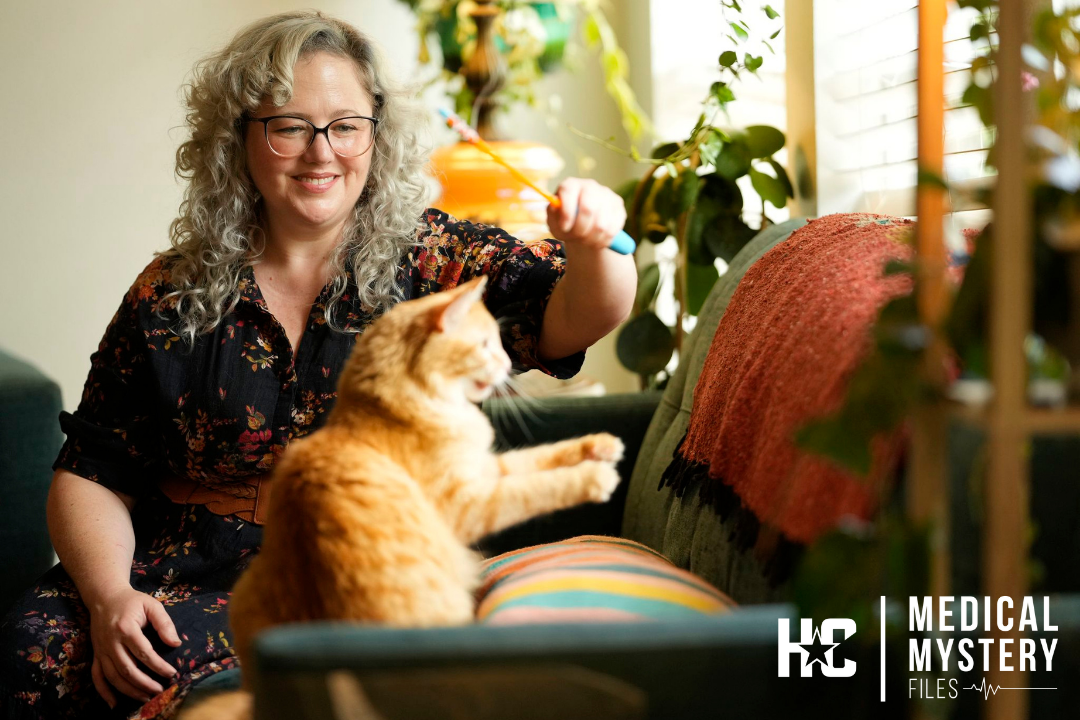
Candice Pauley entertains Nacho the cat in Spring on Wednesday, July 1, 2026. Pauley suffered from allergies, brain fog, heat exhaustion and other symptoms for most of her life until she attempted to donate a kidney to her aunt and discovered she had a rare disorder.
Melissa Phillip/Houston Chronicle
Four years ago, Candice Pauley’s chronic pain and other unexplained symptoms had become so all-consuming that she was forced to give up many of the things she loved.
The Spring resident had suffered from abdominal pain, brain fog and unexplained reactions to food and scents since high school, but her symptoms escalated after the COVID-19 pandemic. The pain she felt in her abdomen, joints, hips and tailbone sometimes became so severe that she’d need to leave restaurants in the middle of dinners with her husband and friends.
Candice Pauley poses for a portrait in Spring on Wednesday, July 1, 2026. Pauley suffered from allergies, brain fog, heat exhaustion and other symptoms for most of her life until she attempted to donate a kidney to her aunt and discovered she had a rare disorder.
Melissa Phillip/Houston Chronicle
Denny Rasberry and his wife, Candice Pauley, pose for a portrait in Spring on Wednesday, July 1, 2026. Pauley suffered from allergies, brain fog, heat exhaustion and other symptoms for most of her life until she attempted to donate a kidney to her aunt and discovered she had a rare disorder.
Melissa Phillip/Houston Chronicle
“I would just be crying on the floor at home, not knowing what was going on,” said Pauley, now 43 years old.
Article continues below this ad
READ MORE: Sign up for alerts from the Medical Mystery Files
Pauley stopped going to concerts, gardening and playing roller derby. She used to co-host a podcast about beer but stopped drinking it after she ended up in the hospital with a life-threatening allergic reaction.
Doctors mistook many of her symptoms for more common ailments, a frequent occurrence for patients suffering from rare medical conditions. Delays in finding a diagnosis can have long-term consequences for some patients because their condition could worsen and it could take longer for them to recover.
Then Pauley went to a hospital to be tested as a potential organ donor for her aunt, who was in advanced kidney failure. The test results were suspicious. Doctors ordered a bone marrow biopsy to determine what was wrong.
Article continues below this ad
The results showed Pauley had a disorder caused by a genetic mutation that’s so rare it typically takes years for doctors to diagnose it. She immediately began looking for more information on the internet, but she worried about what she might find.
“The first thing you’re looking for is, ‘Am I going to die?’” she said. “I think that’s everybody’s first question.”
Unexplained ‘quirks’
Pauley’s search for answers was marked by years of hardship and frustration.
Article continues below this ad
Her symptoms first cropped up when she was a child, but they seemed so disconnected that she never assumed they were related to the same medical condition.
She broke out in rashes and grappled with brain fog and fatigue when it got too hot, which happened often while she was growing up in South Louisiana. She suffered from migraines roughly once a month and sinus infections every few months. In college, she started getting headaches and her face turned red whenever she was around candles, perfumes and other strong scents.
“I really didn’t think about it,” she said. “It was just like I had these little quirks.”
CONTACT US: Tell us about a medical condition that was difficult to diagnose
She was known as the “sensitive stomach kid” because she’d experience abdominal pain and bloating after eating certain foods. Over time she cut meat, fried foods and gluten out of her diet to avoid those symptoms.
Article continues below this ad
She first realized her symptoms might be connected after she moved to Houston in 2012. The stress of relocating to an unfamiliar city and starting a job appeared to trigger all her symptoms at once.
Pauley couldn’t eat because it led to stomach pain. She experienced joint pain and heart palpitations. Her legs were so weak that she could barely stand.
“It was like a full-body response,” Pauley said. “I remember my Mom coming in to take care of me because I couldn’t really function.”
Denny Rasberry and his wife, Candice Pauley, pose for a portrait in Spring on Wednesday, July 1, 2026. Pauley suffered from allergies, brain fog, heat exhaustion and other symptoms for most of her life until she attempted to donate a kidney to her aunt and discovered she had a rare disorder.
Melissa Phillip/Houston Chronicle
Worsening symptoms
The worst of Pauley’s symptoms subsided after a few weeks, though she still experienced gastrointestinal issues and anxiety. Doctors diagnosed her with irritable bowel syndrome and a generalized anxiety disorder, but tests for multiple sclerosis and celiac disease were negative.
Article continues below this ad
Pauley’s symptoms were easier to manage over the next few years. She could go out to eat with friends but occasionally experienced stomach pain afterward. She could exercise and she joined a roller derby league, but the physical exertion still led to brain fog and rashes on her legs.
“Everybody would talk about this euphoria they felt after a really hard workout,” she said. “My brain would just power down to about a quarter of its capacity.”
MEDICAL MYSTERY FILES: A Houston woman’s shoulder pain stumped doctors. It led to a first-of-its-kind surgery in Texas.
She also started a podcast where she and a friend discussed beer and highlighted women in the industry. She met her now-husband, Denny Rasberry, at a beer festival. They started dating in 2019 and moved in together the following year.
Pauley started to feel herself slowing down around that same time. She figured it was part of being in her late 30s and decided to give up roller derby. She also struggled with fatigue and a lack of motivation during the COVID-19 pandemic, but she attributed it to how the crisis had disrupted her life.
Her symptoms didn’t improve after the pandemic ended, though. Her pain became more consistent in her abdomen, joints, hips and tailbone. She didn’t want to attend concerts, go kayaking, play roller derby or do many of the other things she loved. She also began to suffer from crippling anxiety that could be triggered by small moments of stress.
“It was almost like her identity was gone,” Rasberry said. “They weren’t just the things we did together. They were the things that brought her joy.”
A revealing biopsy
Pauley’s symptoms were so consistent by 2022 that she was convinced there must be a medical condition that could explain them all.
She started seeing another primary care doctor, a gastroenterologist, a hematologist and a rheumatologist. Tests for hormone imbalances, thyroid disease, lupus and rheumatoid arthritis were negative. An X-ray revealed she had growths called enchondromas in the bones in her arms, but those tumors are benign.
Pauley’s myriad health issues didn’t deter her from trying to donate a kidney to her aunt. Her desire to help finally led Pauley to the answer behind the medical mystery that had been plaguing her for years.
The screening to determine if she could donate an organ revealed that Pauley had sclerosis in her hips. The transplant center worried that was an indication that she had kidney disease, too.
MORE COVERAGE: A Houston woman thought she had dementia. Then a doctor saw something new in a scan of her brain.
More tests showed her kidneys were fine, so the transplant center ordered a bone marrow biopsy. Pauley thought it was unnecessary until a doctor called her a few days later to deliver the news: Pauley had a rare blood-and-bone marrow cancer.
Her heart sank as she searched the internet for information about the disorder, known as systemic mastocytosis. She initially stumbled upon a statistic that claimed patients lived an average of just five to seven years.
“My immediate thought was ‘I’m going to die,’ which is a weird thing to reckon with,” she said. “But then I started reading more and trying to understand it. The disease is so different for everybody.”
The statistics turned out to be erroneous. Pauley has the most common form of the disorder, known as indolent SM, which is associated with an average life expectancy.
But she still needed to find a doctor who was familiar with the disorder and knew how to treat her symptoms.
Complicated path to an answer
More research and recommendations from Facebook groups focused on systemic mastocytosis led Pauley to Dr. Hussein Abbas, a leukemia doctor at the University of Texas MD Anderson Cancer Center who is also an SM specialist.
Pauley’s long journey to a diagnosis is typical, Abbas said. The disorder is tricky to diagnose because many of its symptoms are common and don’t appear to be connected. Patients with the same diagnosis can also experience different symptoms or not have any symptoms at all, he said.
The disorder affects roughly one in 10,000 to 20,000 individuals worldwide. Patients typically experience symptoms for a median of seven years before they’re diagnosed, Abbas said.
“Many physicians don’t even know this disease exists, and even if they do, they may go through all their lives without seeing a single case,” he said.
The disorder is caused by a genetic mutation that causes the body to produce too many mast cells, a type of white blood cells that protect against infections and parasites. The mutation causes them to build up in bone marrow and other tissues.
It’s difficult for physicians to even identify when a patient should be tested for SM, Abbas said. Most patients are referred to him after a blood test revealed they have high levels of tryptase, an enzyme released by mast cells. But 95% of patients with high tryptase levels do not have SM, he said.
Further complicating matters is the fact that 30% of SM patients don’t even have high tryptase levels, Abbas said.
“I don’t blame doctors, honestly. It’s just such a rare thing if you’re not doing this every day,” he said. “It’s just really impossible to keep up with.”
Managing her symptoms
The fact the transplant center recommended Pauley get a bone marrow biopsy was critical because the procedure is the definitive way to test for SM, Abbas said. But even then, a pathologist needs to be trained to spot the SM mutation under a microscope.
Identifying SM is key because a lack of treatment can lead to a shorter life expectancy for a patient with rarer forms of the disorder, Abbas said. Pauley’s type, indolent SM, accounts for 90% of cases in adults and progresses slowly.
There is no cure for the disorder, but it can be managed with antihistamines, antacids and drugs that target the genetic mutation, Abbas said.
Pauley uses an inhaler, eye drops and a nasal spray and occasionally uses a nonsteroidal anti-inflammatory drug to manage her pain.
“I still have a rough time sometimes, but I have more good days than bad,” she said.
An improved outlook
Pauley’s life has improved since her diagnosis thanks to her ability to manage her symptoms. Avoiding things like the heat, fragrances and certain foods has become second nature for Pauley and her husband.
“It’s baked into our lives, and we know better how to avoid a lot of the triggers,” Rasberry said.
The couple found new hobbies to fill the void of the ones Pauley was forced to give up. They want to buy a camper so they can enjoy the outdoors with access to air conditioning. Her former beer podcast has been replaced by one called “Mast Cast” that focuses on SM and recently featured Abbas as a guest.
Abbas credited Pauley for raising awareness about a disorder that even most doctors wouldn’t think to consider. While SM can be tricky to diagnose, he said stories like Pauley’s illustrate why it’s important for doctors to keep looking for an explanation for a patient’s symptoms until they find one.
“Even if it’s not SM, it doesn’t mean they don’t have a problem,” he said.
Pauley is grateful she finally has an explanation for her symptoms. She now recognizes that her anxiety was tied to her SM, because she no longer goes through her days feeling anxious now that she’s able to manage her symptoms. Knowing her diagnosis has taken away the fear she lived with for years, she said.
“I have a reason for (my symptoms),” she said. “I no longer feel like this failure of a person, because I have a name.”