
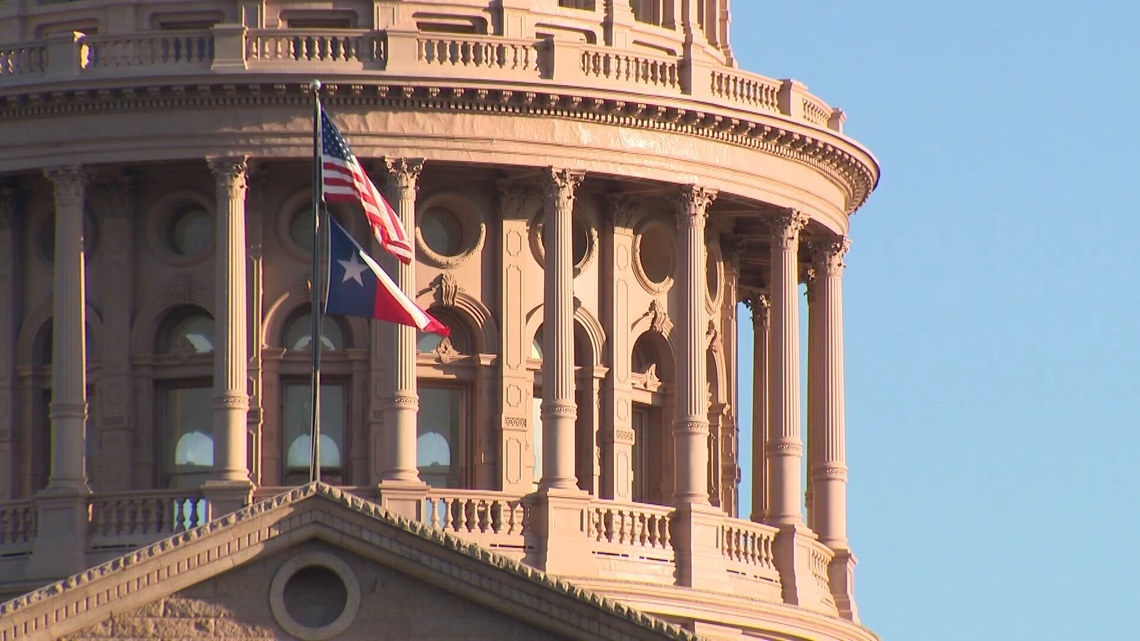
Last week, the state’s top republican leaders told agencies to curb spending and cut their budget requests to lawmakers ahead of the next legislative session.
AUSTIN, Texas — The leaders of nearly every state agency are looking for ways to tighten their belts after top Texas leaders ordered them to curb spending ahead of the next legislative session, which starts next year.
Last week, Texas Gov. Greg Abbott, Lt. Gov. Dan Patrick and House Speaker Dustin Burrows put out joint guidance, telling state agencies to cut their base spending requests by 3% for the 2028, 2029 biennium. These base requests are the starting points for discussions and deliberations about the budget.

This story continues below.
“The fact is that this signals that Governor Abbott, Lieutenant Governor and the Speaker all expect that there will probably be some bumps in the road ahead for the budget and that it may not be what we saw the last two and four years, which was record budget surpluses,” Scott Braddock, the Editor of Harvey Kronberg’s Quorum Report, said. “It was telling the agencies to take a look at what they might trim now. That doesn’t mean there won’t be more cuts down the road. This is a starting point to basically signal to all of state government that things are getting tight around here.”
State lawmakers could be looking at a budget deficit, which the state has not had since 2011.
So why does a state, whose budget surpluses have at times been more than some other states’ total budget, now suddenly need to look at potential cuts? Braddock says the answer is the economy.
“At some point that has an effect on state government and the revenues that are coming in, and the number one revenue driver for the Texas budget is sales taxes,” Braddock said. “When you look at the way people have either been spending or not in a tighter economy, that means less money is going into the government’s coffers in this state, and they may have to make some serious cuts.”
For the Texas Higher Education Coordinating Board (THECB), it means they will have to trim roughly $77 million over the next two years, which is about $38.5 million per year.
Most of the agency’s budget, more than 95%, goes to institutions like community colleges and universities through grants or other mechanisms rather than the agency’s operations.
“If we split things out, it’s about $3.3 million operational, $73 million to $74 million from the institutional support side,” THECB Chief Financial Officer Anthony Infantini said during a board meeting on Wednesday.
That means they can’t just gut internal operational expenses to cover the cuts, so there is a chance some student and institutional programs are affected.
“We will have to look at cuts both within operations and administration, but also in some of these at trustee programs that we send institutions and students,” THECB deputy commissioner for administration and operations Sarah Keyton said. “We’ll be looking at options to minimize the amount of the cut that we need to take in mission-critical programs.”
To try and limit the damage to scholarship and grant programs, Keyton and Infantini said they plan to ask state lawmakers to give them more money than the reduced base through what is known as “exceptional items.”
The agency will ask for extra funding for need-based financial aid programs like the Texas Grant, Texas Educational Opportunity Grant and the Tuition Equalization Grant.
They plan to ask state lawmakers to fund 70% of eligible students. Last session, state lawmakers funded just under 67% of students eligible for state financial aid. The anticipated price tag on that ask is $144 million.
The THECB is also looking at asking for money for large cohorts and award sizes in scholarship programs, like the Texas Leadership Scholars, Texas Research Leadership Scholars and the Texas Armed Services Scholarship.
Keyton said that item will be in the ballpark of $22 million for the Armed Services Scholarship and $33 million for the two Leadership Scholars programs.
On top of having to slash 3% of their budget, public colleges across the state are already dealing with several challenges, including rising expenses, declining enrollment and a ton of uncertainty surrounding grants from the federal government.
Since 2023, undergraduate tuition and fees have been effectively frozen at all public colleges and universities in Texas, so that is not an option to offset any of the cuts.
Some schools may look at employee buyouts or cutting or consolidating programs as a way to deal with the cuts.
Back in 2011, the last time state lawmakers had a significant budget deficit, there were massive cuts, about $5 billion worth, to public education.
“Nobody’s talking about anything that drastic just yet,” Braddock said. “It depends on what’s going to happen with the war in Iran and what that means for energy prices, what that means for the overall economy here in Texas and around the country.”
The three top Republican leaders at the Capitol, Abbott, Patrick and Burrows, have laid out their budget priorities for the next session, like affordability for homeowners and building on the property tax breaks passed in the last session.
“In January, before they even do anything next year, that’s already costing about $51 billion,” Braddock said. “That program started at about $3 billion back in 2019. So all of these things are just exploding in costs.”
One out of every seven dollars in the last two years, $338 billion budget, went to property tax cuts.
“Whether that’s sustainable, that’s going to be a big question,” Braddock said.
This time around, public education is exempt from the 3% cuts, along with the new “Texas Education Freedom Account” or school voucher program. It starts this school year and will allow thousands of Texas families to use taxpayer dollars to help pay for private school tuition.
The program, which was the largest day-one school choice program in the country, cost $1 billion in year one, but costs are expected to grow exponentially as more Texans express interest in the program. The first year was restricted to low-income families and those with disabilities. Republicans are looking to expand the program in 2027.
“Across the next decade, you’re going to see those costs explode as much as $8 or $10 billion, something like that,” Braddock said. “We haven’t really seen a true estimate for what the cost of the program is going to be in this next biennium, in the next two years, because we’ll start to get a real sense of that as they continue to roll the program out.”
State agencies have until the middle of next month to submit their appropriation requests.