
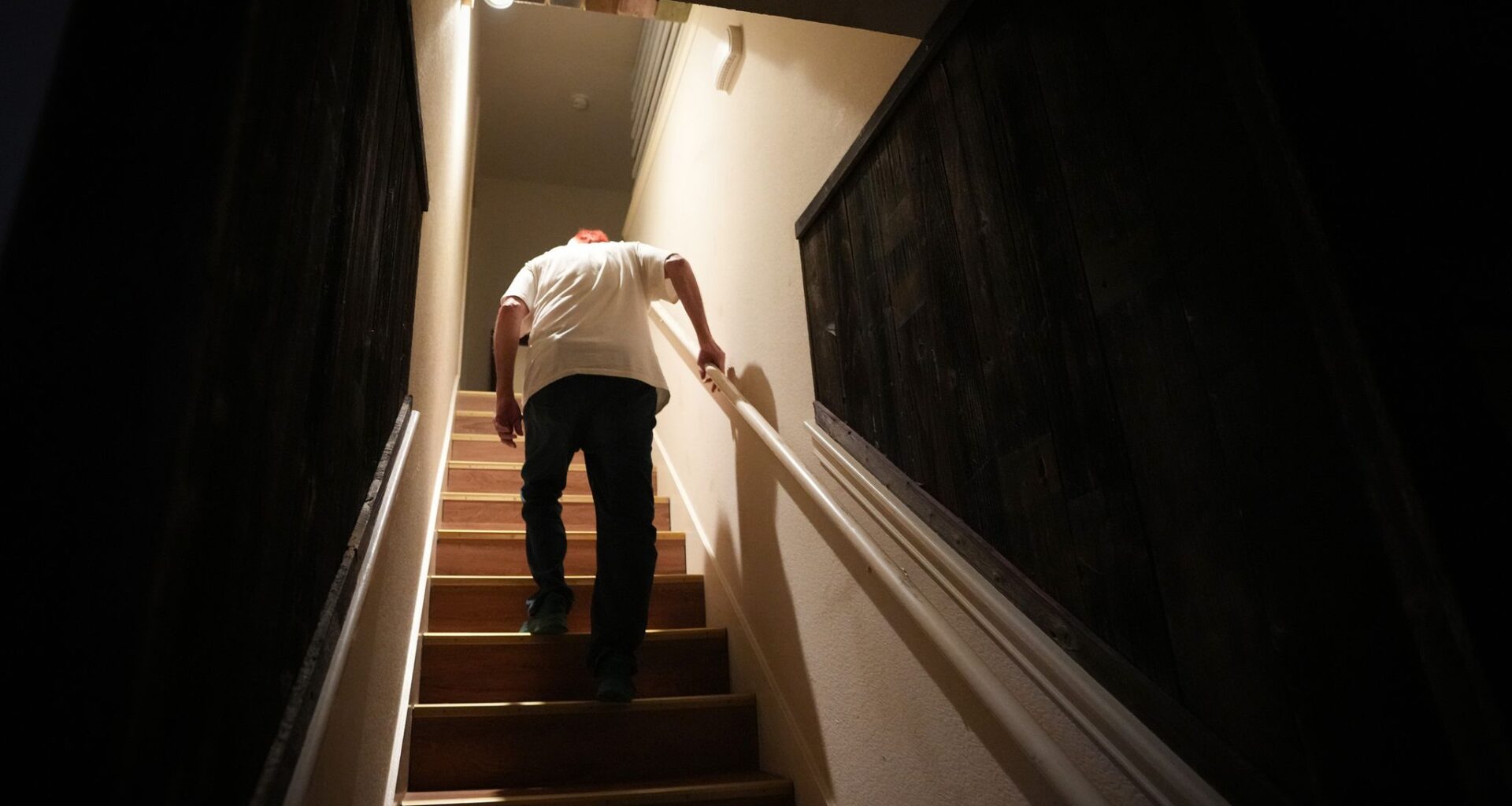
Robert Thayer, a retired Austin musician, walks up the stairs to his rented room in a shared house in Southeast Austin. Cities need more housing options for older residents seeking to downsize and younger families wanting to move in, Jacqueline Angel writes.
Jay Janner/Austin American-Statesman
Across America, many older homeowners want to stay in the communities they love but can’t find smaller, affordable homes nearby. Young families want to move into those same neighborhoods but can’t afford to buy in. Everyone stays put.

The 21st Century ROAD to Housing Act recently became law. As the first comprehensive federal housing package in more than three decades, the bill aims to increase the housing supply by cutting regulatory barriers for new construction, expanding financing and curbing bulk home purchases by institutional investors.
Article continues below this ad
But building more homes won’t fix what’s happening to American communities, where the nation’s housing shortage is colliding with a demographic shift that traps both older adults and young families in housing that doesn’t serve them.
Seventeen states now have more adults age 65 and older than children under 18, and nearly half of U.S. counties are approaching that point, according to the Census Bureau. That shift is changing how communities grow, govern and prepare for the future, testing the unwritten compact through which each generation has made room for the next.
For generations, that compact followed a familiar cycle. Young families moved into neighborhoods; children filled local schools; adults became homeowners, taxpayers, volunteers and eventually caregivers for aging parents.
But as our population ages, millions of people are finding themselves caught in a housing market that no longer lets generations move through cities and towns as they once did.
Article continues below this ad
ALSO READ: Improving Austin’s support for seniors will take a village
Freddie Mac estimates the nation is short about 3.7 million homes. As housing costs have risen, an estimated 1 million households have never formed, largely because younger adults cannot afford to buy or rent homes of their own. Nearly one in three Americans under 35 lives with parents or other relatives, despite most being employed.
This is more than a housing shortage. It is the “Grandparent Trap”: a housing market that no longer allows one generation to make room for the next.
Older homeowners who want to downsize often can’t find affordable, accessible housing nearby. Younger families can’t compete for the limited homes that do become available. The result is a housing market where fewer people move, fewer homes turn over and communities become less generationally diverse.
Article continues below this ad
The effects are especially visible in America’s suburbs. Built after World War II for growing young families, many suburbs are now aging in place. Between 2000 and 2024, the number of older adults living in suburbs more than doubled, while the number of children changed little by comparison. As fewer younger families move in, schools lose enrollment, neighborhoods become less age-diverse, and local governments confront new demands for housing, transportation and caregiving.
Central Texas’ two largest cities illustrate the pattern. Declining enrollment in the Austin Independent School District has intensified debates over school closures, property taxes and public spending. In San Antonio, the story is similar: San Antonio ISD is tracking enrollment scenarios that could range from about 42,000 students to fewer than 38,600, a decline officials point to alongside a $46 million budget shortfall.
SIGN UP FOR THE AUSTIN ANGLE and get Statesman commentaries in your inbox
These debates are usually framed as budget problems. They’re also signs of a housing market that has become stuck, making it harder for one generation to move in as another grows older.
Article continues below this ad
Some communities have begun responding. Minneapolis has expanded housing choices by allowing duplexes, triplexes and accessory dwelling units in neighborhoods once reserved for single-family homes. Portland, Oregon has encouraged “missing middle” housing, while California has reduced barriers to accessory dwelling units that let older parents, adult children or caregivers live nearby.
The 21st Century ROAD to Housing Act’s supply-side reforms give these local efforts a federal tailwind. But the law won’t restore mobility on its own. That requires treating housing policy as aging policy: building neighborhoods where older adults can remain connected without becoming isolated, and where younger families can afford to put down roots. Housing, schools, transportation and caregiving need to be planned as parts of the same community strategy, not separate priorities.
A republic endures because each generation accepts responsibility for the next. The ROAD to Housing Act is a start. We will know we have succeeded when older adults can remain in the communities they helped build and young families can afford to build lives there, too.
Article continues below this ad
Jacqueline Angel is a professor of sociology and public policy at the University of Texas.