
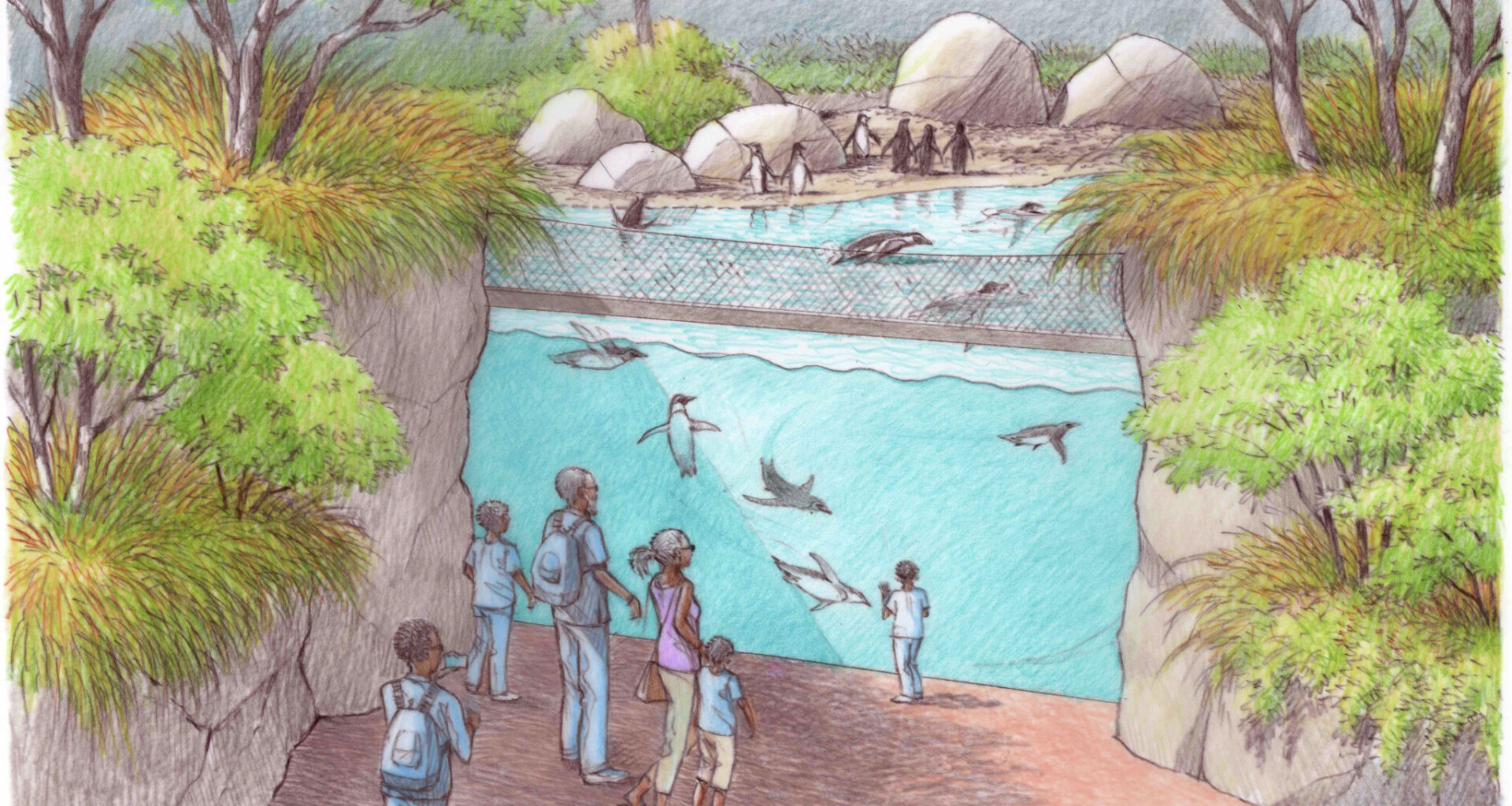
A rendering shows the African Shorelines habitat, where visitors will be able to view African penguins above and below the water as part of the Dallas Zoo’s largest transformation ever.
Courtesy of The Dallas Zoo
The next chapter of the Dallas Zoo begins at the water’s edge.

After years of planning, construction is set to begin this fall on African Shorelines, the first phase of the zoo’s $119 million Wild Horizons master plan and the largest transformation in its 137-year history.
The project will bring to life an immersive coastal habitat home to one of the nation’s largest flocks of African penguins, free-flying lesser flamingos and new education and event spaces.
Article continues below this ad
From there, a half-mile trail built along the route of a decommissioned monorail will connect visitors to forests, grasslands and aviaries, marking the return of a beloved resident visitors haven’t seen at the zoo in more than a decade.
“To get to be part of the team that shepherds this into a new era is so exciting,” zoo CEO Lisa New told The Dallas Morning News in an exclusive interview previewing the expansion. “It’s needed to grow and stay relevant and continue to be one of the top zoos in our country. And we want you to come along for the journey.”
A look inside African Shorelines
At the end of the tunnel connecting ZooNorth to the Wilds of Africa, visitors will step into African Shorelines, an immersive coastal habitat designed to bring them closer than ever to wildlife.
According to Stephanie Allard, the zoo’s chief mission officer, the space will feature more than three dozen penguins and a 10-foot diving pool, giving the flightless seabirds room to play and porpoise.
Article continues below this ad
A pedestrian walkway will extend into the habitat, Allard said, giving visitors the feeling of sharing the aquatic ecosystem.
“They’re sharing experience with the animals,” Allard said. “We’re just ready to see it through a new set of eyes.”
The Dallas Zoo’s African Shorelines exhibit will feature free-flying lesser flamingos and other African birds.
Courtesy of The Dallas Zoo
Nearby, a new free-flight aviary will house the zoo’s brightly colored flamingos and other African bird species, offering a glimpse of the birds’ natural movement and behavior.
The area will include a cafe and an event space, where visitors can observe the birds through a large glass viewing wall.
Article continues below this ad
Future phases
By rolling out the expansion in phases, zoo officials hope to minimize disruptions for guests while allowing new exhibits to debut as construction continues.
“Sometimes, the earth movers and the construction equipment are as exciting as a dinosaur exhibit,” New quipped. “We hope to have some fun with that.”
Future additions include Wild Grasslands, expected to open in 2029, featuring what the zoo says will be the only habitat in the United States where rhinos — last seen at the Dallas Zoo in 2012 — and cheetahs share the same enclosure. The area will also include habitats for African hoofstock, a rhino encounter yard and a mixed-species aviary.
The following year, the zoo plans to open Okapi Forest, a shaded exhibit featuring okapi and colobus monkeys. Elevated pathways will allow monkeys to travel above visitors, while guests will be able to observe and feed okapi from designated viewing areas.
Article continues below this ad
The exhibit will also include a treehouse classroom and a nature-inspired children’s play area modeled after the rocky kopjes of Africa’s Serengeti.
The future, zoo officials say, reflects both rising attendance and growing ambitions.
With annual attendance nearly doubling over the past decade to about 1 million guests, Wild Horizons is designed to keep that momentum growing — adding new habitats and experiences that give visitors more reasons to return while transforming the walk through the zoo into part of the adventure.
“It’s not about getting from point A to point B,” New said. “It’s all the things that happen on the path.”