
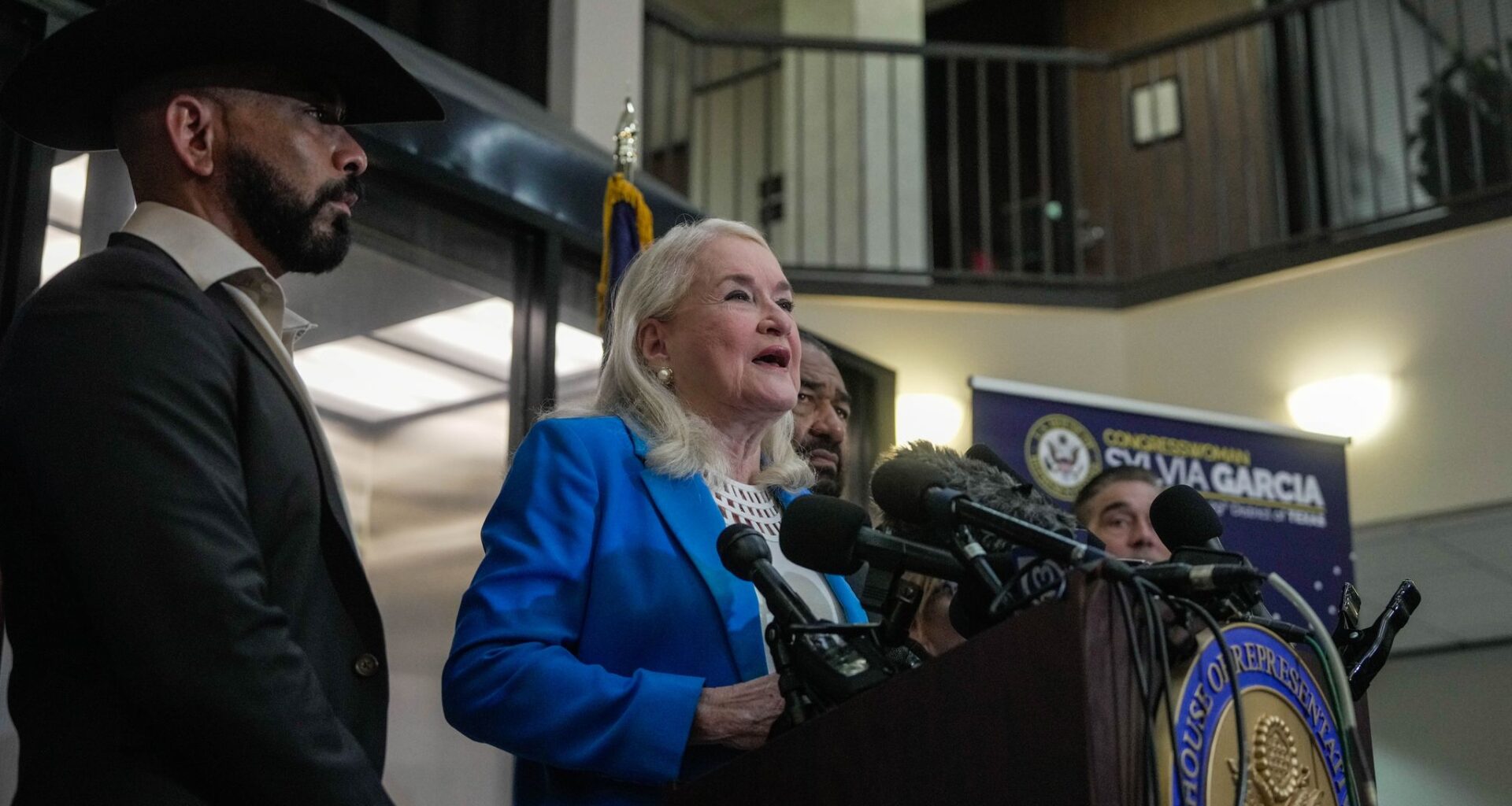
U.S. Rep. Sylvia Garcia speaks during a news conference in Houston on Friday, July 10, 2026, regarding the deadly ICE shooting of Lorenzo Salgado Araujo.
Raquel Natalicchio/Houston Chronicle
Hours after Lorenzo Salgado Araujo was shot by an immigration agent in East Houston on July 7, U.S. Rep. Sylvia Garcia sat with the man’s family at Ben Taub Hospital seeking details about the fatal encounter.
Within the next two days, Garcia, D-Houston, stood with the Salgado family at a news conference to demand answers about why he was targeted and fatally wounded. Then she spoke directly with the acting director of Immigration and Customs Enforcement and learned that neither Salgado nor his passengers were the men ICE agents had been looking for.
Article continues below this ad
MORE COVERAGE: Congressional forum in Houston will scrutinize ICE use of force after fatal shooting of Lorenzo Salgado
“He refused to answer some things, but I did get him to commit to a few things,” Garcia told the Houston Chronicle in describing the conversation. “Now we know that he wasn’t the target. But then it makes it even harder because if he wasn’t, then why did he end up getting shot?”
Taking a leading role in speaking out about the shooting and holding ICE accountable was decades in the making for Garcia, 75. Despite having one of the largest Hispanic populations in the U.S., Houston had never elected a Latino to the U.S. House until Garcia won her seat in 2018, midway through President Donald Trump’s first term.
She was also one of the first Latinas to represent Texas in the U.S. House, winning her election the same year Veronica Escobar, D-El Paso, was ushered into Congress.
Article continues below this ad
READ MORE: Sylvia Garcia visits detained witnesses who dispute ICE’s account of deadly Houston shooting
When Garcia won her primary, she made clear that she wanted to be a voice for a community long underrepresented in the halls of Congress.
“This was for Latinos who, for too long, have sat on the political sidelines while the president sits in the White House blaming all of our problems on immigrants,” she said on the night she won her primary.
As protests erupted over Salgado’s death, Garcia led the way as ICE’s chief antagonist. The East End neighborhood where Salgado was shot is located in her congressional district.
But long before the shooting, Garcia had championed the rights of minorities, immigrants and women outside those political boundaries.
Article continues below this ad
“She’s very passionate about her work and her constituency and trying to make a difference,” state Sen. Carol Alvarado, D-Houston, told the Chronicle. “She’s very persistent. So, I think with an issue like this, that’s what you need.”
Mayor Kathy Whitmire, left, swears in Houston attorney Sylvia Garcia, who was appointed Wednesday to head the Municipal Courts, May 20, 1987. Garcia, 36, who had been night presiding judge since April 1, 1986, becomes the first woman, first Hispanic and youngest person ever to head the city courts.
Buster Dean/Houston Chronicle
From rivals to allies
Alvarado and Garcia were former rivals when they faced each other in the 2013 race for the state senate seat Garcia eventually won. Alvarado said that year featured a “bitter, divisive campaign” but the two have since worked together to support causes they both champion.
“Sometimes you just have to put things aside and look at the greater good of what you can do together,” Alvarado said. “We’ve done that on many issues, standing side by side in press conferences when voting rights issues came up.”
Article continues below this ad
In Austin, Garcia was a fixture at rallies and news conferences where immigrants and their supporters railed against state-based immigration laws they said were discriminatory and counterproductive.
OPINION: The Supreme Court got birthright citizenship right. It should never have been a close call.
Garcia was particularly outspoken about the state’s so-called “sanctuary cities” law, SB4. The legislation, passed in 2017, forbids local entities from refusing to cooperate with federal immigration officials.
She authored a slew of bills later that year to repeal the legislation. She said in a statement that “a broken taillight could lead to a broken family,” alluding to the possibility that a traffic stop could land an unauthorized immigrant in deportation proceedings.
Garcia was born in 1950 in San Diego, Texas, and lived in Palito Blanco with a father who worked as a farmer and a mother who cleaned houses, the National Women’s Conference wrote in a biography of the lawmaker. She was the eighth of 10 children.
Article continues below this ad
Garcia earned a scholarship to Texas Women’s University in Denton and graduated in 1972 with degrees in social work and political science. She moved to Houston later that year and worked as a state social worker before graduating from Texas Southern University with her law degree.
Her advocacy goes back more than 50 years, when Garcia in the 1970s was a member of the now-defunct National Welfare Rights Organization. She was also a member of the Coalition for Barrier Free Living and the National Women’s Political Caucus, a pro-choice, progressive organization created to grow the ranks of women in politics.
She later served as a municipal court judge, the Houston comptroller and a Harris County commissioner before being elected to the state Senate in 2013.
Sylvia Garcia waves to members of her party as she walks to the microphone at Brady’s Landing during the race for County Commissioner of Precinct 2, Tuesday, November 5, 2002 in Houston.
CHRISTOBAL PEREZ/HOUSTON CHRONICLE
Supporting dreamers
As Garcia leads the effort to inform the public on the Salgado shooting, she’s pressing forward to protect immigrants who came to the country without authorization as children.
In Congress, she was quick to file legislation to provide a pathway to citizenship for “Dreamers,” immigrants brought to the U.S. as children but who lack legal status.
“It is about keeping the issue alive and making sure Dreamers know that there are still people fighting for them here,” Garcia said during an interview on the Texas Take Podcast in December about what motivates her to spend so much time on an issue she knows President Donald Trump is unlikely to support.
READ MORE: U.S. Rep. Sylvia Garcia blasts lack of body cameras after fatal ICE shooting in Houston
She refuses to abandon the effort despite being in the minority party. Just weeks before Salgado’s death, Garcia led a news conference at Houston City Hall to commemorate the 14th anniversary of the Deferred Action for Childhood Arrivals, or DACA, program. The 2012 initiative grants some unauthorized immigrants a renewable, two-year work permit and a reprieve from deportation proceedings.
Garcia is also the author of the American Dream and Promise Act, which would grant DACA recipients legal status in the United States and an eventual pathway to citizenship. She launched a discharge petition to force members of the U.S. House to vote on the bill earlier this week.
The DACA anniversary came amid Republican efforts to further erode the program after a court ordered the federal government to only accept renewal applications. Several DACA recipients have claimed that the process has been intentionally slowed to push more people out of status.
“(The Trump) administration is delaying renewals. It is creating gaps that are costing people their livelihoods,” Garcia said. “This is not by accident; it is by design. This is a part of a deliberate effort to suffocate DACA one delayed renewal at a time.”
U.S. Rep. Sylvia Garcia talks to the media after entering the Montgomery ICE Processing Center in Conroe, Saturday, July 11, 2026. Garcia visited with the men who were riding with Lorenzo Salgado Araujo, who was shot and killed by an Immigration and Customs Enforcement agent.
Jacob Lujan/Houston Chronicle
Fear and anxiety
Last year, before Trump was sworn in for his second term, Garcia became one of the first members of Congress nationwide to hold townhall sessions to warn citizens and non-citizens what their rights are if ICE agents approach them.
“There’s just a lot of concern, fear and anxiety,” Garcia said in January 2025 when explaining why she felt compelled to hold the event.
The White House said federal agents were going after immigrants with criminal records. Garcia said she knew they would change course and pad their numbers by targeting people who have never committed any crimes.
She said immigrant families remain afraid to take their children to school, go to a doctor’s appointment or even attend church because of the administration’s push to show their MAGA base they are getting the job done.
In Houston, Garcia’s efforts to seek justice for the Salgado family are continuing this week. She convened a forum in Houston scheduled for Friday where Congressional Democrats will scrutinize use-of-force policies by ICE agents.
She’s also tracking the status of the three men and witnesses who were in Salgado’s van when he was shot. The men — Daniel Tirado Pantoja, Jose Trinidad Rojas, and Victor Salgado, Lorenzo Salgado’s brother — were transported to an ICE detention facility in Conroe after the shooting.
MORE COVERAGE: How will the feds investigate the ICE shooting of Lorenzo Salgado Araujo — and can they be trusted?
Garcia demanded to see the men after she was initially denied access to the facility.
“I of course reminded them that I was a member of Congress. By statute, we have authority of oversight over this facility and that under the law, they had to let me in,” she said outside the facility.
Through it all, Garcia has maintained the polite but deliberate demeanor she’s become known for during moments that divide her community. She’s not immune, however, to letting the emotions take hold, if only for a few seconds.
After a news conference, she was asked where Salgado’s death ranked among everything else she’s dealt with during her time as a public servant.
“It’s heartbreaking. It reminds me a lot of the Vanessa Guillen case,” she said, fighting back tears as she remembered the death of the 20-year-old Army soldier and Houston native.
Then it was immediately back to business for Garcia.
“ICE has just completely iced everybody out,” she said without a hint of the sadness she showed just seconds before. “It’s similar to what the Army was trying to do before I got involved.”