
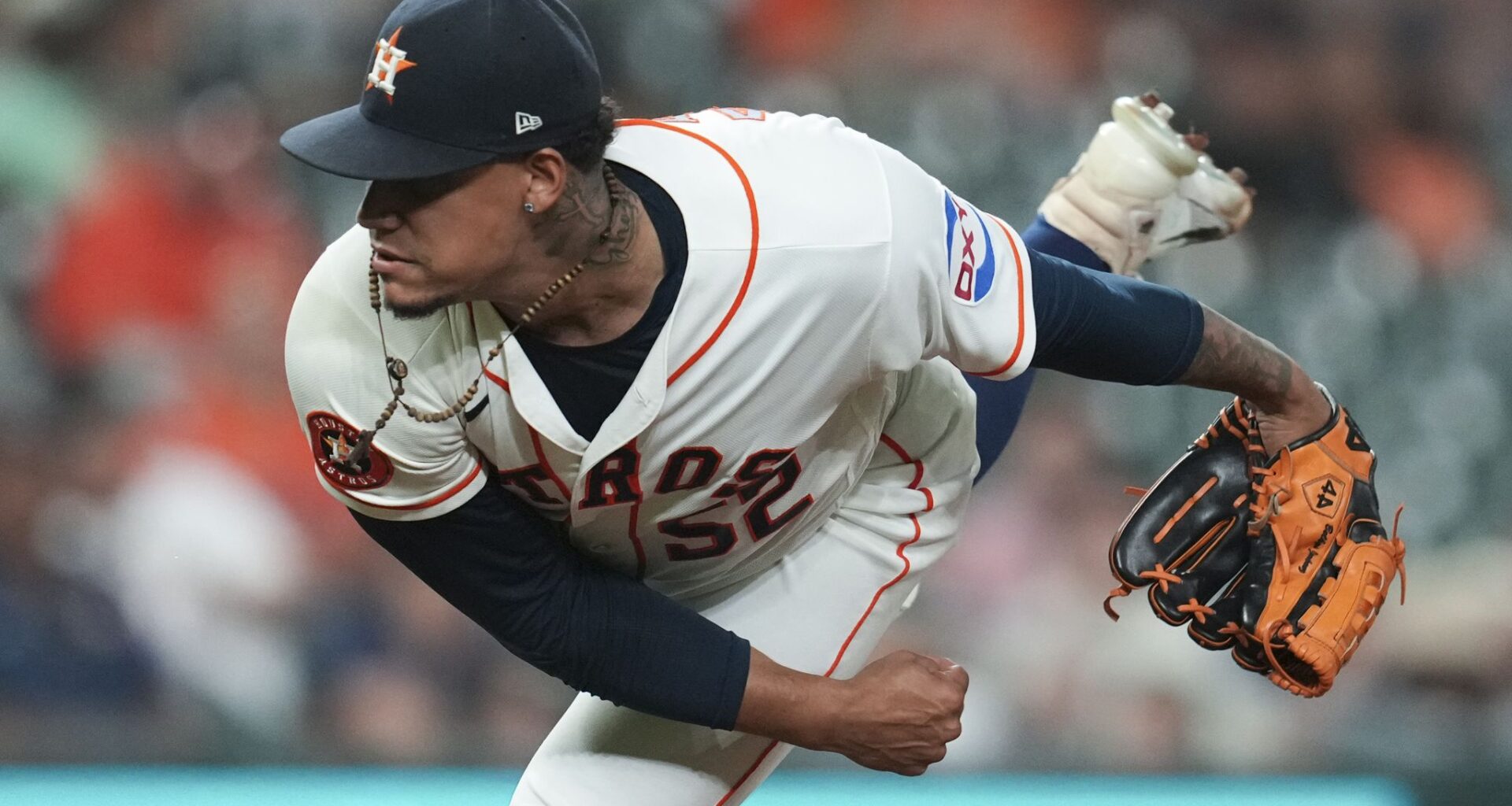
Houston Astros closer Bryan Abreu (52) delivers during the ninth inning of an MLB baseball game in Houston, Wednesday, July 22, 2026.
Jason Fochtman/Houston Chronicle
CHICAGO — Bryan Abreu began to warm for the Houston Astros as they entered the bottom of the eighth inning Wednesday tied with the Marlins. It indicated that, at least, Abreu would be tasked with preserving a tie in the top of the ninth. Instead, home runs by Yordan Alvarez and Isaac Paredes created a save situation. Abreu inherited it and worked a clean ninth to finish Houston’s 5-2 win.
Closer Josh Hader was unavailable after pitching three of the previous four days, Steven Okert and Enyel De Los Santos had already pitched and the bottom three spots in Miami’s lineup were due in the ninth. Changing any of those might have altered the calculus of using Abreu for the final three outs. That he did appear, still, suggested possible progress in where the Astros are willing to use him.
To say Abreu, who still owns a 5.29 ERA, is back to the point of commanding high-leverage opportunities for the Houston bullpen may be presumptuous. Three of the right-hander’s five outings in July before Wednesday, still, occurred in eighth innings with the Astros leading or tied. The embattled erstwhile set-up man worked a scoreless inning in each.
Article continues below this ad
“I’m going to continue to look for some pockets for him where I can continue to get that traction and get him going,” manager Joe Espada said after Wednesday’s game. “But the last month, he’s showing signs that the velo is there, he’s throwing quality strikes, his slider is in the zone, you’re starting to see chases.”
Abreu’s abysmal start — a 12.54 ERA in his first 11 appearances through April — featured an alarming lack of the latter. Abreu threw 38.8% of his pitches in-zone in that stretch and generated just a 20.4% swing rate on pitches out of the zone. He walked 15 batters in those 9⅓ innings, creating traffic on the bases and compounding the four home runs and 59.1% hard-hit rate he allowed in them.
Abreu’s in-zone rate has crept upward since, and with it the chase and overall swing rates against him. After a dip in May, when his fastball velocity was at its lowest this season — something he attributed to mechanical issues — Abreu’s swing-and-miss rate has also inched upward the past two months. He had walked 12 batters over his last 24⅔ innings entering Friday’s series opener in Chicago.
Article continues below this ad
No pitching staff in baseball had a higher walk rate through April than Houston’s, a fault Abreu helped fuel. A league-wide jump in walks early on was widely attributed to pitchers and catchers adjusting to the new ABS challenge system, which regulates the strike zone to individual hitters’ heights, and some lineups opting for extreme patience — as the Astros did early — while pitchers adjusted.
“I think you look at our staff in general, we’ve got guys that find whiffs,” Astros pitching coach Josh Miller said Friday. “When guys aren’t chasing as much it really affects how you can pitch, and maybe we were a little bit too late to adjust. We’ve tailored some attack plans differently, we’ve added some pitches to some guys to help them get in-zone more, and we’re starting to see dividends of that. Still walking too many guys as a staff in general and we’ve got to get better at that.”
Abreu began throwing a cutter in June. He explained then that adding the pitch was meant to help him get in-zone by allowing him to throw it in the middle and let the movement do the work rather than always aiming for corners. Abreu had thrown the cutter 13.5% of the time since the start of June going into Friday. Hitters were 1-for-6 with a 55.6% whiff rate against it.
“He’s got a really good slider, a devastating slider,” Miller said. “But it’s a pitch that’s not a high in-zone rate pitch, it requires chase to get the whiff. So using it early in the count like he has early in his career wasn’t as fruitful. So having the cutter, something that moves a little bit less, something he can throw more similar to a fastball, throw it in the zone more, it’s been a pretty good pitch, too. It also helps round out his arsenal a little bit.”
Article continues below this ad
While the Astros and Abreu experimented with numerous adjustments early in the season, Miller said he believes a key one was changing his throwing program to include more pre-game throwing off a mound. Abreu is not throwing full-intent bullpens every day, but Miller said he thinks throwing a number of pitches off the mound to feel “timing of release point from the slope has been helpful” for consistency.
Entering Friday, Abreu had a 2.55 ERA across his last 26 appearances since the start of May. Remove one outing against Pittsburgh, in which Brandon Lowe hit an inside slider off the foul pole at Daikin Park for a three-run home run, and Abreu had a 1.52 ERA in his other 25 outings in that stretch. Opposing hitters owned a .188 average and a 27% strikeout rate against him since May 1.
That has not propelled Abreu back into a regular setup role. But getting Abreu back to some semblance of his previous form could impact the Astros on multiple levels. Their options to bridge games to Hader dwindled when Bryan King was sent to Triple-A. Right-handed leverage relief is a need, meanwhile, one the Astros might be less inclined to pursue at the trade deadline if they feel Abreu is resurgent.
Regardless of whether Houston adds pitching at the trade deadline, Abreu pitching like he did in recent seasons would bolster its bullpen down the stretch in what it hopes is a postseason race.
Article continues below this ad
“I’m going to continue to rely on him,” Espada said. “He’s one of the best relievers in the game and he’s starting to get traction now towards the end, and no better time to do it than right now.”