
Texas continues to grow as a major hub for space travel, with the launch of the Texas Space Commission and a growing private space industry helping companies expand their reach.
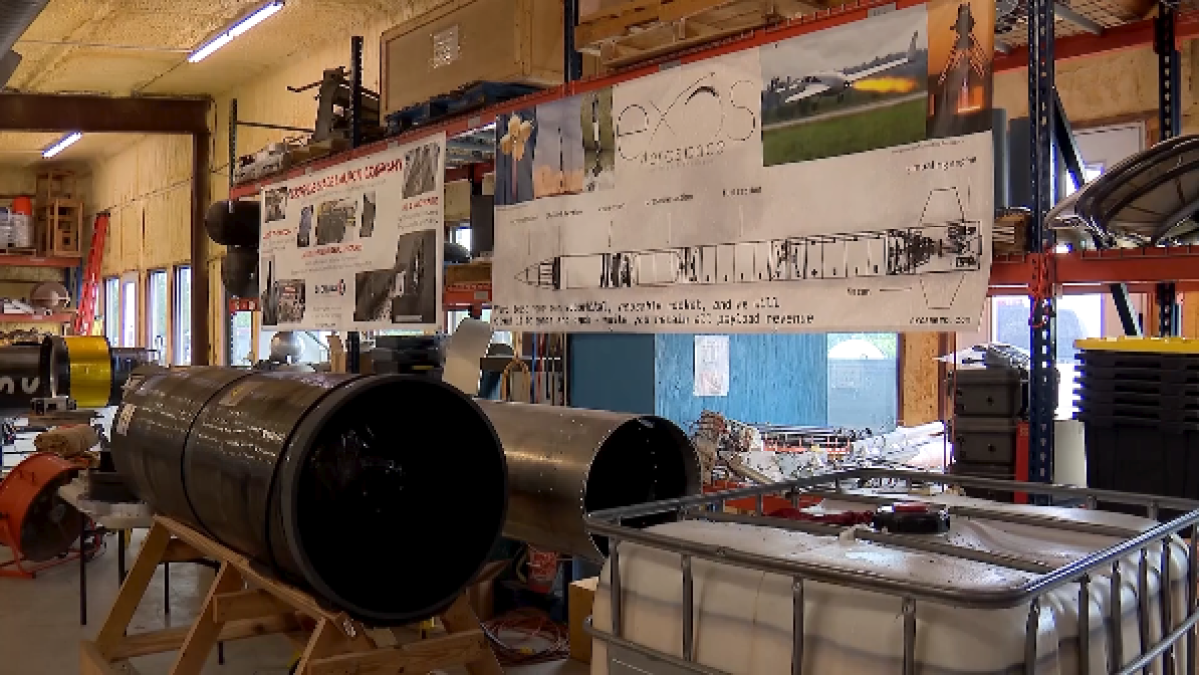
On the outskirts of Greenville, Exos Aerospace is preparing for a spring launch of its Block 3 rocket. The mission will carry a payload 62 miles above Earth from Spaceport America in New Mexico, giving research customers several minutes of microgravity before returning to the ground.
Operations Manager Phil Eaton said the rocket uses an ethanol-based propulsion system.
“It’s an ethanol 190 proof system. And it’s all denatured, but it’s very similar to Everclear,” Eaton said.
Eaton said the company is assembling the rocket with Scorpius Aerospace propulsion tanks to provide researchers with four to five minutes of microgravity on the edge of space.
“This is a much lower-cost opportunity to do some initial research. Make sure your experiments actually function in a space environment. Before you pay millions of dollars before you take them to orbit or up to the moon,” Eaton said.
Exos Aerospace is part of Texas’ growing commercial space sector, which has received a boost from the new Texas Space Commission. The commission helps companies connect with investment opportunities as the state’s space industry expands.
CEO John Quinn said Texas provides the resources and workforce needed to build rockets.
“If you look around this shop, we have 100% of everything we need to build these rockets. So the raw materials are accessible here in Texas. The talent is certainly here, whether it’s from NASA, from SpaceX, from Blue Origin,” Quinn said.
Quinn said one of the company’s biggest milestones has been developing reusable rockets that can fly, return, be reloaded and launch again. Exos Aerospace is one of three companies licensed to reuse rockets, alongside Blue Origin and SpaceX.
“Prove that something works in space. We can get you there in a matter of minutes. And bring it back and give it back to you proven in a space environment,” Quinn said.
This spring’s mission will carry a small amount of radioactive material — similar to the material used in the glowing hands of a watch. The goal is to determine whether it can help power equipment on the moon during the nearly two-week lunar night, when sunlight is unavailable.
“That obviously multiplies the value of putting a lander down that actually can do something now because you can keep the electronics and the batteries from freezing,” Quinn said.
Exos Aerospace works with universities, private companies and the Department of Defense to conduct suborbital tests before customers move on to larger, more expensive and higher-risk space missions.
The company says those shorter, lower-cost flights allow researchers to verify their technology in space before committing to missions that can cost millions of dollars.
This story was originally reported for broadcast by NBC DFW. AI tools helped convert the story into a digital article, and an NBC DFW journalist edited it again before publication.