
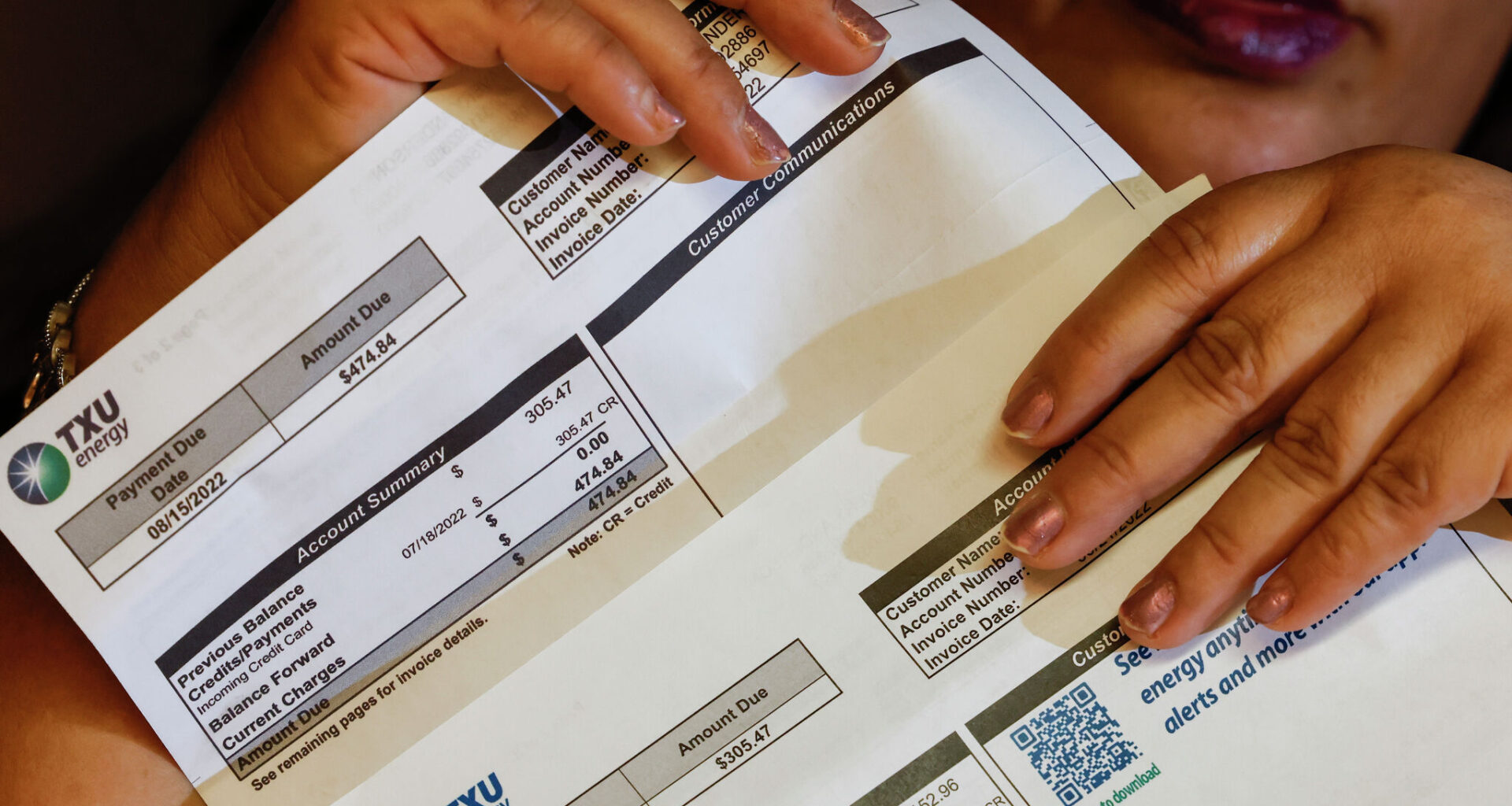
Texas’ electricity mess goes way beyond the devastating winter storm in February 2021. The Watchdog explains how deregulation, ERCOT, bailouts and confusing plans left Texans paying for past mistakes.
2022 File Photo/Shafkat Anowar
I keep thinking of a fictional family who moved here for, let’s say, a new job. They comprise just a few of the thousand newcomers who move to Texas every day. If I could, I’d sit the newcomers down and warn them that they are not only launching a new life in Texas, but they also are becoming enmeshed in one of the biggest scandals in state history. The cockamamie electricity system.

It’s so messed up that you’ll be paying for past mistakes along with almost everyone else, even if you didn’t live here. The Watchdog prepared this primer for you. But as for everyone else, see how much you remember.
The start
People think our most serious problems began with February 2021’s devastating winter storm. Most of us suffered with limited electricity during a four-day crisis. But actually the problems began much sooner.
Article continues below this ad
Enron, a Houston-based company grew into the largest energy company in the world. But its top executives played endless games with their financial books. The company used loopholes to hide bad debts. Enron also inflated its earnings.The company went bankrupt in 2001 and closed. Executives went to prison. The shutdown harmed thousands of investors. Losses were said to be $74 billion. Thousands of employees lost their jobs.
Why is this included here? Enron pushed hard for deregulation. Even though the company failed, Texas leaders pushed the Enron model through when they launched deregulation.
ERCOT
ERCOT is the Electric Reliability Council of Texas, a nonprofit that operates the independent Texas electricity grid. The Texas grid connects to the national grid in only a few places. Leaders say they want to keep federal regulators out of our business. ERCOT’s record is hardly clean. In its early days, some managers were convicted in a bidding scam.
ERCOT was repeatedly criticized by state lawmakers for its leaders’ arrogance and lack of transparency. But nobody fixed any of these flaws in time to save Texans. What happened?
Article continues below this ad
When the weather turned cold with icy precipitation in 2021, ERCOT was ordered by the Public Utility Commission of Texas to keep electricity prices at the $9,000-per-megawatt-hour cap — 10 times the previous $900 maximum — as millions of Texans lost power.
Texans froze in their homes. Electricity and gas companies lost millions of dollars during the crisis.
ERCOT leaders, trying to justify their actions, said they were a mere 4 minutes and 37 seconds away from a massive blackout that could have shut the grid down. I always had doubts about that number.
PUC leadership
During testimony it became clear that PUC commissioners didn’t see it as part of their jobs to be more aggressive.
Article continues below this ad
“You’re the commissioner!” one Republican senator chastised PUC chairperson DeAnn Walker: “Y’all don’t have any teeth,” another scolded.
She replied meekly, “If you believe we have that authority, I’m open to moving forward with it.” She resigned in disgrace and was replaced by Arthur D’Andrea. He lasted only two weeks as chair. He was caught telling investors not to worry about their losses. Affected businesses wanted to make certain that billions of dollars in overcharges would not be reversed. In his words he vowed to do everything in his power ‘to tip the scale as hard as I could’ on behalf of businesses.
Even though his prediction was true and would come to pass, he quickly resigned too.
Securitization
Securitization is such an ugly word, especially in this situation.
Article continues below this ad
So many companies suffered severe losses when prices jumped during the 2021 winter crisis that many didn’t know what to do. They lobbied hard for bailouts. The purchase of bonds would save them. That’s securitization. State leaders from the governor on down liked the idea of buying billions in bonds to, as they said, make dozens of companies “whole.”
With a state budget surplus around $40 billion, leaders could have raided that fund to pay for the bonds. Did they do that? Nope. They sold bonds by the billions and tacked that on to our electric bills for the next 20 to 30 years.
The Texas Railroad Commission, which regulates the gas industry, started out with $3.4 billion. Of that Atmos Energy was slated to receive $1 billion.
On the electricity side, the PUC handled $2.1 billion in bonds for company bailouts such as $409 million for TXU Energy and Direct Energy, $117 million.
Unlike most companies, Reliant Energy said it would not pass its $312 million cost on to customers. Instead, the company said investors would absorb the loss.
According to the initial setup, bonds could be repaid by current users as far off as 2050. That’s 24 more years.To all newcomers, see what you got into?
Overpayments
As I explained in my previous column on this subject, a new study by a retail energy expert argues that a typical family overpaid $480 in one year on their power bill.
Article continues below this ad
The system does not favor consumers.
Energy expert Laurel Peltier wrote in her study, “Retail suppliers do not compete to deliver the lowest long-term price. They compete to capture customers during brief promotional windows and then monetize those relationships through deceptive autorenewables, uncapped variable rates and opaque green offerings. In this environment, disclosure alone cannot protect consumers, and caveat emptor — ‘buyer beware’—is not a viable public policy for an essential service.”
Marketing
Shopping for a low electricity rate is extremely difficult.
Under deregulation, competition was supposed to reduce prices.
Article continues below this ad
Right now many Texans are paying double compared to what they paid in the pre-Uri world.
Reading an electricity contract causes eyes to glaze over. The true story of how much a kWh costs is not big and bold on most company sales websites. You also have to root out the “Electricity Facts Label,” an add-on to a contract.
Know what your kWh rate you’re paying. When does your contract expire?
Don’t fall for cute company commercials with celebrity endorsements.
Know that free nights and weekends schemes often don’t state loud and clear that your kWh rate during the rest of the week is often astronomical.
You must pay attention to avoid getting suckered by people who are a lot smarter about this than you are.
If you lose, you pay more.