
Tens of thousands of children are about to head to private schools as part of the first batch of recipients under Texas’ $1 billion voucher program.
Though the first day of most academic years is still weeks away, the program is already causing headaches for some public schools, which may need to cut back on teachers and other resources as students leave for private school or homeschool.
Administrators at more than half of the state’s school districts still don’t know how many of their enrolled students, if any, have been awarded a voucher and plan to leave their classrooms. That’s because the state comptroller’s office, which runs the program, is withholding data to districts where fewer than 30 students got a voucher, citing a need to keep families’ data confidential.
READ MORE: How Texas’ $1 billion voucher program is fueling a microschool boom
Article continues below this ad
As a result, about 16,000 voucher recipients aren’t accounted for in the data, or 15% of all recipients.
The redaction is mostly hitting smaller and rural districts, where administrators say losing even a handful of students could significantly impact their operations. Brandon Enos, legislative chair of the Texas Rural Education Association, said he and his colleagues’ requests for more data for their individual districts have so far gone unfulfilled.
Enos serves as superintendent of Gunter ISD in North Texas, which serves just 1,200 students. The lack of information is casting uncertainty over much of his planning for next school year, he said, including everything from teacher hiring to bus routes.
“We are asking for the information we need to responsibly operate our schools,” Enos said. “We can’t just react afterwards because, unlike large urban districts, a relatively small number of students dramatically affects our staffing.”
Article continues below this ad
The state released an initial data drop on voucher recipients in June, broken down by the school district where each recipient lives. Large districts in urban and suburban areas led the rankings, with Houston and Fort Bend ISDs claiming top spots.
The state suppressed data for any district with fewer than 30 residents awarded vouchers, saying that sharing it could make it possible to identify individual recipients. Redacting small datasets to protect people’s identities is common. The U.S. Centers for Disease Control, for instance, suppresses death counts that are less than ten.
The comptroller’s office said it chose a conservative threshold for anonymizing the data in part because it could be easier in districts with very small populations of eligible students to identify individual voucher recipients. It also noted that many recipients are students with special needs, which could make them even more identifiable in those smaller districts.
“We know that there’s a ton of public interest in this program – who’s participating in demographics, geography, all of that,” said Travis Pillow, a spokesman for the program. “So we’re continuing to find ways to provide data transparently to the public, while also making sure that we are protecting students’ privacy.”
That threshold leaves nearly 700 districts out of the dataset, forcing them to guess whether 0 or 29 students could be leaving their classrooms. In all, more than 16,000 awardees are unaccounted for, either by where they live or the district they would have attended.
Article continues below this ad
The gap could make it hard to measure one of the thorniest aspects of the policy debate: whether vouchers would benefit rural areas or leave them behind. For years, rural Republican lawmakers opposed school choice programs, fearing vouchers would disproportionately benefit wealthier metro areas and threaten the stability of their own communities, many of which rely on public schools as major employers.
The Comptroller’s office is required by law to release an annual program report, including demographic and geography information, on August 1. It is not clear whether the 30-award threshold will also apply to that report.
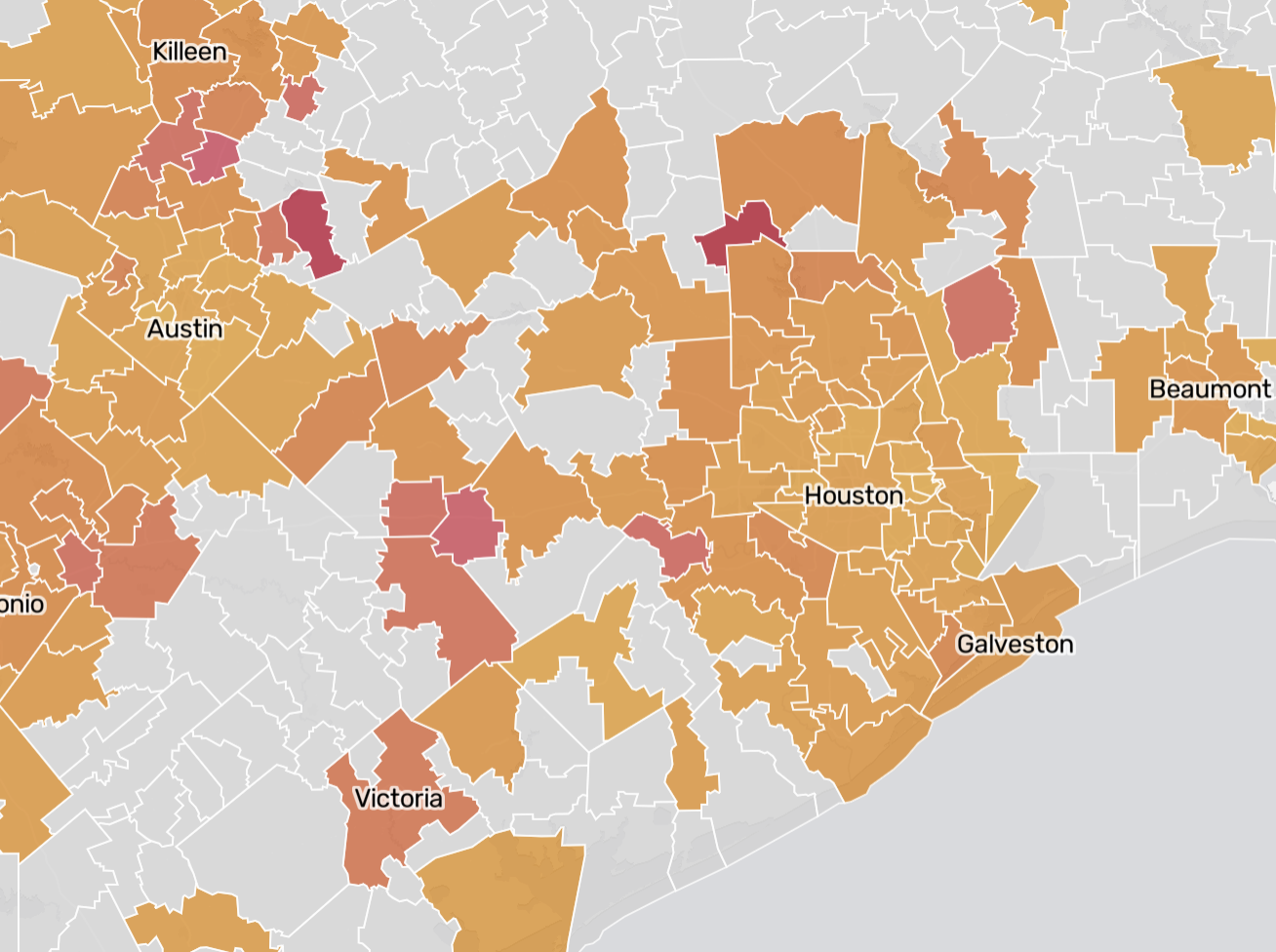
For districts that were included in the data, most saw between 1 and 5% of all enrolled children awarded a voucher, according to a Hearst Newspaper analysis that compared the comptroller’s numbers with census counts for each district. That proportion was led by exurban or small-town districts, like Princeton ISD, on the edge of the Dallas-Fort Worth metro, or Fredericksburg ISD in the Hill Country.
The figures suggest that vouchers are popular in many districts, but they do not represent the total enrollment loss a district should expect. Fredericksburg, for example, has 170 vouchers awarded within its district boundaries, but only 33 of those represent students previously enrolled in its schools, according to public records.
Article continues below this ad
Statewide, 43% of awardees were previously enrolled in a traditional public or charter school setting. The remainder were either already in private or homeschool, or too young to have been enrolled.
Texas does not require parents to report to school districts or the state if they switch to homeschool, private school or move to another district, and districts often do not know their final enrollment numbers until the school year begins, when students show up for class.
Public schools are required to serve any student who shows up for class.
“It’s just difficult, you know, in a smaller school where five more, or fewer, kids makes a huge difference,” said Jaime Clark, superintendent of Henrietta ISD, near the Oklahoma border. “Our budget is so tight that it only takes about one or two little changes like that to put us in a bigger deficit.”
Others were less concerned. Randy Willis, director of the Texas Association of Rural Schools, said most of his member districts contain few private schools, which should lead to minimal enrollment impacts.
Article continues below this ad
The state Legislature also significantly boosted funding allotments of smaller school districts last year, gave rural teachers heftier raises, and included provisions that protected districts from losing too much state funding based on student withdrawals, at least temporarily, Willis noted.
But rural areas could still see declines if more families are attracted to homeschooling, eligible for a smaller $2,000 voucher. Nearly a third of all voucher recipients said they intended to use the money for homeschool, including increasingly popular microschools and co-op schools.
Public school administrators have a few strategies amid the uncertainty. Some have set stricter or earlier enrollment deadlines, or asked families to complete voluntary surveys or stay in close contact with districts if they are considering vouchers.
For now, administrators await for the first day of school.
“They don’t tell us anything, and whenever kids do or don’t enroll, we’ll have to figure it out,” said Enos. “This is another way that this economy of scale is hurting the small districts.”
Clarification: This story was updated to include additional information about how the comptroller’s office chose the 30-recipient threshold for anonymizing data.
About the data
The Houston Chronicle compared data from the Texas Comptroller of Public Accounts on school voucher awards to data from the US Census Bureau on nursery and preK-12 enrollment for public school, private school, homeschooled and eligible online students three years old or older. Both datasets group students by the school district where they live, not the school district where they attend school.
The school voucher awards data covers awards granted as of June 23, 2026. The data is not finalized as awards are still being accepted, declined, and offered to waitlisted applicants. Though the Texas Comptroller validates award data, a spokesperson for the agency said some data entry errors may still exist.
For example, Northside ISD Vernon shows more voucher awards than students enrolled. A spokesman for the program did not provide a definitive answer for this anomaly, but said that the existence of two districts named Northside may be causing some vouchers to be mislabeled.
The state did not release data on school districts with less than 30 vouchers to protect the privacy of students. About 500 voucher awards for the Harris County Department of Education are not shown on this page. A spokesman for the program said these awards would be regrouped to the corresponding district for each awardee in future data releases.
The school enrollment data is from the 2024 5-Year American Community Survey. The data represents estimates and is subject to a margin of error. Since the data is older it does not account for recent changes to student populations.