
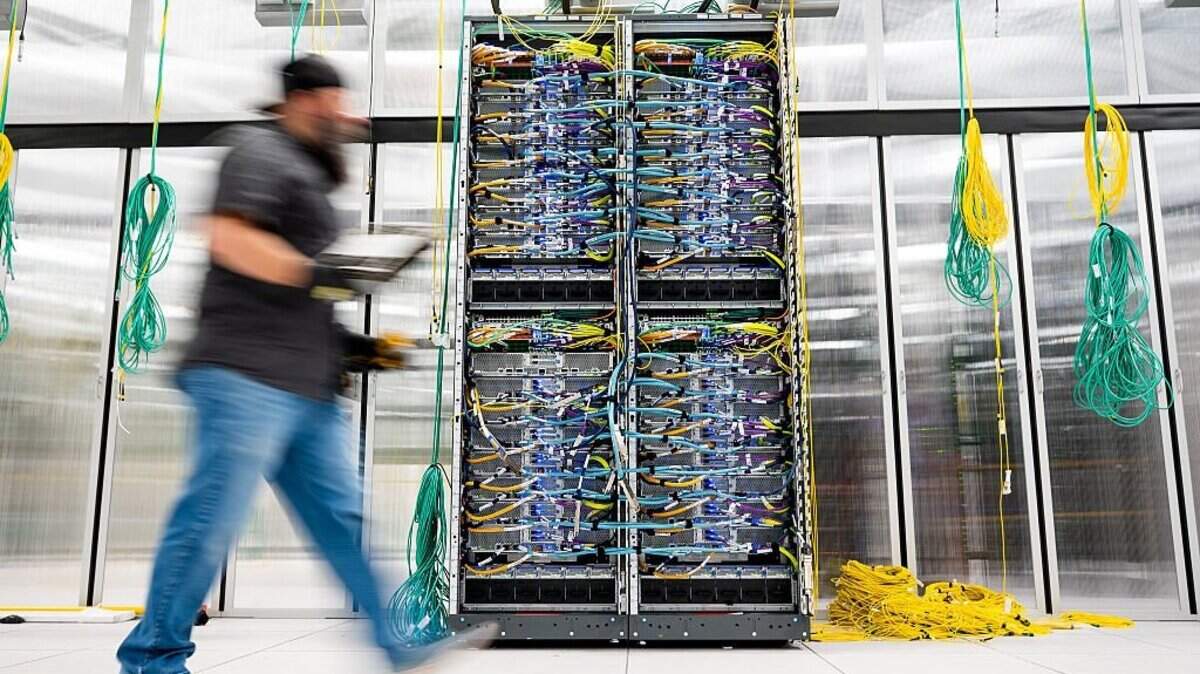
AUSTIN, TEXAS – APRIL 2: In this handout provided by Amazon, An Amazon Web Services technician passes on a AWS UltraServer in Austin, Texas on October 2, 2025. (Photo by Noah Berger/Getty Images via Amazon Web Services)
Handout
Getty Images
Should Texas keep giving data centers a break on paying sales tax? That’s the $3 billion question before state lawmakers as they prepare for their next legislative session.
Tax incentives can lure the industry and its economic activity but can also increase the tax burden on other businesses and consumers. The Senate Finance Committee begins its work on the matter when members meet on July 27 in Austin for an interim hearing.
Senators are tasked with reviewing laws passed more than a decade ago that exempt certain data centers from paying sales taxes on goods that are essential to their operations. Examples generally include things like electricity, cooling systems and servers.
The policy’s cost to the state has ballooned into the billions as the industry grows and evolves, prompting some state officials to call for an end to the tax break.
The incentive was implemented back when data centers were seen as a “startup business,” said Sen. Paul Bettencourt, a Houston Republican who oversees much of the chamber’s tax policy.
“Now we know that it’s been one of the biggest growth areas in the national economy,” he said.
Debates over data center policy have exploded in the 10 months since the Texas House and Senate adjourned. As Americans grow increasingly alarmed by the rapid changes spawned by AI, community leaders have been weighing the economic boons of the industry against residents’ concerns about water and power use, noise and whether the gains are sufficient, especially in rural areas.
Supporters highlight the other types of revenue data centers bring in and credit the incentive with helping Texas become a leader in the industry, but opponents say the tax break is unnecessary and puts business over people.
Lawmakers are facing mounting pressure from Texans to address their concerns about data centers. The politically-fraught topic is also the subject of debate in Washington and in city councils and commissioners courts across the state, where communities have considered local tax incentives.
“Since when do billionaires deserve charity?” said Tom Weeks, who lives near a cryptocurrency mine in Granbury, during a data center-focused news conference for Texas’ Democratic candidate for governor. Hood County has become a flashpoint for the data center debate in Texas. “These people, they can pay their taxes like everyone else. We’re being drowned in our taxes, and they’re getting all these breaks.”
The cost of Texas’ data center tax exemption
State sales tax exemptions for data centers were estimated to cost the state $14.6 million for 2014-15, but now it’s projected that the state will miss out on $3.3 billion in sales tax revenue in the 2028-29 biennium.
Sen. Joan Huffman, a Houston Republican who chairs the budget-writing Finance Committee, told the Star-Telegram in April that the cost is unsustainable.
An exemption’s duration depends on the size of the data center facility and how much money is invested into the project, but it can last 10, 15 or 20 years, according to the Texas comptroller’s office.
Any qualifying project gets a break on state sales taxes, but large projects spanning at least 250,000 square feet — a little less than 6 acres — can also have local sales tax exempted.
The options to address sales tax exemptions for data centers could include limiting the sales tax exemption or repealing them, Huffman said. There have been bipartisan calls in recent months to do away with the break.
Huffman said the process could involve reviewing the “laundry list” of what goods are tax exempt and the qualifications for the incentive, which include creating at least 20 jobs and a capital investment of at least $200 million over five years.
“When we’re starting to talk about well over a billion dollars a year in exemptions, that’s big money, and so we have to look very, very carefully at what we’re doing and to make sure that we are not giving special preference to one industry over another,” she said.
Dan Diorio, the executive vice president of state policy and government affairs for the Data Center Coalition, said the group that advocates on behalf of the industry would welcome discussion about the parameters for receiving the incentive.
There are various practices across the country for similar exemptions, with requirements that range from a required capital investment and guarantees to create a certain number of jobs to eco-friendly building and emissions standards, he said.
Exemptions for data centers are in step with longstanding exemptions for manufacturers, said Diorio, who plans to testify at Monday’s committee hearing.
Tax revenue brought into the state and communities surpasses the costs of the incentives, he said, pointing to a study that found data centers netted $2.2 billion for Texas and $2.3 billion local taxes in 2024.
Sales tax exemptions are a key part of what has made Texas — which has emerged as an industry hub — a welcoming environment for business, he said.
“I worry Texas will make itself an outlier in the country, and I worry that Texas will send the wrong message,” Diorio said.
Thirty-eight states have dedicated tax incentives for data centers, according to the National Conference of State Legislatures. They range from sales tax exemptions to property tax breaks.
Should lawmakers get rid of Texas’ sales tax break for data centers?
In a June 10 letter, Gov. Greg Abbott vowed to work with legislators to repeal the policy and “other outdated or unnecessary incentives for data centers.” This comes from a Republican governor who has championed Texas as a business friendly environment for artificial intelligence and data and crypto mines.
Sen. Juan “Chuy” Hinojosa, a McAllen Democrat and vice-chair on the finance committee, agrees that the tax break needs to go.
“These are public dollars that should be invested in infrastructure and other priorities that benefit all Texans,” he said in a June written statement.
Abbott’s Democratic opponent for governor, state Rep. Gina Hinojosa, and Democratic U.S. Senate nominee James Talarico have also included the repeal as part of their data center campaign platforms.
A spokesperson for Republican Lt. Gov. Dan Patrick did not return requests for comment. His interim charge that prompted Monday’s meeting calls on lawmakers to “study the cost and consequences of the sales tax exemption provided to data centers” and “make recommendations providing safeguards to ensure that Texans benefit from data center investment.”
House Speaker Dustin Burrows was not available to weigh in, aides said, but his office noted that he’s expressed support for Abbott’s data center policy plan that included repealing the exemption.
Bettencourt said he’s keeping an open mind about the best path forward. He wants to listen and learn more about the state of the exemption.
The exemption helped to attract the industry to Texas, bringing new investment, jobs and opportunities with it, but it also comes with a large price tag, Bettencourt said.
“All this has got to be weighed,” he said.
This story was originally published July 27, 2026 at 5:24 AM.
Related Stories from Fort Worth Star-Telegram

Fort Worth Star-Telegram
Eleanor (Elly) Dearman is a Texas politics and government reporter for the Fort Worth Star-Telegram. She’s based in Austin, covering the Legislature and its impact on North Texas. She grew up in Denton and has been a reporter for more than six years.
Support my work with a digital subscription