
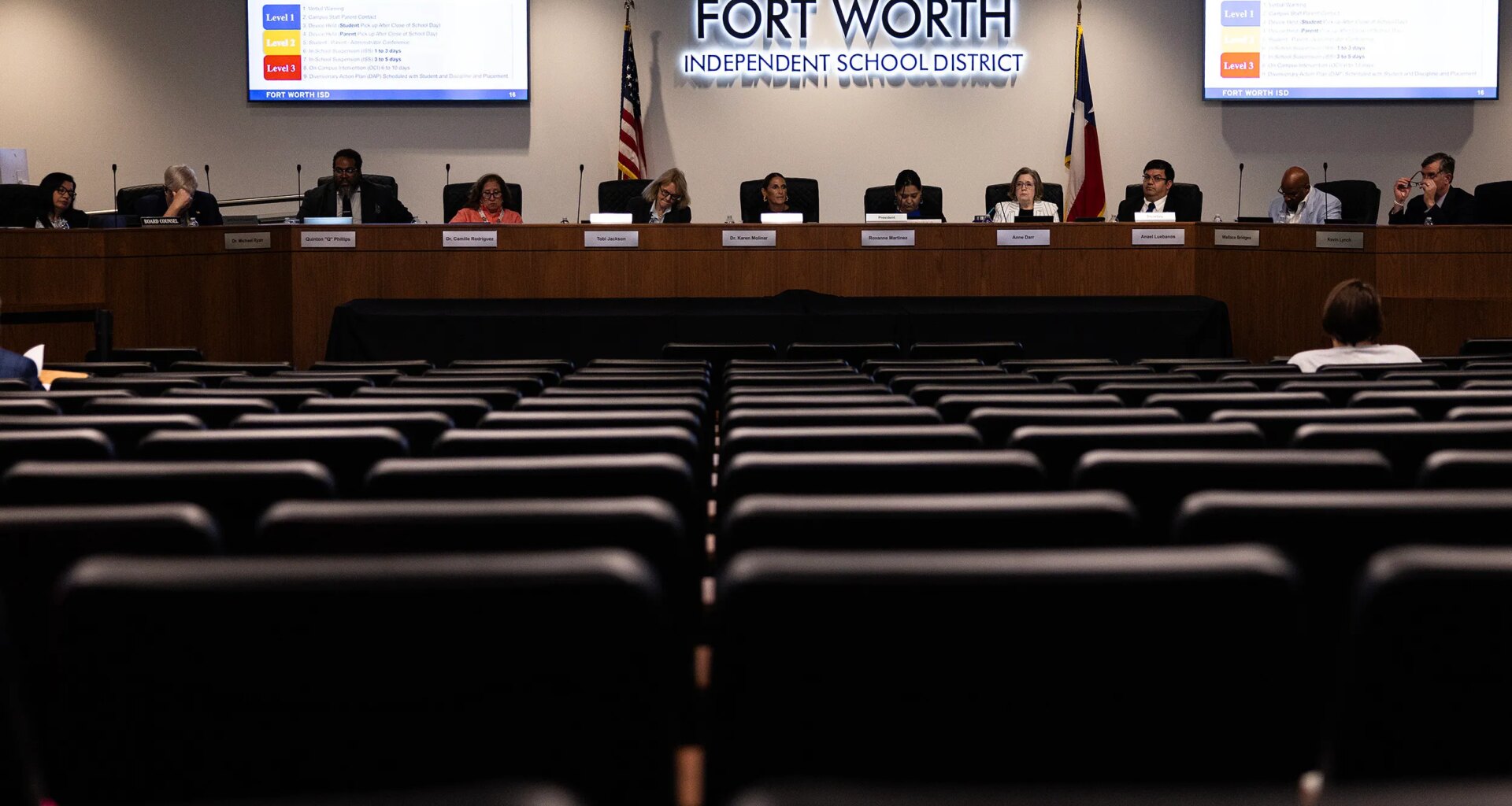
A new conflict-of-interest policy for Fort Worth ISD will create what board President Pete Geren calls a new standard for school board ethics in Texas.
However, elected trustee Michael Ryan says the state-appointed board of managers has no business rewriting the rules — and that the proposal would mean only the wealthy could run for school board.
The proposal targets a fixture of FWISD politics: campaign contributions that flow from the district’s contractors to the school board members who determine whose bids prevail. The state-appointed board of managers gave initial approval to the new policy on Tuesday and are expected to finalize it on Aug. 11.
The policy drops the contribution limit for FWISD vendors and contractors from $2,000 a year to zero, caps gifts to board members and their families and empowers the board to censure members who break ethics rules.
The policy would apply to both managers and trustees.
A Fort Worth Report review of campaign finance reports found seven of the district’s elected trustees have accepted a total of $84,450 in campaign contributions from three law firms that do business with FWISD.
Geren, a former congressman, said he wrote the policy plainly, so that no one — not the public, board members or companies bidding for district work — has to guess what constitutes a violation.
“The line should be bright, and the rules should be public,” Geren said.
Beyond ending vendor donations, the ethics policy also:
Defines “conflict of interest” as any instance where a board member’s personal interests may benefit from their official actions and influence.
Clarifies that board members and their family cannot accept gifts valued at more than $100 from anyone doing business with the district.
Requires board members to disclose debts owed to vendors.
Directs the board president to remind members to disclose their conflicts of interest at every meeting.
The campaign finance restrictions would only affect elected trustees who remain on the ballot during the takeover. The board of managers is appointed by Texas Education Commissioner Mike Morath and has oversight of the district for the duration of the state’s intervention. Managers do not campaign for office.
Currently, district vendors can give $2,000 to each trustee per year. Vendors’ partners and employees may also contribute to create a donation above the $2,000 cap. The rewritten policy bars contributions from partners and employees of vendors and also covers vendors the district is considering for contracts.
Ryan, a retired educator, knows the cost of running a school board campaign. He raised more than $3,000 in his first bid — and lost. The second time, he raised $30,000 — and won.
“With that rule, are (the restrictions) going to limit who runs for the school board to the people who have deep pockets?” Ryan said. “I think it will.”
Law firms gave $84,450 to current elected trustees
Seven of the district’s eight elected trustees received at least a combined $84,450 from three law firms that have done business with FWISD.
Kevin Lynch was the only elected trustee with no contribution from the firms identified in the review.
Donations from Linebarger Goggan Blair & Sampson accounted for $63,000, or 75%, of law firm donations to trustees. The firm has collected delinquent taxes for FWISD since 2010, and its current contract runs through June 2029.
The dates of contributions overlapped board decisions involving the firm.
In May 2024, trustees selected Linebarger for the tax collection work after the firm agreed to match a competitor’s 15% collection fee. Trustees Tobi Jackson, Anael Luebanos and Ryan, as well as former trustee Wallace Bridges, supported raising the rate to 20%, but the proposal failed 4-5.
Trustees Anne Darr, Camille Rodriguez, Quinton Phillips, Roxanne Martinez and Lynch opposed the increase.
Luebanos, Darr and Jackson declined to comment for this story. Lynch, Rodriguez and Phillips did not respond to requests for comment.
At the time, Darr questioned why trustees would give Linebarger a higher rate after the firm said it could perform the work for 15%.
“I applaud Linebarger for agreeing to that 15%,” Darr said at the meeting. She later asked whether changing the rate after the bidding process would be “disingenuous.”
The contract went forward at 15%.
Trustees returned to the issue in Aug. 2025 and unanimously agreed to raise Linebarger’s fee to 20% for successfully collecting taxes that became delinquent that year and any collected going forward. The change was approved as part of the consent agenda without separate public discussion.
The fee is paid by delinquent taxpayers, not directly by the district. Administrators said the higher rate could allow Linebarger to assign more employees to collections and potentially recover more money for FWISD.
Joe Householder, a Linebarger spokesperson, said the firm participates in the civic life of communities it serves and makes political contributions transparently and legally.
“Linebarger Goggan is committed to participating in the civic life of all the communities we serve — whether that is through individual charitable contributions, support for worthy community causes or through contributions to elected officials whose policies we believe benefit the community as a whole,” Householder said. “Any changes to the FWISD policy will be met with full compliance.”
O’Hanlon, Demerath & Castillo and firm partner Kevin O’Hanlon gave current trustees $13,950 since their initial campaigns. Cantey Hanger gave $7,500. Both firms have also represented FWISD.
PACs donate big dollars
During an interview with the Report, Ryan warned that vendors would work around the policy by donating to political action committees.
He raised the same concern during a January school board meeting when he said restrictions on direct contributions could be circumvented through PACs. He also criticized state lawmakers for imposing campaign restrictions on school boards while accepting large political contributions themselves.
The ethics policy proposal currently does not address PAC donations. However, amendments could be added to the policy before the board of managers finalizes it, Geren said.
PACs and political organizations have provided some of the largest contributions in recent FWISD elections.
The Great Schools, Great City PAC gave trustees nearly $103,000 in the past seven years — more than any of the law firms. Judy Needham, a former FWISD trustee of more than 20 years, started the PAC in 2019.
Lynch received the most during his 2023 bid: $40,000 — more than any law firm gave to any trustee. The ethics policy as proposed would not have touched his biggest source of support.
Lynch did not respond to a request for comment.
Since 2022, Great Schools, Great City has received a total of $28,000 in contributions from O’Hanlon, Demerath & Castillo, Cantey Hanger and 2021 bond manager Procedeo Group.
During the January meeting, Darr said she supported the reasoning behind requiring trustees to recuse themselves when donors had business before the district. But she worried that a proposed $250 threshold could leave the board without a quorum if an entity had contributed to several trustees.
She also warned that restricting campaign money could discourage former teachers and other residents without personal wealth from seeking an unpaid office.
“I understand the reasoning behind this. I support the reasoning behind this,” Darr said. “I’m not sure that our elections are currently structured and our campaign finance is currently structured to where we can abide by this at this time.”
Phillips cautioned trustees against eliminating the recusal language entirely, saying the board needed some protection against campaign-related conflicts, even if the contributions threshold needed changing. Rodriguez said she supported retaining the language if state law already restricted those relationships.
Other ethics policies
The district has debated stronger conflict rules before. Trustees adopted an expansive policy modeled after Houston ISD’s rules in April 2017, then replaced it with a less detailed policy that December.
The discarded version treated the appearance of a conflict as seriously as an actual financial conflict. It required broader disclosures and recusals and barred gifts worth more than $50 from people who could seek district business. The current proposal would set the gift limit at $100 but go further by eliminating vendor campaign contributions.
Rachel White, a University of Texas at Austin education policy professor who studies school boards, said the proposal takes a different approach from a new Texas law governing relationships between trustees and vendors.
The state law can expose vendors to criminal penalties for bidding on or receiving contracts when certain prohibited financial relationships exist with sitting trustees. The FWISD proposal attempts an earlier intervention by limiting who can finance the campaigns that put trustees in office, White said.
Censure and recusal could be meaningful tools, White said, but the policy’s effectiveness will depend on who checks campaign filings, investigates complaints and determines whether a violation occurred. Public censure would expose misconduct, she said, but would not remove a trustee from office.
Houston’s policy required a full department enforcing it — which FWISD lacked and which led trustees to rescind their earlier version, according to documents obtained by the Report.
White also questioned why rewriting campaign rules became one of the managers’ early priorities during a takeover prompted by academic performance.
“Is this one of the things that’s contributing to the lack of student growth in some of the schools in the district?” White said. “Is this where we should be spending our time and our energy?”
Still, White said governance rules can affect public confidence. A future elected board could reconsider or repeal the policy after local control returns, she said, but trustees would have to explain how any such decision reflects on their competence, integrity and commitment to the community.
Jacob Sanchez is education editor for the Fort Worth Report. Contact him at jacob.sanchez@fortworthreport.org or @_jacob_sanchez.
Matthew Sgroi is an education reporter for the Fort Worth Report. Contact him at matthew.sgroi@fortworthreport.org or @matthewsgroi1.
Disclosure: FWISD manager Pete Geren leads the Sid W. Richardson Foundation, a financial supporter of the Fort Worth Report. FWISD manager Laurie George is a member of the Report’s reader advisory council. At the Fort Worth Report, news decisions are made independently of our board members and financial supporters. Read more about our editorial independence policy here.
This <a target=”_blank” href=”https://fortworthreport.org/2026/07/25/why-fort-worth-isd-wants-to-ban-campaign-donations-to-trustee-candidates-by-its-vendors/”>article</a> first appeared on <a target=”_blank” href=”https://fortworthreport.org”>Fort Worth Report</a> and is republished here under a <a target=”_blank” href=”https://creativecommons.org/licenses/by-nd/4.0/”>Creative Commons Attribution-NoDerivatives 4.0 International License</a>.<img src=”https://i0.wp.com/fortworthreport.org/wp-content/uploads/2021/04/cropped-favicon.png?resize=150%2C150&ssl=1″ style=”width:1em;height:1em;margin-left:10px;”>
<img id=”republication-tracker-tool-source” src=”https://fortworthreport.org/?republication-pixel=true&post=690144&ga4=2820184429″ style=”width:1px;height:1px;”><script> PARSELY = { autotrack: false, onload: function() { PARSELY.beacon.trackPageView({ url: “https://fortworthreport.org/2026/07/25/why-fort-worth-isd-wants-to-ban-campaign-donations-to-trustee-candidates-by-its-vendors/”, urlref: window.location.href }); } } </script> <script id=”parsely-cfg” src=”//cdn.parsely.com/keys/fortworthreport.org/p.js”></script>