
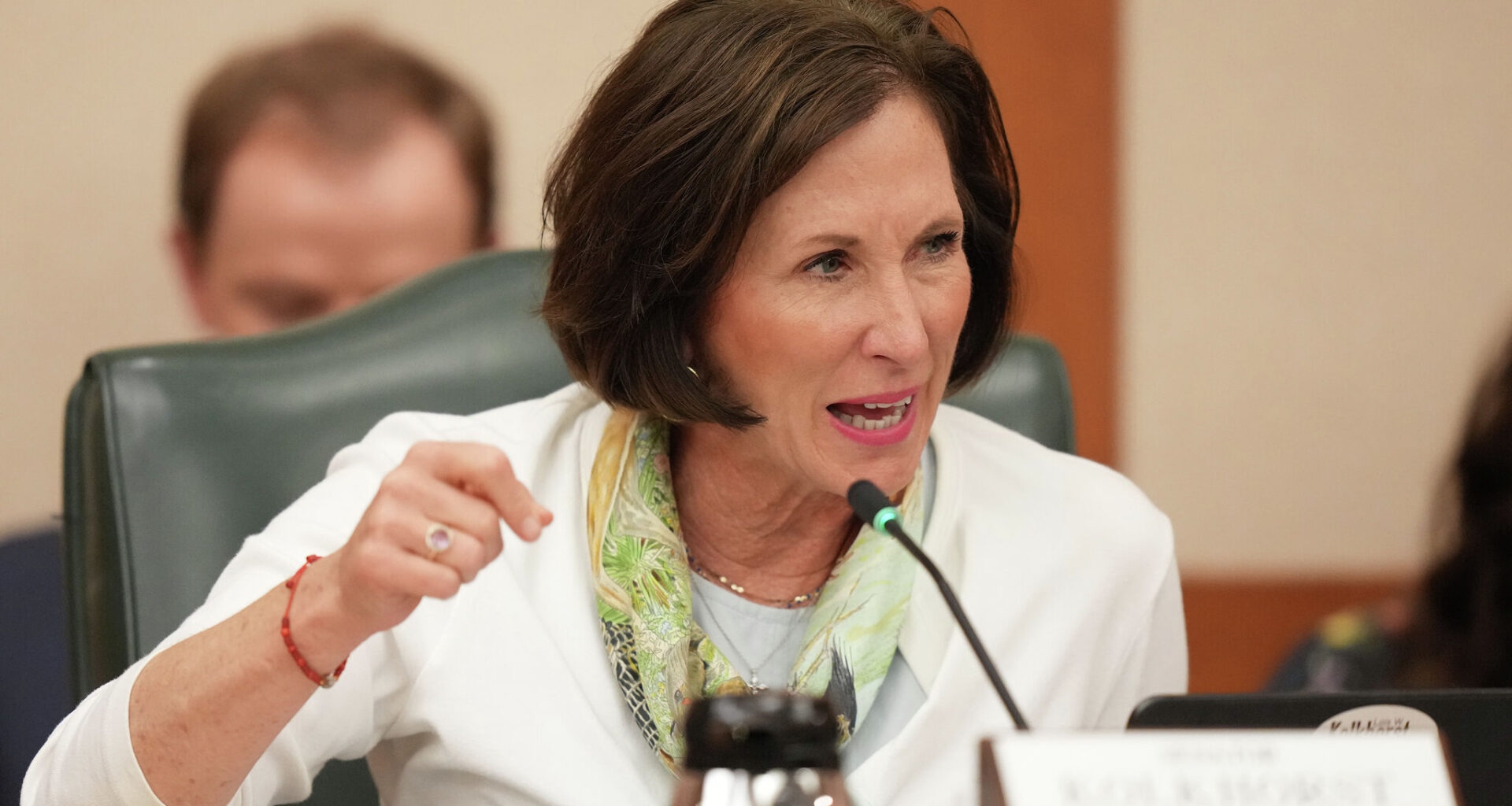
Sen. Lois Kolkhorst, R-Brenham, asks questions at a Texas Senate Committee on Finance hearing on data center investment and state fiscal effects at the Capitol in Austin, Monday, July 27, 2026.
Jay Janner/Austin American-Statesman
Sue Ellen Davis of Angleton protests data center expansion at a rally at the Capitol before a Texas Senate Committee on Finance hearing in Austin, Monday, July 27, 2026.
Jay Janner/Austin American-Statesman
Sen. Joan Huffman, R-Houston, listens during a Texas Senate Committee on Finance hearing on data center investment and state fiscal effects at the Capitol in Austin, Monday, July 27, 2026.
Jay Janner/Austin American-Statesman
A key panel of state lawmakers appeared open on Monday to repealing or limiting a decade-old sales tax exemption for data centers that has come under scrutiny for costing billions of taxpayer dollars amid the boom in artificial intelligence.
Facing mounting backlash from rural communities over the resource-intensive computing centers, lawmakers from both parties agreed it was time to end the subsidy, which is projected to cost the state $3.3 billion in its upcoming budget cycle.
The 2013 law, a sales tax exemption for qualifying data centers, means data center developers don’t pay taxes on things like electricity, cooling systems and servers for up to two decades.
Article continues below this ad
READ MORE: A rare bipartisan coalition takes aim at Texas data centers, urging Abbott to call a special session
“What we thought we were voting for back in 2013, it’s a much different animal these days,” said state Sen. Joan Huffman, a Houston Republican who chairs the Senate finance committee. “It’s time and it’s appropriate and necessary for the Legislature to reexamine whether this exemption still delivers a return that justifies its rapidly mounting foregone tax revenue.”
Lawmakers initially forecast that the exemption would cost the state only $14.6 million in forgone revenue in 2014 and 2015.
But even early projections “significantly” underestimated the cost of the sales tax exemption, said Brad Reynolds, the chief revenue estimator at the comptroller’s office. “Of course, we never anticipated the kind of rapid development in numbers and scale that we see today.”
Article continues below this ad
In 2026, the number of data centers that qualify for the exemption has nearly doubled, Reynolds said. Of the 138 eligible data centers, 59 have been certified this year alone.
The comptroller’s office is required to audit companies receiving the exemption five years after they qualify. Of the 20 projects audited so far, five failed to comply with the requirement that a project create 20 full-time jobs.
“These are highly capital intensive projects, and to be unable to justify employment of even 20 people on a permanent basis at one of these things tells you how little employment is really stemming from this, at least in terms of direct employment,” Reynolds said.
In June, Abbott committed to working with lawmakers to repeal the exemption along with “other outdated or unnecessary incentives for data centers.”
Not all lawmakers were ready on Monday to repeal the exemption. State Sen. Paul Bettencourt, a Houston Republican, said the data center industry was “integral” to the state’s economy.
Article continues below this ad
“The public has yet to really understand just how much they use data centers already,” he said. “The cloud exists not in the atmosphere but in all these data centers.”
The computing power required to run AI represents less than a quarter of data center demand, said Dan Diorio, the executive vice president for state policy and government affairs with the Data Center Coalition. “Cloud and the basic digital infrastructure that we all depend on continues to be the dominant reason for data center development,” he said.
Texas is on track to become the world’s largest data center hub within two years. Lois Kolkhorst, a Brenham Republican, asked Diorio if data centers would keep building in Texas without the sales tax exemption, who said he was concerned about the state’s long-term competitiveness.
“If you want to be in Texas because of what we’ve built here I think you’re going to come without all these incentives because it’s the best decision for your company,” Kolkhorst said.
Article continues below this ad
When they convene in January, lawmakers will have to decide how, precisely, they want to repeal the exemption. Reynolds noted that it would be “exceptionally controversial” to repeal the statute without extending the exemption for companies with existing agreements.
On Monday morning, in advance of the hearing, grassroots organizers from across the state convened at the Capitol to voice their opposition to the massive computing centers and call on Abbott to call a special session immediately.