
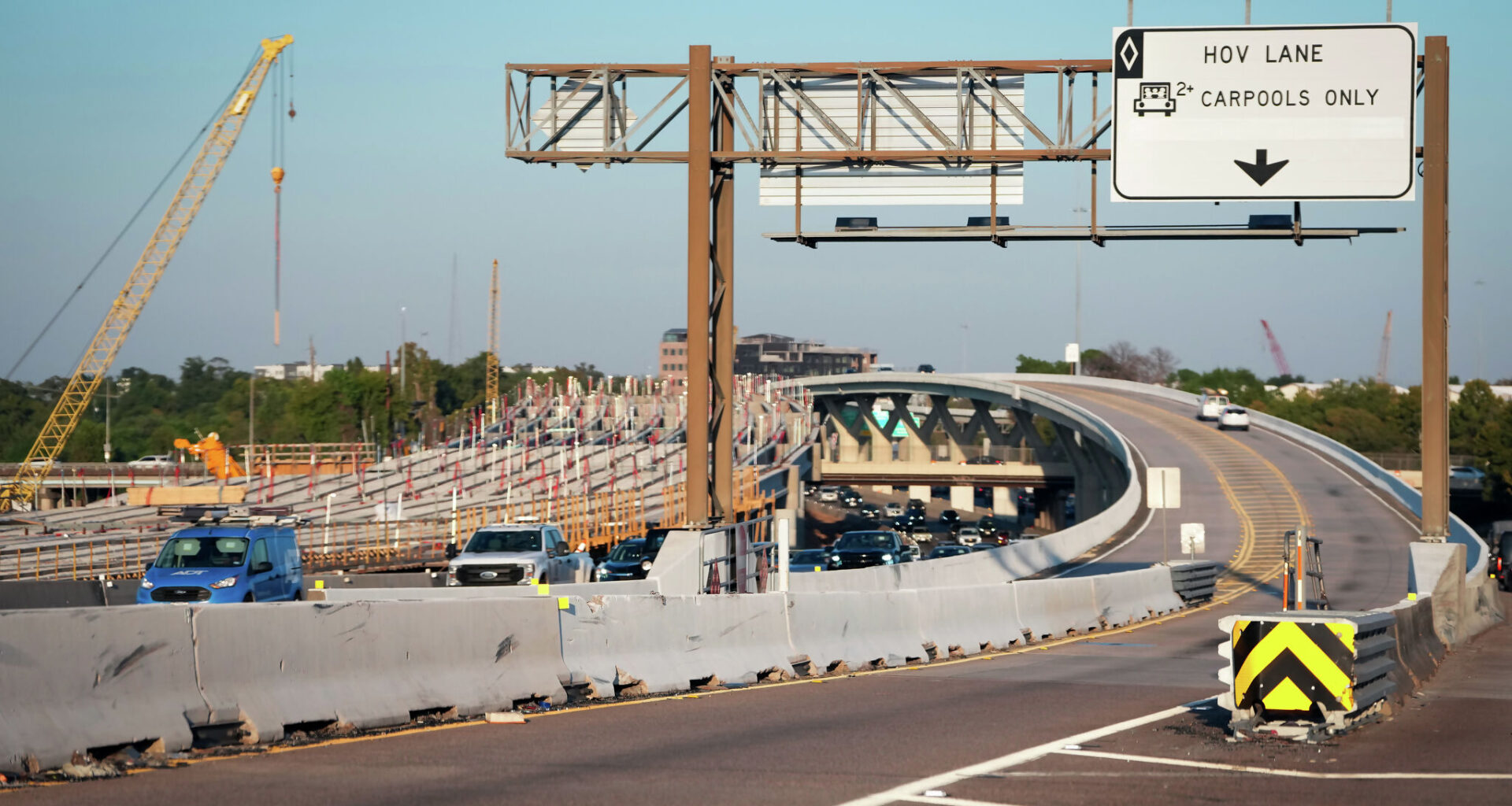
Work continues on the I-10 White Oak Bayou Elevation Project in Houston, Wednesday, Oct. 15, 2025. The existing downtown I-10 HOV ramp, also known as the Katy Freeway-Downtown Connector, near Studemont Street, is slated for removal as part of the TxDOT’s reconstruction.
Jill Karnicki/Houston Chronicle
A Metropolitan Transit Authority light rail train travels on Capitol and Rusk streets on Tuesday, March 22, 2022, in Houston. Metro is rethinking its voter-approved Inner Katy BRT after facing constraints and estimated triple costs to the project.
Godofredo A. Vásquez, Houston Chronicle / Staff photographerMetro discussed using future managed lanes on Interstate 10 for buses instead of building a dedicated bus rapid transit route after the Inner Katy project estimated costs rose to $800 million.The Inner Katy BRT project proposals are facing construction inflation, right-of-way constraints and conflicts with other major TxDOT projects.The downtown I-10 HOV ramp could impact thousands of transit riders due to its upcoming construction work.
Metro officials are recommending a new approach to improving transit along the Interstate 10 corridor after the estimated cost of the Inner Katy Bus Rapid Transit project nearly tripled to $800 million.
Instead of building Metro its own dedicated bus rapid transit route, board members discussed using the Texas Department of Transportation’s future I-10 managed lanes to move buses between West Loop 610 and downtown, and studying alternatives.
Article continues below this ad
“The Inner Katy project was a great project, but because of the existing circumstances, we as an agency cannot proceed,” board member Roberto Treviño said before voicing support for the recommendation at a committee meeting.
TRACK HOUSTON FREEWAYS: 6 massive road projects that could reshape your commute
TxDOT Houston District spokesperson Danny Perez said in an email that TxDOT can accommodate Metro’s buses in the managed lanes, as it now does west of Loop 610.
Metro spokesperson Meredith Johnson said in an email that the agency is also evaluating the other options to approve mobility for the corridor that keep costs down and ensure the project can be maintained long term.
Article continues below this ad
“We will present the best options to the Metro Board of Directors upon completion of our review,” she said.
Metro began planning the Inner Katy BRT project in 2018 to extend high-occupancy vehicle access and create a bus rapid transit route between the Northwest Transit Center and downtown.
Over the past several years, officials repeatedly revised the Inner Katy BRT project as TxDOT’s Katy Managed Lanes plans changed, right-of-way constraints became more apparent and a major drainage project was added. In 2024, Metro board members de-scoped the project. By this year, Metro estimated the dedicated bus route would cost at least $800 million, up from about $300 million in 2019.
The complexity of multiple transportation projects in the I-10 corridor and significant construction inflation between 2018 and 2026 increased the bus rapid transit costs, Johnson said.
Metro evaluated several concepts to fit the Inner Katy BRT into the corridor, including an elevated structure that would carry both highway traffic and bus rapid transit, said Shri Reddy, Metro’s executive vice president for planning, engineering and construction.
Article continues below this ad
He said the joint elevated structure “became very complicated” to construct, would have caused “major impacts to existing traffic,” and carried a high cost, making it “not a very viable option.”
“So, it came to a point where we’re at an impasse in terms of having a feasible and a reasonable solution,” Reddy said.
Perez explained that the alternative highway design requested by the city of Houston and Harris County Precinct 4 on the west end of the project — if that option is selected by TxDOT — would leave little room for Metro’s initial Inner Katy BRT plan.
He said Metro could also study acquiring additional property to make the Inner Katy BRT project work, but the limited space in the corridor would require close coordination between agencies.
Article continues below this ad
KATY BUS LINE ‘DE-SCOPED: Metro ‘de-scoping’ plans for rapid transit on I-10 in favor of HOV lanes
The existing downtown I-10 HOV ramp, also known as the Katy Freeway-Downtown Connector, near Studemont Street, is slated for removal as part of the TxDOT’s reconstruction.
TxDOT has provided a broad timeline for the surrounding interchange work, but has not announced a specific reopening date for the HOV ramp, according to TxDOT’s July project updates.
Peter Eccles, director of policy and planning for the transit advocacy group Link Houston, said the lack of a timeline for reconstructing the HOV ramp could affect more than 13,000 daily transit riders who rely on the ramp.
Article continues below this ad
“Transit can be a welcome antidote to I-10 construction traffic, but only if TxDOT works well with Metro to make transit trips quick and reliable,” he said.