
You’re the reason Austin isn’t weird anymore.
It’s tough to hear, I know. But it’s you. You moved here, and it’s no longer weird.
Or maybe you’re the reason Austin is still keeping it weird. Or maybe Austin was never really weird?
You’ve undoubtedly heard of the city’s unofficial “Keep Austin Weird” slogan. Since its inception in the early 2000s, the slogan sparked an undying debate in an aggressively nostalgic, navel-gazey city. And it’s led to a perennial question: Are we still keeping Austin weird?
How did we get ‘weird’?
The adoption of the slogan “Keep Austin Weird” capped off decades of counterculture in the live-music-loving city. In the 1970s, outlaw country icons like Willie Nelson and Doug Sahm found a home in Austin, along with granola-pilled hippies and rock-and-roll blues types, at the Armadillo World Headquarters, the Rome Inn, Antone’s and other clubs and dives.
Kerry Awn was in the scene at the time, designing now-iconic posters for Armadillo, Soap Creek Saloon and the Ritz Theatre downtown. He also painted the iconic “Austintatious” mural on The Drag with his friends Tom Bauman and Rick Turner.
Awn says the vibe back then wasn’t something people fussed over. The town attracted artists because it was cheap, there was plenty of natural beauty and it was overall pretty laid-back.
“We didn’t know it was weird at the time,” he said.
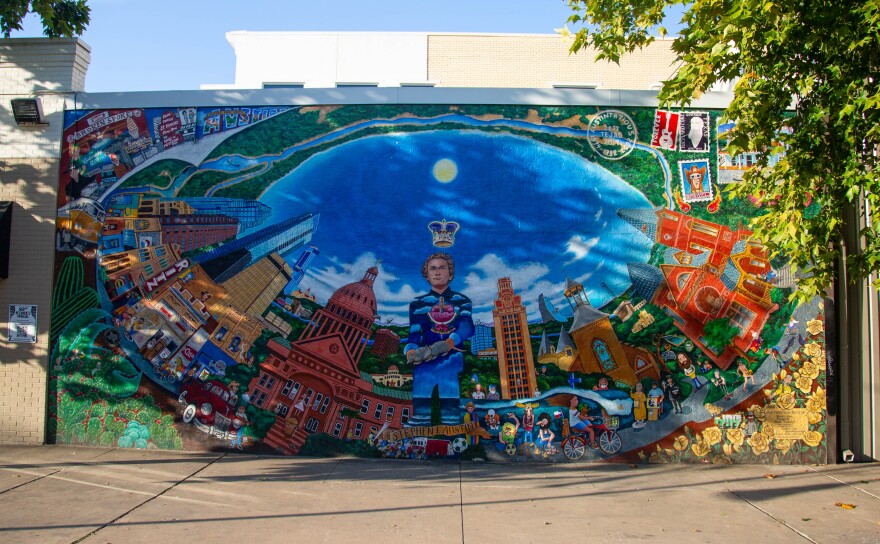
The Austintatious mural on Guadalupe Street across from the UT campus.
And there was a lot of overlap, with artists, like Awn, who also was a standup comic at the club that ultimately became The Velveeta Room and was in the band Uranium Savages. People would mix and mingle and things just kind of morphed into a monoculture.
That’s the vibe that Red Wassenich always enjoyed about Austin. For decades, Wassenich was a librarian at Austin Community College until his death in 2020. Before that, he was a student at the University of Texas and an artist and aspiring author. He told KUT in 2016 that you could find a motorcycle repairman who’s got a band on the side, or “accountants who collect mannequins.” It was weird, but Wassenich said that was the norm in Austin, whereas other cities in Texas, not so much.
“You get a lot of it kind of, for lack of a better word, everyday people who are weirdos, you know?’” he said. “That’s just that’s cool in Austin. Whereas other places they might, you know, be looked at a bit askance. Here, it’s celebrated.”
A guy could, for example, be a solar panel technician who hosts a volunteer radio program — for two hours — that plays croony, lounge singers exclusively from France. That’s the kind of stuff Jay Robillard has done for more than 30 years at KOOP Radio. Back in 2000, Wassenich called into Robillard’s show during a pledge drive. Asked why, Wassenich said the show was helping “keep Austin weird.”
He and his wife began printing up stickers saying “Keep Austin Weird.”
In the 2000s, local businesses borrowed — and weaponized — the “Keep Austin Weird” slogan to fight back against corporate-backed development. Book People and Waterloo Records launched a campaign with Wassenich’s approval to stall and ultimately kill the construction of a Borders Books and Music at Sixth Street and Lamar Boulevard.
Death of ‘weird’
A lot’s changed since the “Keep Austin Weird” slogan was coined.
Many an Austinite would argue Austin’s weirdness has died since the turn of the century. If it has, it’s died a lot of deaths.
Some say the dot-com boom and “Dellionaires” of the late ’90s killed Austin’s “weird.” Others say it died when Leslie, the city’s beloved cross-dressing mayoral candidate and unofficial mascot, died or when Las Manitas was paved over to make way for the Marriott downtown. Others insist it was Elon Musk who murdered Austin’s quirk when he moved Tesla’s headquarters here, shepherding in a horde of tech bros and a cavalry of gleaming Cybertrucks.
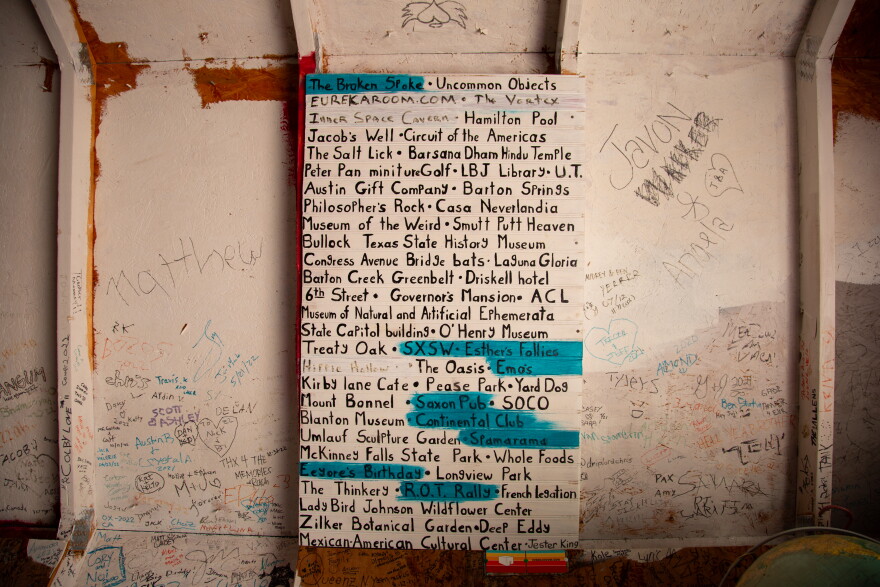
A list of notable Austin locations are pictured inside of Vince Hannemann’s shed at the Cathedral of Junk.
Second generation Austinite Daniel Cruz says that influx of tech culture has been especially prevalent over the last 10 years — even more than when Dell Technologies brought scores of tech-minded people to Austin in the early 2000s.
“They rebranded the city as a tech city and never told the artists,” he said. “It left so many people lost without venues, communities and places to create.”
Before moving to Seattle, Cruz worked putting on art shows at the Pine Street Station, a one-time rail depot run by Austin artist Reji Thomas that was a hub for art and music in the 2010s as Austin saw explosive growth and soaring housing costs. The venue hosted the Fader Fort during SXSW and shined an international spotlight on Austin’s East Side before a 2014 eviction.
Capital Metro took over the site and it was redeveloped into a mixed-use development at Plaza Saltillo. Now, Cruz says, the area — and the city as a whole — is “more polished” and “not really weird anymore.”
“The charm of creativity is gone,” he said.
But Cruz says there is hope for Austin’s weirdness. He points to the relatively recent trend of underground tunnel raves as proof of Austin’s “ability to bring the best out in Creators.”
Maybe it’s still ‘weird’?
Awn, the longtime Austin artist, also split from Austin after more than 50 years in 2021. Now, he runs a gallery in Alpine, secluded from the traffic and the growth that pushed him to move out West.
He was in town recently for a city-sponsored exhibit of the decidedly weird comic artist Gilbert Shelton. Awn said Austin looks different and he gets easily turned around navigating downtown, but the city’s vibe and reputation as a weird place comes from the people, wherever they come from.
“It’s still weird,” he said. “But it’s really the people that make it weird, not anything about the town itself. The people make it weird.”
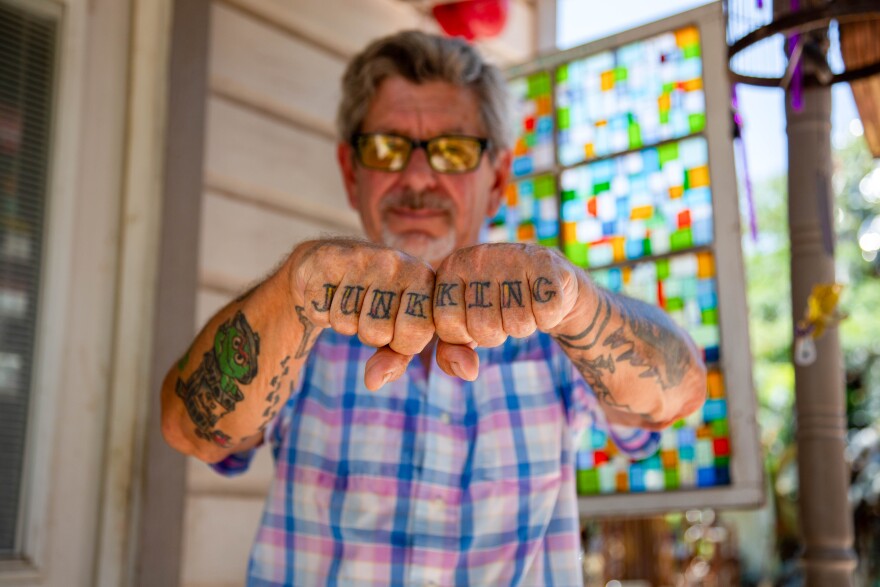
Vince Hannemann puts up his “JUNK KING” tattooed knuckles for a portrait at the entrance of the Cathedral of Junk.
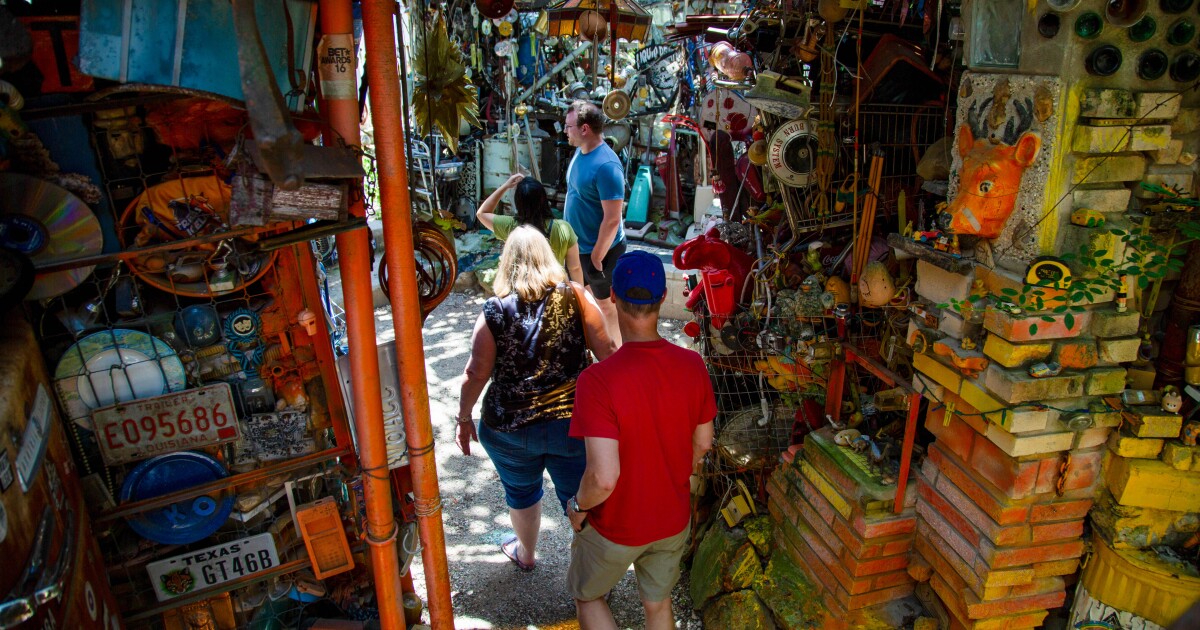
Vince Hannemann is one of those people who have kept the city weird. Nearly 40 years ago, Hannemann began erecting a massive backyard sculpture. His mom jokingly dubbed it the “Cathedral of Junk” and it stuck. Now, it’s a globally recognized totem of Austin’s weirdness.
The self-described “Junk King” gets this question a lot, whether Austin’s weird. Hannemann says the city attracts “novel” people, but that’s not unique to Austin.
“The same thing that makes Austin weird is what makes America weird. We foster creativity, novelty, innovation, you know?” Hannemann said. “I mean, like, we don’t give a s—t! Screw you, we’re America. Screw you, we’re Texas, right? It’s that, but, you know, in a nice way.”
Jennifer Hecker, a native Austinite and archivist with the Austin History Center, says the debate over weirdness is really just a debate about growth and change. A venue closes? Austin’s not weird. You see a Cybertruck covered in an ad for peptide treatments that promise to “OPTIMIZE HUMANITY”? Austin’s not weird. A beloved local artist leaves because it’s unaffordable? Austin’s not weird. Hecker says that hand-wringing is eternal in Austin.
“I’ve always lived here. So, is it just like that anywhere else? I don’t know,” she said. “But that has to do with how fast things change here.”
Thor Harris, longtime Austinite, percussionist and self-described weirdo, says Austin is, in fact, still weird. You just have to know where to look.
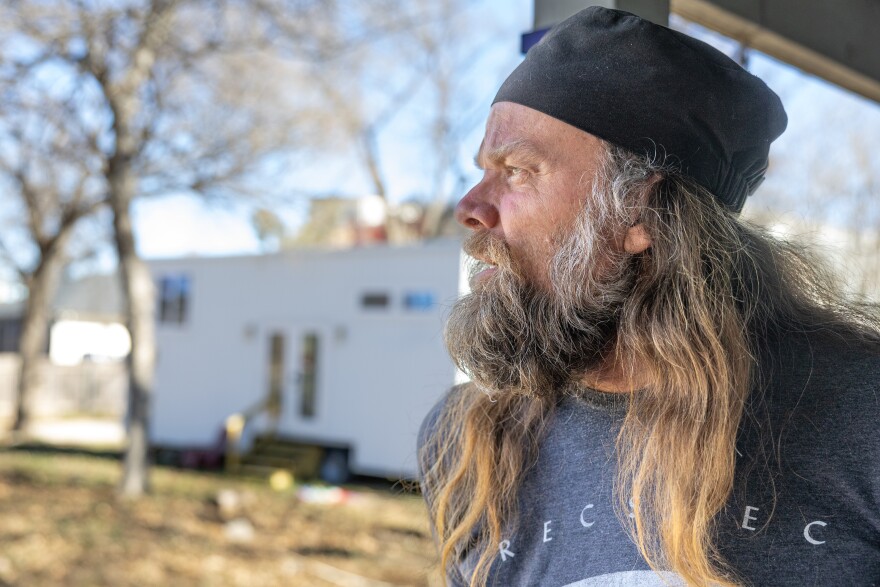
Thor Harris poses for a photo at Austin Art Village.
There’s always going to be normal people “just doing basic boring s—t,” Harris says, but artists are still doing weird stuff at the Museum of Human Achievement, Dada Labs and Me-Mer-Mo Mondays, among other venues. Harris himself just participated in a Satanic Floor Tom Army, where a bunch of drummers just got together to drone away on some floor tom drums. It was super-weird, Harris said.
“There’s so much weird s—t going on,” he said. “We lost Leslie, but I assure you there are a lot of weirdoes still in this town and the outward expression of it has many faces.”
If you found the reporting above valuable, please consider making a donation to support it. Your gift pays for everything you find on KUT.org. Thanks for donating today.